Mumbai: One of the most chastening defeats India have suffered in T20Is came against England in the semifinal of the 2022 T20 World Cup in Australia.
The Three Lions, who had embraced all out aggression, hammered India by 10 wickets with Jos Buttler and Alex Hales chasing down a competitive 169-run target in just 16 overs.
That defeat at the Adelaide Oval on a balmy summer evening stung head coach Rahul Dravid and captain Rohit Sharma badly. Despite possessing the best T20 league in the world – the IPL – and having a wealth of exciting talent at their disposal, the Indians had failed to adapt a fast-evolving limited-overs cricket, especially T20Is. They followed the ODI template of the old even in T2oIs – cautious to begin with, rev up the engine in the middle overs and then press the accelerator towards the end.
With an ODI World Cup at home less than a year away, Dravid knew a thorough shake-up was needed. Just like how England changed their method in 50-over cricket following an abysmal 2015 ODI World Cup where they crashed out in the group phase, Dravid figured that for India to succeed in white-ball cricket they had to abandon conservative approach and embrace fearlessness – something England did exceptionally post 2015 to win the 2019 ODI World Cup at home and the 2022 T20 World Cup.
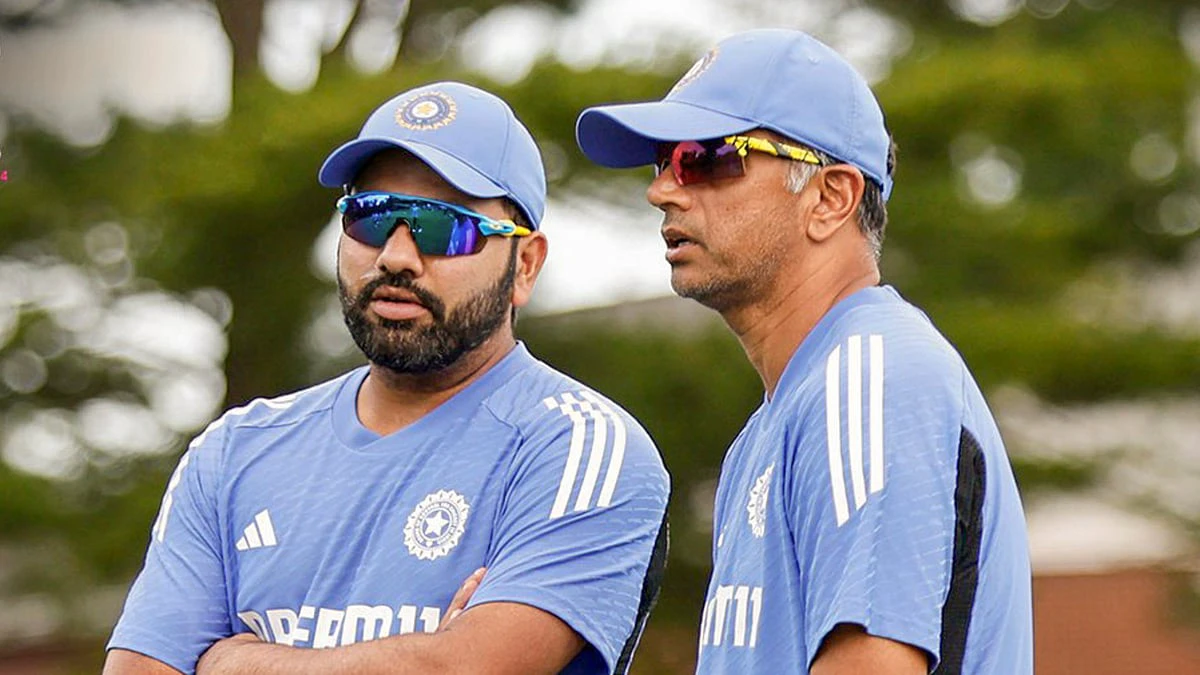
Dravid, who doesn’t get enough credit for his aggressive cricketing mentality because of his gentlemanly demeanour on and off the field, broached the idea to Rohit. A serial winner with Mumbai Indians with a record five IPL trophies then, Rohit was instantly bought into the idea. The toughest part though was implementing it. A radical change in philosophy isn’t always welcome in Indian cricket, especially when seniors are around. Pushback isn’t uncommon and discontent comes out in the open. Rohit, a much-loved figure in the dressing room, decided he’ll show the way with ultra-aggressive batting so that it won’t be tough to ask his comrades to follow the same.
Coming charging out of the blocks like a racehorse out of the gates, Rohit focused on maximising the advantage during Power Play by constantly playing over the top. Even when the field spread out, the onus was on scoring a boundary instead of the customary single or two. Players were given the licence to play attacking cricket without worrying about failures which are bound to occur in a high-risk game.
“The nature of batsmanship in white-ball cricket over the last 10 years or so, everything had started to change. In some ways, there was a feeling that we were slightly behind and we needed to get better at that. We needed to push the envelope a little bit more. We needed to take a few more risks. Run-rates were going up,” Dravid recalled during an event in Bengaluru recently.
“When I first took the job and decided that was the direction we needed to go in and had the conversation with Rohit, he instantly was on board with it. He took the lead on that immediately. He was someone who took the responsibility of setting the game forward. The tempo (of playing limited-overs) needed to change. And when your leader stands up and says, ‘I’m the one who will do that at the cost of sometimes my so-called average and the runs that I may score,’ it’s a lot easier to pass that message.”
Since then, this Indian team has been a beast in limited-overs cricket. They smashed every comer in the 2023 ODI World Cup, falling short only in the final hurdle against an inspired Australia. Even after that colossal heartbreak, they stuck with the fearless approach, going on to win the 2024 T20 World Cup and 2025 Champions Trophy – both undefeated. They picked up the Asia Cup last September, again spotless.
The Dravid blueprint has been carried effectively by Gautam Gambhir, especially in T20Is. There have been concerns of late in bilateral ODIs but thankfully the fearless philosophy has been maintained. That 2022 defeat against England, whom India meet for a third successive semifinal in the T20 World Cup here on Thursday, sowed the seeds of revolution.