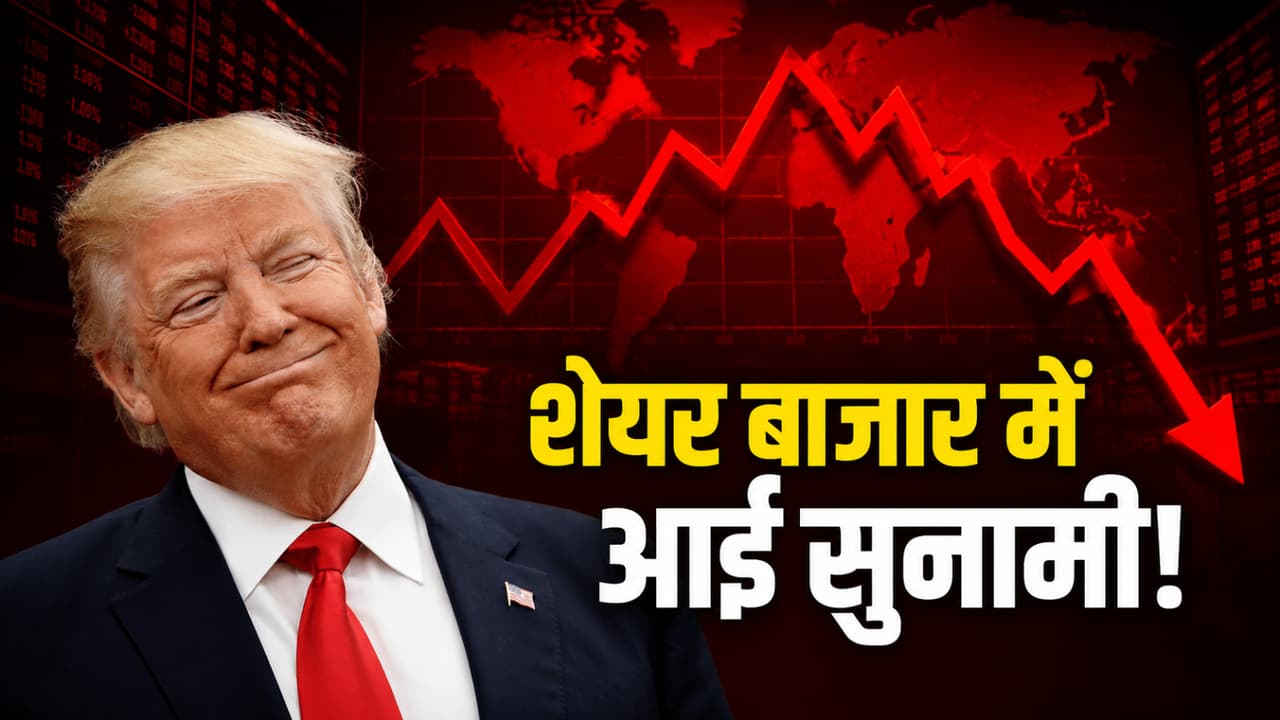
Stock Market Crash: Due to the big fall in the Indian stock market, investors lost about Rs 9 lakh crore. Sensex fell by more than 1700 points and Nifty slipped below 24,000. Know how Trump’s statement, crude oil prices and global markets increased the pressure.
Sensex Crash Today: Heavy selling in the Indian stock market on Friday gave a big shock to investors. Investors’ wealth worth about Rs 9 lakh crore was lost in just a few hours of trading. The Sensex fell by more than 1,700 points, while the Nifty slipped below the crucial level of 24,000. Not only domestic reasons, but also increasing tension in the Middle East, rise in crude oil prices and weak signals from global markets were responsible for this huge fall in the market.
Big fall in Sensex-Nifty, all sectors under pressure
At around 2 pm, the Sensex fell by more than 1,700 points to 76,472.78, while the Nifty50 fell by 438 points. The total market capitalization of BSE listed companies declined to about Rs 471 lakh crore.
Major stocks like Hindustan Unilever, InterGlobe Aviation, Maruti Suzuki, Kotak Mahindra Bank, Bharat Electronics and Bharti Airtel fell by 2 to 4 per cent. Nifty Bank, FMCG and Oil & Gas indices also fell by more than 2 percent.
Why did the stock market crash? Understand 5 big reasons
The biggest reason for this decline is believed to be US President Donald Trump’s statement regarding Iran. Trump said that the interim ceasefire agreement with Iran has ended, which deepened the fear of increasing tension in the Middle East.
As tensions increased, Brent crude rose by about 5 percent and crossed $ 78 per barrel. The fear of oil supplies being affected through the Strait of Hormuz further increased investors’ concerns. Apart from this, weak signals from the markets of Europe, Asia and America, increase in US bond yields and weakness of the rupee against the dollar also increased the pressure on the market.
What should investors do now?
Experts believe that in the coming days, the direction of the market will depend on the situation in the Middle East, crude oil prices, activities of foreign investors and the movement of the rupee. At such a time, instead of taking decisions in a panic, investors should adopt a long-term strategy and keep an eye on global developments.
If geopolitical tensions increase further, market volatility may continue for some time. At the same time, there will be a possibility of recovery in the market if the situation becomes normal.