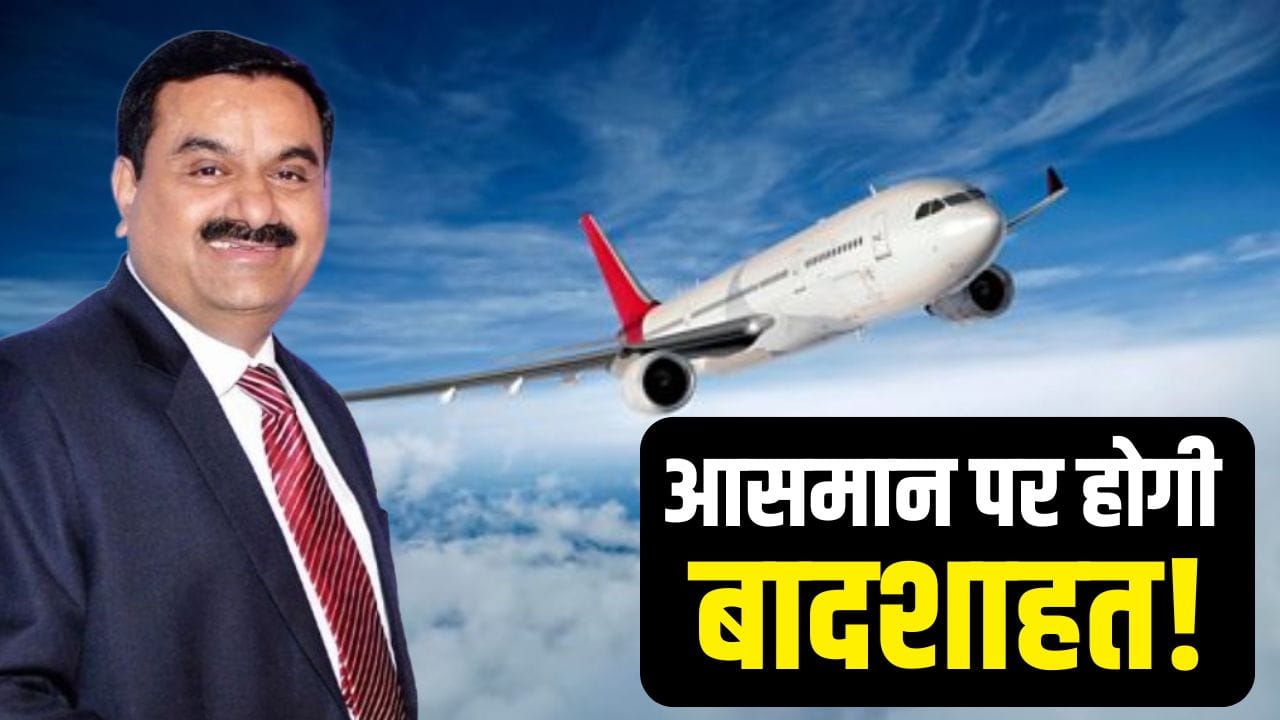
Adani Group is now preparing to enter the airline industry.
According to government officials and company officials, Adani Group has asked the government to change the rule that prevents operators of the country’s busiest airports – New Delhi and Mumbai – from holding more than 10 percent stake in any scheduled airline. This will help this group doing business ranging from energy to defence, to start an airline and increase its reach in the aviation sector. In this sector, apart from already running eight airports, the group has a strong presence in works like pilot training, aircraft repair and ground handling. Adani currently holds 74 percent stake in Mumbai Airport, while GMR Airports has 74 percent stake in Delhi Airport.
Government wants to break the duopoly of Indigo and Air India?
The ministry is seeking opinion from Solicitor General Tushar Mehta on the legal validity of making retrospective changes in that rule. This rule was included in the agreements made at the time of privatization of these two airports in 2006. Cabinet approval will be necessary for any such change. Senior officials said that the central government probably wants a well-funded airline operator which can bring the necessary competition by breaking the duopoly (dominance of two companies) of IndiGo and Air India. These two companies together control about 90 percent of the domestic market. In December last year, Jeet Adani, son of group chief Gautam Adani, had denied any interest in the airline business.
What is the company’s philosophy?
Jeet Adani had said that this is not right according to the capital discipline of the company. This change in thinking is directly related to the group’s plan to set up an aircraft manufacturing unit in collaboration with Brazilian company Embraer. People with knowledge of the matter said that Adani Group has not been able to garner interest from existing airlines to buy Embraer planes and it feels that starting its own airline could be a way to make the project successful. He said that the manufacturing unit can be commercially successful only if it gets big orders for the plane. A senior Adani official said that no concrete decision has been taken yet, but there is no doubt that there is a possibility of synergy in starting the airline for the group.
may have to face opposition
He said that it was suggested to the government that such a rule should be made so that there would be no restrictions. However, he also said that at present there is no concrete discussion going on within the group about buying any airline. Adani Group did not respond to the questions. Airline officials say that domestic airlines may strongly oppose this group’s plan and the competition regulator may closely examine it. This is because it may give unfair advantage in access to airports, especially in slot allocation, and may distort the competitive environment. Airport slots are specific times given to airlines for take-off or landing of aircraft. Slots during peak hours are considered very valuable.
Indigo and Air India will also get a chance
Senior industry officials say that if the government approves Adani’s proposal, it will also allow airlines like IndiGo and Air India to buy stake in the airport, thereby fending off their rivals. A senior official of the airline industry said that Adani Group has eight airports in the country, including the main airport of Mumbai. He said that if the aim was to prevent monopoly, it would have the opposite effect — any airport owner competing with airlines could prevent its rivals from getting good slots. He also said that the government has not yet held any talks with the airlines on Adani’s plan.
The arrangement could be something like this
However, government officials say that if this rule is changed, it will include provisions to maintain complete separation (arms-length distance) between the operations of the airport and the airline. This will include a ban on direct or indirect disclosure of commercially sensitive information related to slot allocation and a ban on the appointment of the same type of chief managers in both the divisions. He stressed that India’s slot allocation guidelines — under which an airline is guaranteed to retain its slots in the next season if it utilizes 80 per cent of the allotted slots — are sufficient to prevent any unfair advantage.