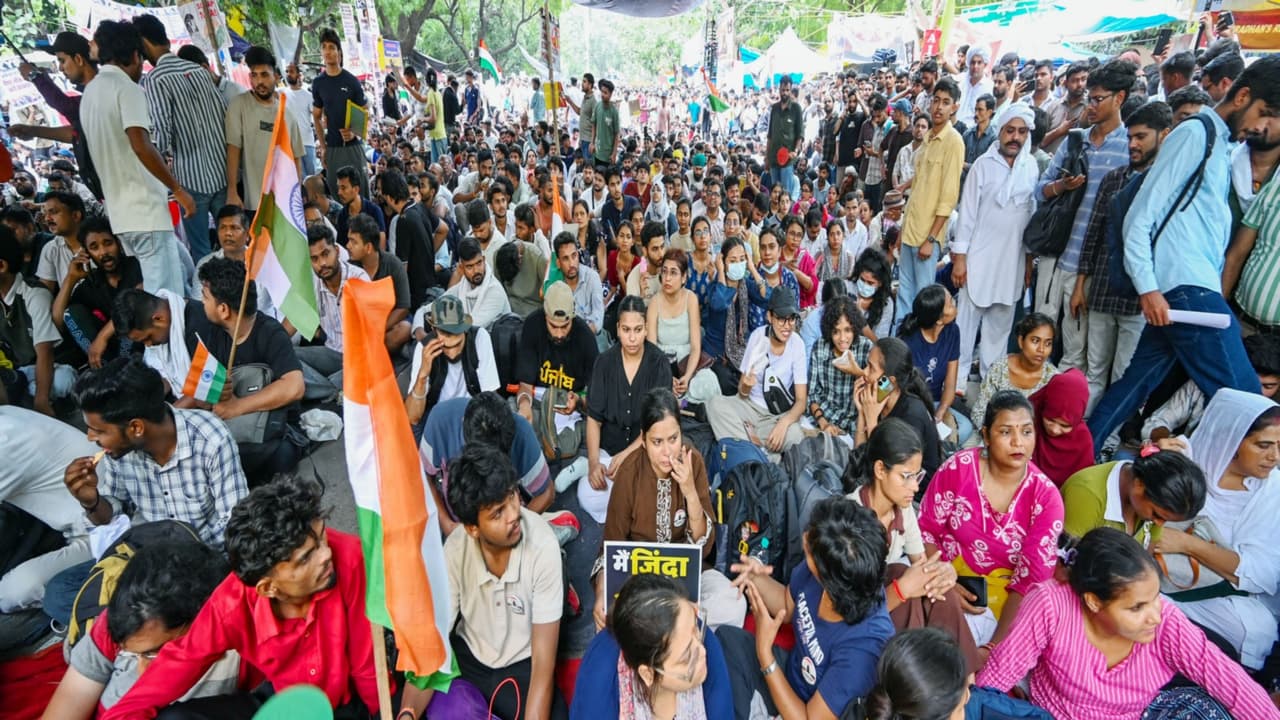
Security has been tightened in Delhi in view of the monsoon session of Parliament and a protest march. DMRC has closed 16 metro stations around Jantar Mantar and Parliament House till further orders. However, interchange facility will be available at major stations.
New Delhi [भारत]July 22 (ANI): Delhi Metro Rail Corporation (DMRC) has announced temporary closure of 16 metro stations to maintain security arrangements, while also ensuring that train changing facilities will be available at major interchange stations.
16 metro stations closed in Delhi
According to Delhi Metro Rail Corporation, the stations which have been closed till further orders include Lok Kalyan Marg, Rajiv Chowk, Patel Chowk, Ramakrishna Ashram Marg, Barakhamba Road, Supreme Court, Seva Tirtha, Janpath, Mandi House, Central Secretariat, ITO, Delhi Gate, Indraprastha, Khan Market, Jor Bagh and Shivaji Stadium. However, interchange facility will be available at Rajiv Chowk, Mandi House and Central Secretariat.
Delhi Metro Rail Corporation, in a post on X, detailed the specific locations affected by the safety protocols and clarified how the train changing facility will work for passengers. The closure occurred on the third day of the monsoon session of Parliament, as all these sixteen metro stations are located near Jantar Mantar and the Parliament House complex.
Similarly, on Sunday morning too, Delhi Metro Rail Corporation (DMRC) had announced closure of five stations in Central Delhi – Janpath, Rajiv Chowk, Patel Chowk, Central Secretariat and Seva Tirtha “due to security reasons”.
Police alert regarding ‘Chalo Sansad’ march
With the CJP calling for its “Chalo Sansad” march, Delhi Police has stepped up security measures near the complex in view of the monsoon session. Several Rapid Action Force personnel were deployed nearby to handle both the CJP protest march and the upcoming session. As security is increasing, CJP continues its protest at Jantar Mantar in Delhi.
According to Delhi Police, the organization has not yet approached them to seek official approval for this march. The march was first announced by activist Sonam Wangchuk, who was admitted to hospital on Saturday morning.
On Monday, Delhi Police issued an advisory clarifying that no permission has been sought nor given for any proposed march by the CJP to Parliament, and also warned that strict action will be taken against anyone violating prohibitory orders in the New Delhi district.
In a statement, Delhi Police said prohibitory orders under Section 163 of the Indian Civil Security Code (BNSS), which is similar to the earlier CrPC Section 144, are in force in New Delhi district. According to the advisory, protest marches, processions, demonstrations and gatherings of five or more persons are prohibited, except at the designated protest site at Jantar Mantar, where demonstrations can be held with prior permission.
Why are protests happening?
Earlier, Sonam Wangchuk had said that she would end her hunger strike if the government accepts accountability for recent failures in the education system, including paper leaks, or if MPs assure her that the issue of education accountability will be raised during the monsoon session of Parliament.
These protests began in June, when protests broke out at Jantar Mantar over the alleged paper leak in the NEET-UG 2026 exam, demanding the resignation of Union Education Minister Dharmendra Pradhan. The movement gained national momentum when activist Sonam Wangchuk joined the protest site in late June and began an indefinite hunger strike. (ANI)
(Except for the headline, this story has not been edited by Asianetnews Editorial staff and is published from a syndicated feed.)