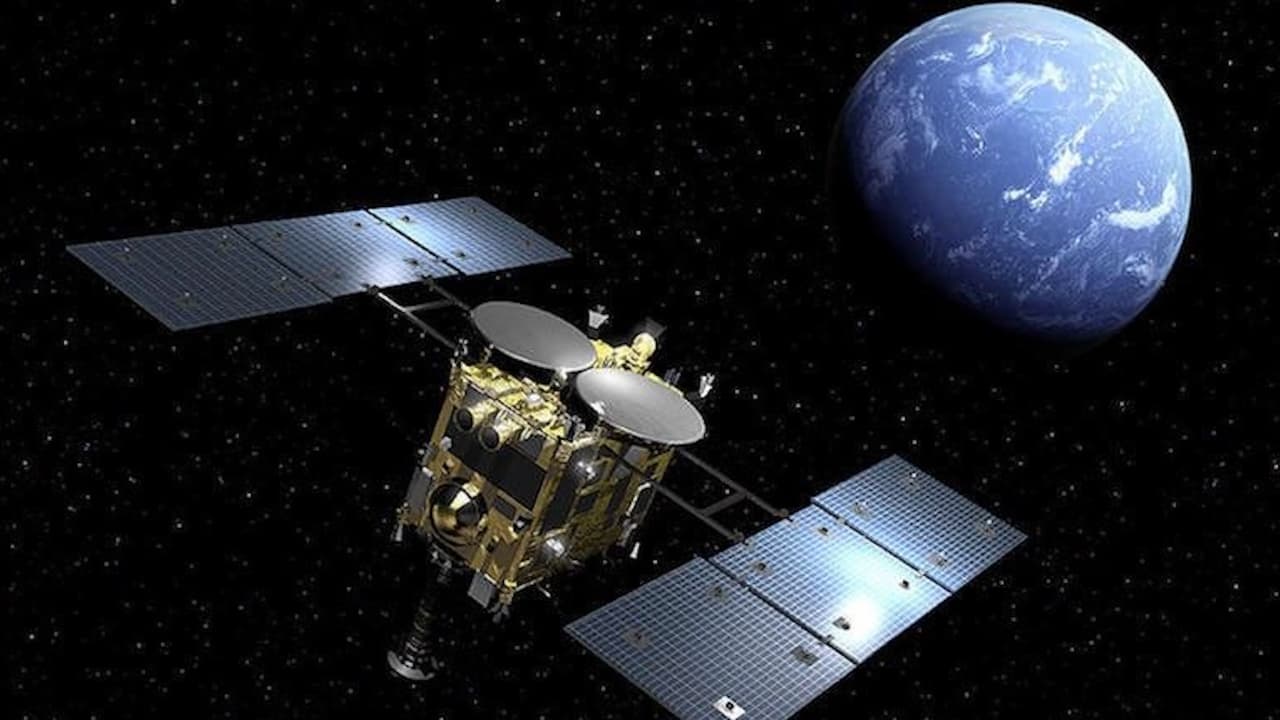
JAXA’s Hayabusa2 completes risky flyby of ‘Torifunne’ asteroid. This revealed that it is made of two connected rocks (contact binary). This success is important for future planetary defense missions.
Scientists had warned that this was a very dangerous step, but Japan’s space agency JAXA (Japan Aerospace Exploration Agency) completed this courageous mission. Hayabusa2 spacecraft flew very close to the asteroid named ‘Torifune’ located near the Earth. The pictures received after this flight have surprised scientists all over the world.
This close flyby took place on July 5 and when the photos were received on July 6, former Hayabusa2 mission manager Makoto Yoshikawa and his team discovered two surprising things. First, Torifune is not an ordinary asteroid, but a ‘contact binary’ asteroid, that is, two rocks that are connected to each other due to gravity. Second, the images found were much larger and clearer than expected.
“We did not expect to find such connected structures at all. We did not even think that we would get such a big picture,” Yoshikawa said at the ‘Asteroids, Comets and Meteors’ conference in Poland.
Months of debate behind the dangerous decision
Behind this success was a months-long debate between the scientists and engineering teams. The aging Hayabusa2 spacecraft was working at the last limit of its capacity. Hayabusa2 was launched in December 2014. Four years later, it reached an asteroid named Ryugu, collected samples from there and brought them back to Earth in 2020. Having completed its main mission, it is now on its way to a small asteroid named 1998 KY26 in 2031. The Torifune flyby was a test conducted during this long journey.
Usually, while flying near an asteroid, a distance of at least 100 kilometers is kept. But the scientific team said that good pictures would not be obtained from such a distance. Hayabusa2 was designed to stop and land on an asteroid, not fly by at a speed of 5.3 kilometers per second.
Journey from one kilometer to 800 meters
Initially engineers suggested flying from a distance of 10 kilometers. Later, on the request of the scientific team, this distance was reduced. Ultimately the engineers agreed that the spacecraft could pass at a distance of one kilometer from the center of the asteroid. But just a month before the flight, mission leader Yuya Mimasu suggested reducing the distance even further.
When the proposal came to increase the distance to 800 meters, some scientists opposed it. His response was, “It’s too dangerous.” After this there was a very heated debate. The biggest concern was that no one knew Torifune’s true size. Based on observations made from Earth, the asteroid could have a maximum length of 1,400 meters and width of 400 meters. Eventually, permission was granted to fly from a distance of 800 metres.
Surprising pictures and scientific data
On June 19, Hayabusa2 found Torifune. The spacecraft was being controlled from Earth until three hours before the flight, after which it was put into automatic mode. A special software was also created for this mission. Torifune’s double size was clearly visible in pictures taken from the spacecraft’s Optical Navigation Camera Telescope.
At the same time, other scientific instruments also gathered important information. The Thermal Infrared Imager confirmed the ‘contact binary’ structure by taking pictures of the asteroid’s heat. The infrared spectrometer and laser altimeter also gathered data. Yoshikawa said this may be the first time a laser has successfully measured distance during an asteroid flyby.
Paving the way for future planetary defense missions
JAXA has clarified that the Torifune flyby was not just a photo experiment. “JAXA has achieved the technology to collide a spacecraft with a small celestial body,” Yoshikawa said. Comparing it to NASA’s DART mission, he said that this technology will prove to be very helpful in future missions to protect the Earth from asteroids (planetary defense).
Hayabusa2’s journey does not end here. The next big goal of this spacecraft in 2031 is to reach a very small (just 11 meters) and rapidly rotating asteroid named 1998 KY26.