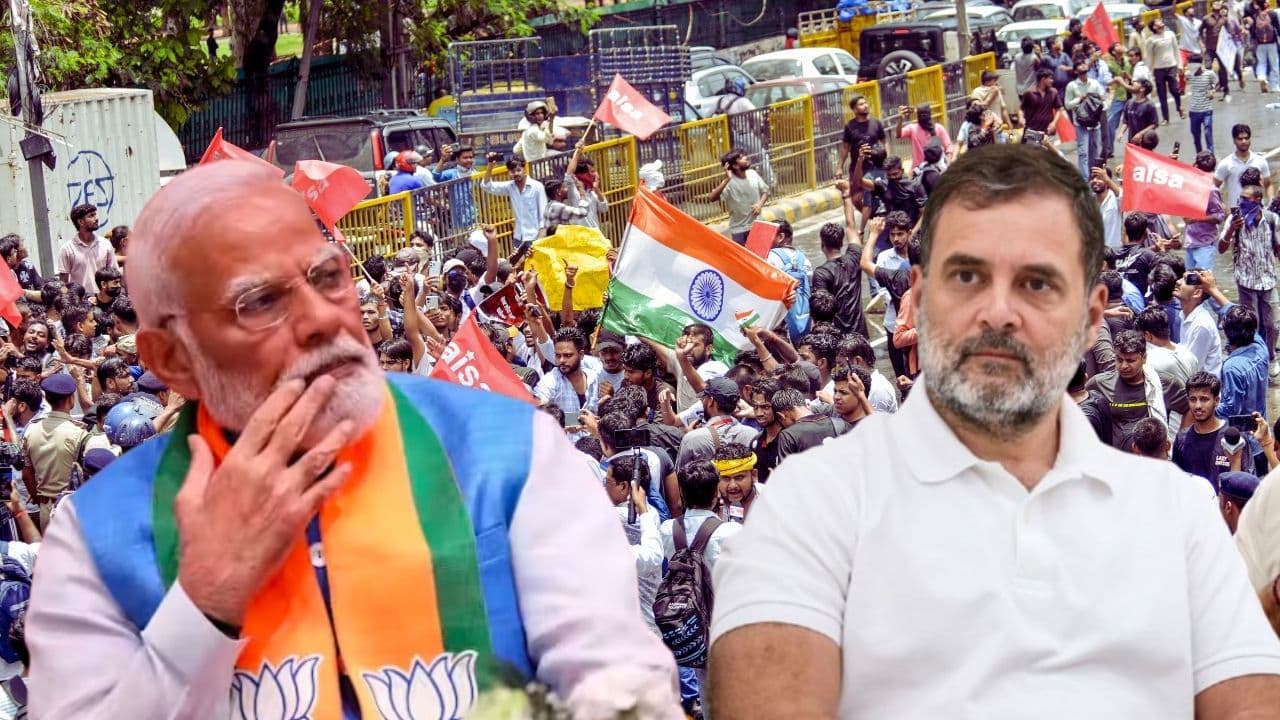
Rahul Gandhi claimed that 152 papers were leaked in 10 years, but no culprit was punished. Is there a loophole in the law through which the accused escape? Know the complete story of Public Examinations Act, Default Bail and Fast Track Court.
Amidst the ongoing protests over NEET paper leak, Congress MP and Leader of Opposition in Lok Sabha Rahul Gandhi has launched a major attack on the government. On the second day of the dharna outside the Prime Minister’s residence, Rahul Gandhi claimed that in the last 10 years, 152 papers were leaked across the country, affecting about 7.5 crore students and their families, but till now the culprits have not been given final punishment in any case. Meanwhile, Prime Minister Narendra Modi has announced the creation of a fast track court to hear paper leak cases. In such a situation, the question is arising that when the laws are so strict, how do the accused get away?
Rahul Gandhi’s claim and government’s reply
Rahul Gandhi said in the press conference that despite repeated leaks of papers, the culprits are not being punished. They allege that this is continuously affecting the future of the students. On the other hand, Prime Minister Narendra Modi announced that fast track courts will be created for speedy trial in paper leak cases, so that the culprits can be punished quickly and severely.
Public Examinations (Prevention of Unfair Means) Act, 2024 is already in force in the country. Under this, there is a provision of punishment ranging from 3 to 10 years and heavy fine for crimes like paper leak, solver gang, buying and selling of question papers and hacking in the examination system. Many states have also made their own separate laws.
Also read: New angle in Bengaluru triple murder, were 3 people murdered by asking AI?
After all, what is the biggest loophole in the law?
According to legal experts, the biggest challenge is the time taken for investigation and filing of chargesheet. If the charge sheet is not filed after arrest within the prescribed legal time limit, then the accused acquires the right to get statutory (default) bail.
In cases like paper leaks, investigations take a long time due to digital evidence, investigation spread across several states, forensic reports and a large number of witnesses. In such situations, many times the charge sheet is not filed on time and the accused come out on bail. This is why despite arrests, it takes years to reach the final punishment.
How will the picture change with the fast track court?
The government believes that with the formation of fast track courts, hearing of paper leak cases will be done faster. However, experts say that merely increasing the number of courts will not completely eliminate the problem. If the investigating agencies file strong charge sheets on time and collect digital evidence quickly, then only the culprits will be punished quickly.
That is, strict laws on paper leaks already exist, but only effective investigation, timely prosecution and speedy judicial process will decide whether the culprits in such cases will actually be punished soon in future or not.
Also read: Big revelation in NEET paper leak case! CBI gives clean chit to Sanjeev Mukhiya