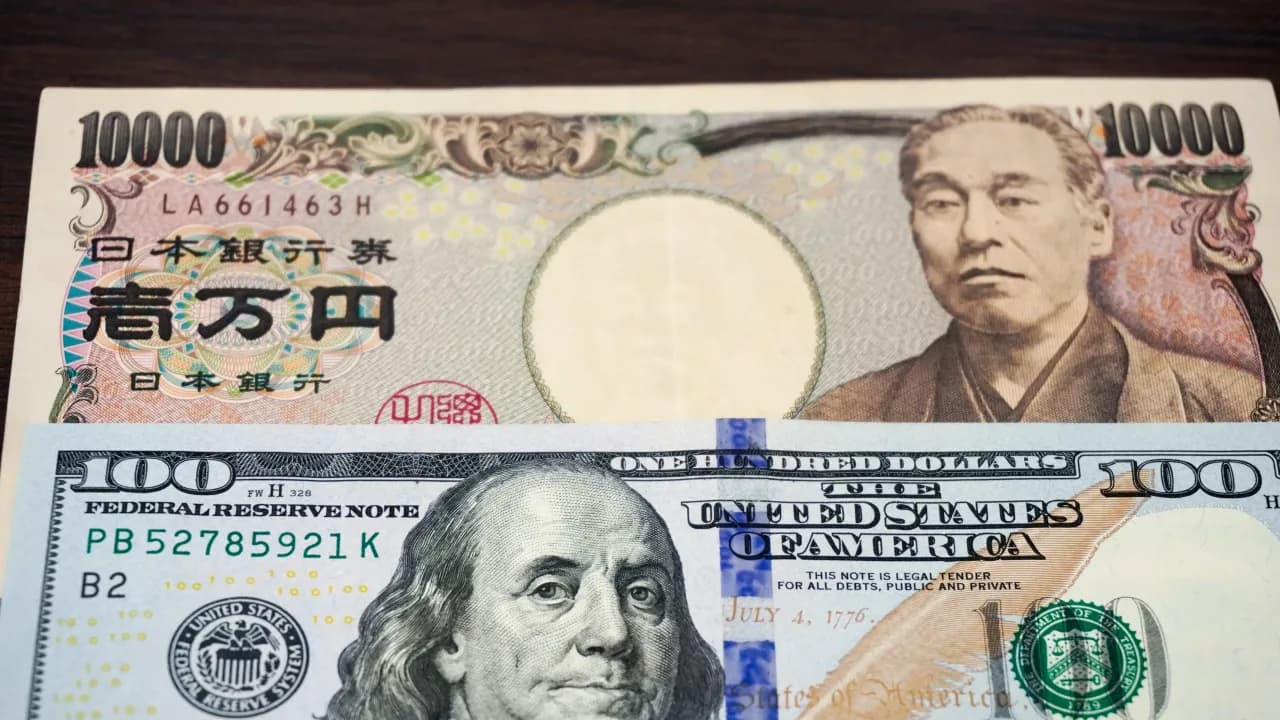
The Japanese yen briefly weakened beyond 161.95 per dollar, eclipsing the level that prompted the country’s authorities to intervene in foreign-exchange markets in 2024.
- The yen has remained under pressure as investors favor dollar-denominated assets on expectations the Federal Reserve will keep interest rates higher for longer than the Bank of Japan, ING Think analysts said.
- The firm added that the widening divergence in monetary policy has continued to support the dollar and weigh on the Japanese currency.
- ING said rising short-dated options volatility suggests markets are positioning for a possible intervention.
The Japanese yen slid to its weakest level against the U.S. dollar since December 1986 on Monday, extending a yearslong decline that is renewing focus on currency intervention risks and the global yen carry trade.
The currency briefly weakened beyond 161.95 per dollar, eclipsing the level that prompted Japanese authorities to intervene in foreign-exchange markets in 2024, even after the Bank of Japan raised interest rates to their highest level in decades.
Why Is The Yen Falling?
The yen has remained under pressure as investors favor dollar-denominated assets on expectations the Federal Reserve will keep interest rates higher for longer than the Bank of Japan, analysts at ING Think said.
The firm added that the resulting divergence in monetary policy has continued to support the dollar while weighing on the Japanese currency.
Traders are increasingly watching for another round of Japanese intervention. ING said rising volatility in short-dated options suggests markets are positioning for a possible intervention, with Finance Minister Satsuki Katayama reiterating last week that authorities stand ready to take “bold steps” against excessive currency moves.
ING added that the period around the July 4 holiday, when market liquidity tends to be thinner, could provide a potential window for intervention, although officials may choose to act sooner.
The benchmark 10-Year Treasury yield rose one basis point to 4.38%, while the 30-Year yield declined one basis point to hover at 4.862%. The 2-Year Treasury yield rose three basis points to hover at 4.113% at the time of writing.
Meanwhile, the iShares 20+ Year Treasury Bond ETF (TLT) edged lower by 0.01% at the time of writing, while the iShares 7-10 Year Treasury Bond ETF (IEF) declined 0.08%.
Burry’s Warning
Earlier this year, “The Big Short” investor Michael Burry warned the Japanese yen was “long, long overdue for a trend reversal,” arguing that an eventual unwind of the carry trade could trigger capital flows out of U.S. stocks and bonds as investors repatriate funds to Japan.
While the yen has continued to weaken since Burry made those comments, Monday’s move underscores how extended the currency’s decline has become, keeping investors focused on what an eventual reversal could mean for global markets.
What Is The Yen Carry Trade?
The yen carry trade involves borrowing in Japan, where interest rates remain comparatively low, converting the proceeds into other currencies, and investing in higher-yielding assets such as U.S. stocks and Treasuries.
Investors profit from the difference in borrowing costs and investment returns.
A sharp rebound in the yen could force investors to unwind those positions by selling overseas assets and buying yen to repay their loans, potentially creating volatility across global markets.
At the time of writing, the SPDR S&P 500 ETF (SPY), which tracks the S&P 500 index, rose 1.28%; the Invesco QQQ Trust ETF (QQQ) surged 1.85%; and the SPDR Dow Jones Industrial Average ETF Trust (DIA) gained 0.61%. Retail sentiment on Stocktwits regarding the S&P 500 ETF was in the ‘bearish’ territory.
For updates and corrections, email newsroom[at]stocktwits[dot]com.<