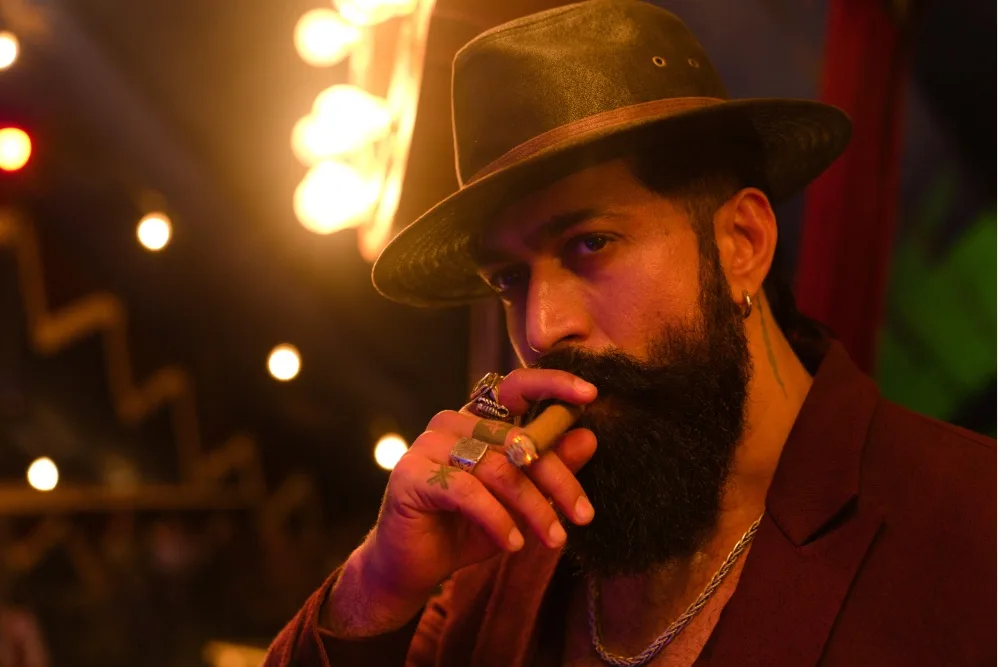
Four years after “K.G.F: Chapter 2” redefined box office benchmarks across India, Yash is preparing to unveil his next project on a scale that extends far beyond familiar territory.
The Indian actor-producer-writer reflects on a creative journey that prioritizes artistic challenge over commercial formula, positioning “Toxic: A Fairytale for Grown-Ups” as a deliberate step toward dismantling barriers that have historically confined Indian cinema to regional and diaspora audiences.
The decision to pursue “Toxic” emerged not from post-“K.G.F” momentum, but from resistance to it. “I heard a lot of things which kind of felt like it’s falling into formula or maybe somewhere it also looked like you’re just trying to encash on the success,” Yash says. “From the beginning in my life, I’ve just gone for something where I have to really think how do we do it. And that gives me high, and that gives me energy.”
Yash had been considering a larger concept when director Geethu Mohandas approached him. The alignment between his vision and her idea, combined with her creative energy, sparked the collaboration. What began as that meeting of minds developed into a narrative that, while carrying the visual markers of a gangster film, operates within deeper thematic territory. “On the face of it, it might look like a gangster film with all the commercial things, but it’s so nuanced because there is so much of moral ambiguity or raw emotions or dark side of human or certain topics which as an artist or at this point in my life, I would like to explore those kind of things on celluloid,” he explains.
Mohandas is known for intimate character studies like Sundance title “Liar’s Dice” and Toronto selection “Moothon,” and “Toxic” represents a significant expansion in scale for the filmmaker. For Yash, that shift poses no concern. “Whatever scale and all is not the primary aspect which I look into when we do a film. I think story is important,” he says. “I believe in people. I believe in talent. I believe when they want to do it, if the scale is something which they have never done, it doesn’t mean they cannot do. The intent is very pure. The storytelling at its core is about human emotions or relationships and all the power dynamics between people in any profession.”
The production’s scale supports that intent rather than replacing it. Production designer T.P. Abid’s work creates a fictionalized version of Goa during the transitional period between Indian independence in 1947 and Goa’s integration in 1961, when Portuguese rule persisted. The setting allowed for casting that serves narrative authenticity rather than marketing strategy. “We have cast some actors keeping those things in mind, but nothing to do for the sake of like people cast Indian actors or Chinese actors to break through their market,” Yash notes. “I don’t believe in that because sometimes the idea itself should drive it, not you have a story and then try to put it in a sense of marketing.”
Among the ensemble is Darrell D’Silva, a U.K. theater actor. The cast also includes Nayanthara, Kiara Advani, Huma Qureshi, Rukmini Vasanth and Tara Sutaria in what Yash describes as roles built around power dynamics that extend beyond conventional gender frameworks. “There’s a different set of politics, a different kind of violence involved with every human being,” he says. “We have some female characters who are really badass women who have taken responsibility about their lives and who survive in any situations.”
Working with a female director fundamentally altered the material’s perspective. “We [men] see life differently. We see things differently,” Yash observes. “There is always a different point of view when women looks at things. We miss out on a lot of emotions or a lot of things. Maybe it doesn’t matter to us. What matters to us may not be the thing which they’ll be focusing in an incident or a situation. So that perspective becomes so refreshing, and it’s so layered, and it’s so deep.”
The action choreography brings its own global credentials through J.J. Perry, the Hollywood stunt coordinator behind “John Wick” and “Fast & Furious,” who broke with his typical practice of assembling international teams to work exclusively with Indian stunt performers on “Toxic.” Perry spent 45 days during Mumbai’s monsoon season mounting what he described as action sequences designed to be “immersive, visceral, and new to Indian cinema.” VFX house DNEG is handling visual effects for both “Toxic” and Yash’s “Ramayana.”
The production was shot simultaneously in Kannada and English, with English-language performance presenting specific challenges around dialogue delivery. “You can speak in English, but when you perform in English, it has to be very organic, and it should look like yes, they do converse in English, not like force trying to make it like a stage show or a play,” Yash explains. “This is a film which is based or rooted in the emotions of Indian culture, but as a core of the filmmaking process, as a craft, it is very global, truly international.”
That international positioning carries strategic implications that diverge sharply from typical Indian release patterns. Where marketing usually begins during production in India, “Toxic” follows a model closer to Hollywood practice: complete the film first, then build distribution partnerships. “Right now I’ve taken a decision of taking my time and releasing this film,” Yash acknowledges. “That is really something my fans or people in India will not like. They’ll be upset because culturally you’re used to like once you start shooting the film, there is a timeline in their head. And unfortunately, marketing happens even if you don’t want to. The moment we start shooting, people start writing about it.”
The delay serves a specific purpose. Western distribution requires finished product for acquisition decisions, creating a structural mismatch with Indian production timelines where financial investment concentrates in final stages. “In the West everything starts when you finish the film,” he notes. “If somebody wants to buy the film or if somebody wants to be part of the film, they want to see the film because huge money is involved. Those are the things which is a challenge, but I think I have faith in my people, so they understand what we are trying to do is something what we all should do.”
This patience extends to franchise considerations. While “K.G.F: Chapter 3” remains an anticipated project, Yash resists treating intellectual property as pure monetization opportunity. “Everybody is waiting for ‘K.G.F: Chapter 3.’ But we’ll do it when it’s time, when it’s right,” he says. “It’s not just about exploiting the IP where people are ready. Somewhere it is important when people are excited, people want to watch it, but until unless we feel that this is the right thing to do, this is the right story and it fits, the franchise for the sake of monetization or just because you know the name works is never a goal.”
Balancing roles as writer, producer and star requires constant compartmentalization. “When you’re writing, you should not think of a producer when you’re writing on paper,” he explains. “But when you write on paper, next point is you should think as a producer – how much of this thing it takes, what are the logistics, how much sense it makes in terms of business. By the end of the day, a lot of people depend on cinema. It’s a profession. And then when I come on screen, when I’m performing, I actually only think about what a writer is trying to say or director is trying to say through that scene.”
Beyond “Toxic,” Yash is starring in and producing a new version of ancient Indian epic “Ramayana” with Namit Malhotra’s Prime Focus Studios, positioning both projects as contributions toward global platform building for Indian storytelling. “These are two different routes we are taking to reach the same destination,” he says. “Both me and Namit came together for the sole purpose of putting our Indian craft or our stories on a global platform. What can we do being here when people have given us so much love and support? We think that, okay, it’s a huge responsibility and stay away from it or get scared, or take that responsibility and be responsible.”
For “Ramayana,” that responsibility involves balancing cultural reverence with technological spectacle. “‘Ramayana’ can be done. It’s been done many times in this country or even you go to a smallest village, they have their own depiction of ‘Ramayana,’” Yash notes. “At the core, ‘Ramayana’ is something which we all know since our childhood. But with the technology, with the spectacles what we imagine about those scenes, if it can be brought on screen and offer it to the world, so they will hopefully find the truest form of that story and the spectacles blended in such a way where they go mesmerized.”
The parallel pursuits reflect a broader philosophy that rejects artificial distinctions between commercial and experimental storytelling. “I don’t get this concept of why can’t we experiment in large scale,” he says. “When you have to tell a story in a certain manner, we should not be in a position where we say we can’t do it because the market is not letting us. So let’s clean the market, let’s get the market, let’s do things where there is no restriction.”
The challenge, as Yash sees it, lies less with audience appetite than with structural impediments. “It is not the audience, it’s the system which is difficult to break through,” he argues. “A lot of money is involved in it. Time is the issue. There is a fundamental difference between how we release our films and they [the West] release their films. Their films are finished, locked, and then they go into marketing for six months or planned in such a way that you have a lot of time and you decide the release date much in advance. What we do is because the financials doesn’t work in India, we invest a lot of things in the last minute.”
The path forward requires creating successful precedents that establish new models. “Let’s be very clear about things in life in cinema – people only follow when there is a successful model,” he says. “Somebody has to do that. I think hopefully we’re going to do it. Everybody’s trying towards the same goal, but hopefully we’ll be able to do it.”
That ambition, however, stops short of pursuing Hollywood career trajectories in the conventional sense. “My idea is to tell our stories and our strength,” Yash emphasizes. “Why not if there is a nice thing where I feel I’m being taken or being part of the film because I am needed, not because I’m an Indian? You understand there is a difference, a vast difference. More or less, I think my idea is to represent, our country with pride or represent our craft, and show it to the world. That’s more exciting for me.”
Written by Yash and Geetu Mohandas and directed by Mohandas, “Toxic: A Fairytale for Grown-Ups” is produced by Venkat K. Narayana and Yash through KVN Productions and Monster Mind Creations. The film will release in English, Kannada and multiple Indian language versions.