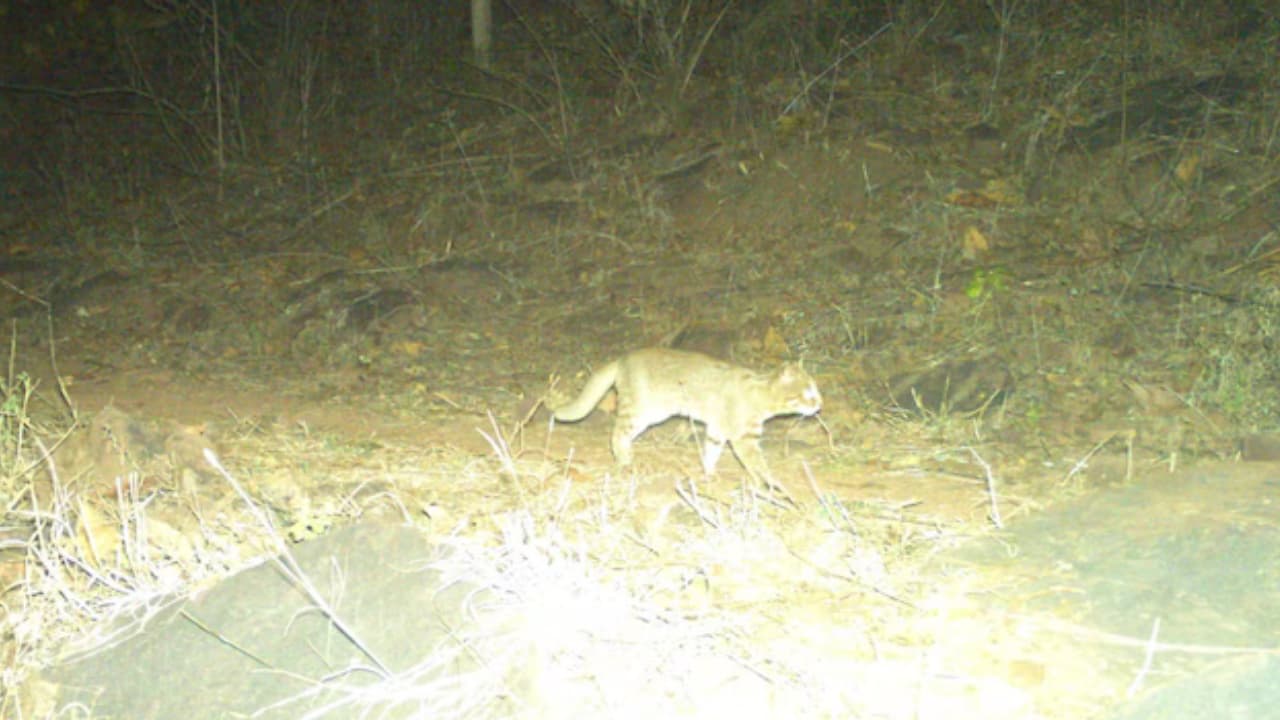
The world’s smallest wild cat, the rusty-spotted cat, has been photographed in Madhya Pradesh’s Veerangana Durgavati Tiger Reserve during a wildlife survey, providing rare visual confirmation of its presence.
Wildlife researchers have made a significant observation in central India: the world’s smallest wild cat, the rusty-spotted cat, has been captured on camera in the Veerangana Durgavati Tiger Reserve. This image provides the first confirmed visual evidence of the species in this area and was taken using camera traps during a major survey.
Survey Work
The photograph was part of a large-scale monitoring effort conducted between February and March 2024 by the Madhya Pradesh Forest Department in partnership with WWF-India.
While the primary goal of the survey was to assess tiger populations across a 442 square kilometre region, researchers later discovered something surprising. On March 12, cameras in the Dongargaon range captured the rare cat.
Tiny Predator
The animal identified is the rusty-spotted cat (Prionailurus rubiginosus), recognized as the smallest wild cat species globally. It usually weighs between 3 to 4 kilograms and has a body length of approximately 35 to 48 centimetres, making it small enough to fit easily in a human hand.
Its coat is greyish with rust-coloured markings, and it has round ears, large eyes, and a long, bushy tail that is nearly half its body length.
Life in the Wild
Despite its small size, the rusty-spotted cat is an active and skilled hunter. It inhabits dense vegetation, rocky terrain, and forest edges, primarily feeding on rodents, birds, and insects. It can also thrive in scrublands, dry and moist forests, and even farmland, though it is less commonly found in dense evergreen forests.
Conservation Status
Experts highlight the significance of this discovery for conservation efforts. The species is currently classified as “Near Threatened” on the IUCN Red List due to habitat loss and fragmentation.
In India, it is protected under Schedule I of the Wildlife Protection Act, which offers it the highest level of legal safeguarding.
For a long time, scientists thought the rusty-spotted cat was mainly found in southern India. However, recent sightings in regions like Gujarat, Maharashtra, Uttar Pradesh, and Haryana indicate that the species is more widespread and adaptable than previously believed.
Rich Habitat
The Veerangana Durgavati Tiger Reserve, spanning over 2,300 square kilometres, is already known for its diverse wildlife, including tigers, leopards, wolves, and sloth bears. The presence of this tiny predator underscores the reserve’s ecological importance and the necessity of ongoing monitoring of lesser-known species.