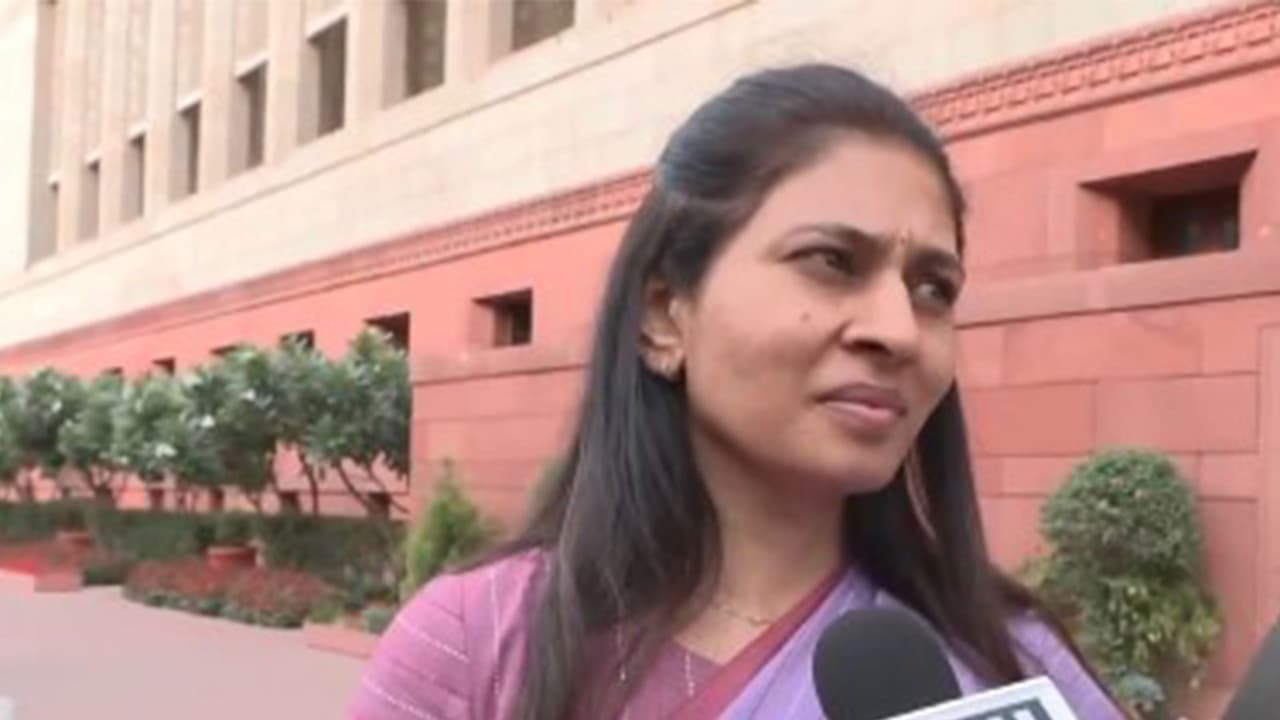
Union Minister Raksha Khadse termed the Women’s Reservation Bill a ‘collective necessity’ for national growth, urging cross-party support. She said the bill would empower women, who are 50% of the population, to contribute to policy-making.
Union Minister of State for Youth Affairs and Sports, Raksha Nikhil Khadse, on Thursday, emphasised that the Women’s Reservation Bill is a collective necessity for the country’s growth, transcending political boundaries. Following Prime Minister Narendra Modi’s address on the landmark legislation, the Minister noted that the initiative aims to integrate women into the core of legislative decision-making, ensuring their contribution to the nation’s future development.
‘A Bill to Empower Women for Country’s Development’
Union Minister of State for Youth Affairs and Sports, Raksha Khadse, while speaking to ANI, said, “The PM called on all the political parties to support this Bill because this is not just for any one political party, but to empower women for the country’s development. For 10 years, PM Modi empowered women in various ways, and now it is their right to voice themselves in the Lok Sabha and Assemblies and contribute to the government’s policy-making.”
“Women constitute 50% of the country’s population, so why shouldn’t we get equal rights in the Lok Sabha and Assemblies?” Raksha Khadse added.
PM Modi Guarantees Fair Implementation
Meanwhile, Prime Minister Narendra Modi on Thursday said “whether it is the South, the North, the East, the West, small states or large states, the decision-making process will not do injustice to anyone”, and there will be no change in proportion in the proposed increase in seats in the lower House of Parliament. Participating in the debate on the Constitution Amendment Bill for early implementation of the Women’s Reservation Act in the Lok Sabha, PM Modi said he can give a guarantee or a promise about his remarks if the opposition wants, as the government’s intention is clear. “I want to say from this House today with a great sense of responsibility that whether it is the South, the North, the East, the West, small states or large states… this decision-making process will not discriminate against or do injustice to anyone. In the past government that was in power, in whose time the delimitation took place, there will be no change in that proportion either, and the increase will also be in the same proportion,” he said.
Legislation Introduced in Parliament
The Constitution (131 Amendment) Bill, 2026, the Delimitation Bill, 2026, and the Union Territories Laws (Amendment) Bill, 2026 were introduced in the Lok Sabha on Thursday after the Opposition pressed for a division against the move to introduce three Bills, instead of a voice vote. The government has convened a special sitting of Parliament on April 16,17,18 to pass the amendment to the Nari Shakti Vandan Adhiniyam. The Opposition members in the Lok Sabha had pressed for a division against the move to introduce the bill. As per the final division, there were a total of 251 AYES and 185 NOES out of the total 333 votes. With the 251 AYES majority, all three Bills, including the Constitution (One Hundred and Thirty-First Amendment) Bill, 2026 and the Delimitation Bill, 2026, were introduced in the Lok Sabha. (ANI)
(Except for the headline, this story has not been edited by Asianet Newsable English staff and is published from a syndicated feed.)