The modern vehicle world lacks icons. There is the occasional supercar but we live in an era of sameness both in design and performance. A recent social media post highlight the same, while comparing the side-profiles of a bunch of C and D segment SUVs, the resemblance was uncanny.
In fact, a recent Netflix crime show even mentioned the emergence of a surprising new job in the US police: ‘Vehicle Identification Expert.’ I can’t imagine how difficult that job is.
However, occasionally a car stands out. Not necessarily for its iconic looks; nothing can beat the legendary Volkswagen Beetle or the Mini Cooper. But still the Toyota Hilux manages to stand in a league of its own.
The Toyota Hilux was always a favourite of car enthusiasts, but then the television show Top Gear (2002) took it to another level of fame. Keep in mind that this was not only the top motoring show in the world, but one of the best shows of its time.
The show subjected the Hilux to torture, submerged it under a river and then placed it on top of a high-rise building that was demolished. Yet, every single time they did something, the Hilux refused to die and the engine still turned on. Of course, that was before they took a modified the car in the frozen hell beyond the Arctic Circle and the magnetic North Pole.
The car even served Afghanistan’s armed fighters, the Levant and even the Sahel. The Hilux soon became Top Gear’s preferred choice of vehicle. When I shared on Instagram that I was driving one, the comments came in hard and fast, with many wondering whether it was suitable for modification as a weapons platform. Which it is.
Staying relevant
India, however, hasn’t really taken to the idea of a pick-up truck as a mode of private transport. The Hilux was launched in India a few years ago, and sales were rather tepid. Other than car lovers, the near Rs 40-lakh price tag put off most buyers.
But as Toyota brings in the ninth-generation Hilux they have tweaked things a little. A brand new two-wheel drive version at Rs 31.99 lakh aims to bring in new buyers as well as a top-end VX model at Rs 36.69 lakh, which features a four-wheel drive system. And so, Toyota India hopes to prove that the Hilux is not just a toy for rich gentlemen farmers and adventure junkies.
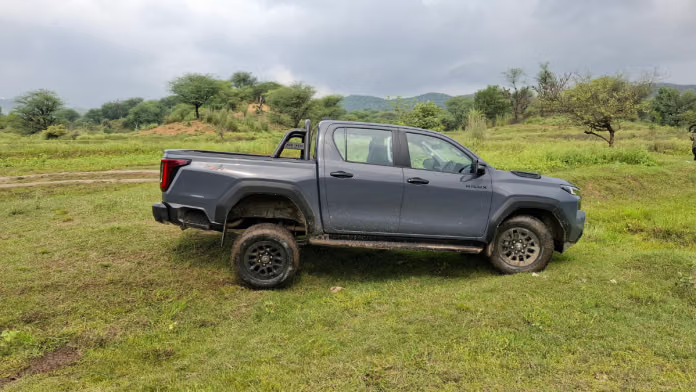
I recently had the pleasure of driving this on an off-road trail outside Jaipur. The Hilux remains supremely capable, with its iconic TOYOTA lettering on the tailgate symbolising the reliability that the badge carries.
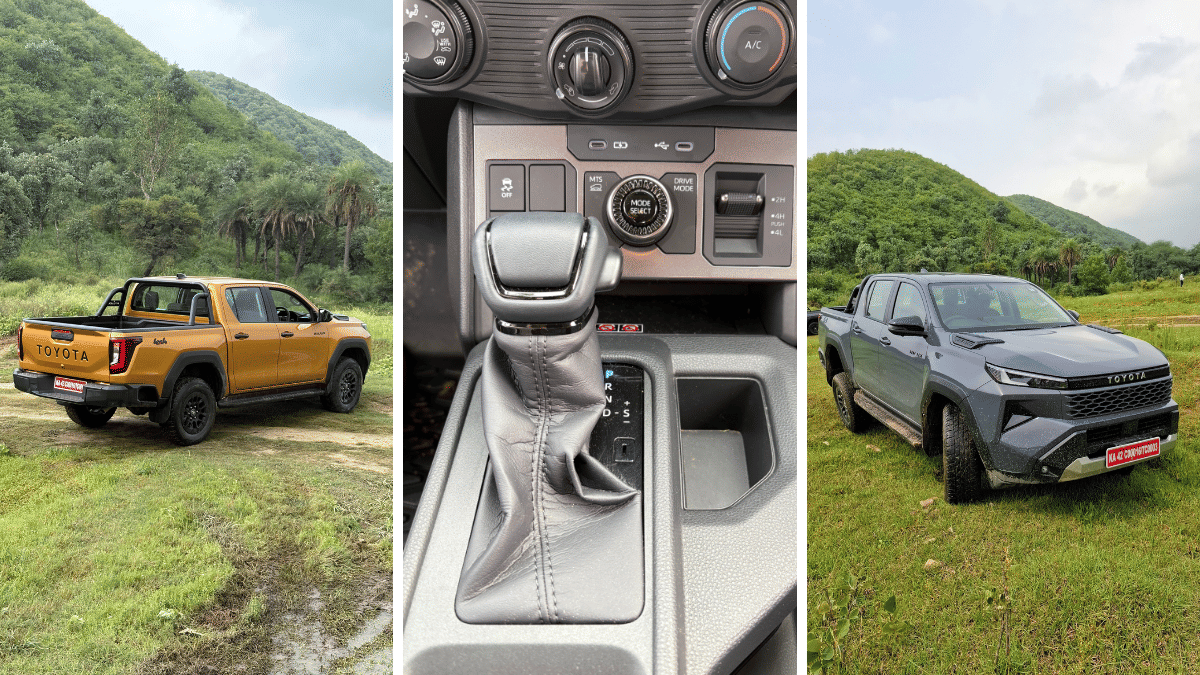
Certain things have changed from the previous model, though. There is a larger floating infotainment display as well as an improved audio system. But on the downside, there is no automatic air-conditioning system and only fabric seats, which seems like a cop-out compared to its original Thailand edition.
One could argue that, given what the Hilux is designed for, one does not need these features. This is, after all, a go-anywhere vehicle. And it does go anywhere and everywhere, at least the four-wheel drive version. I wish my six-year-old son, who hasn’t yet grown out of Peppa Pig cartoons, could appreciate how I charged through the puddles he loves to jump in with the 2.8-litre Toyota diesel motor.
Unlike Southeast Asia though, the lack of demand for pick-ups in India is curious. Maybe because we are not a society where we put goods on the back of a vehicle expecting strangers not to “help” themselves to them. But you could always buy lockable covers or even a full-fledged camping kit, with an expandable mobile home on the flat-bed section.
I am awfully tempted to get one, though, but it really doesn’t make sense unless you drive off the beaten track. If you are that sort of person, you genuinely can’t get anything better.