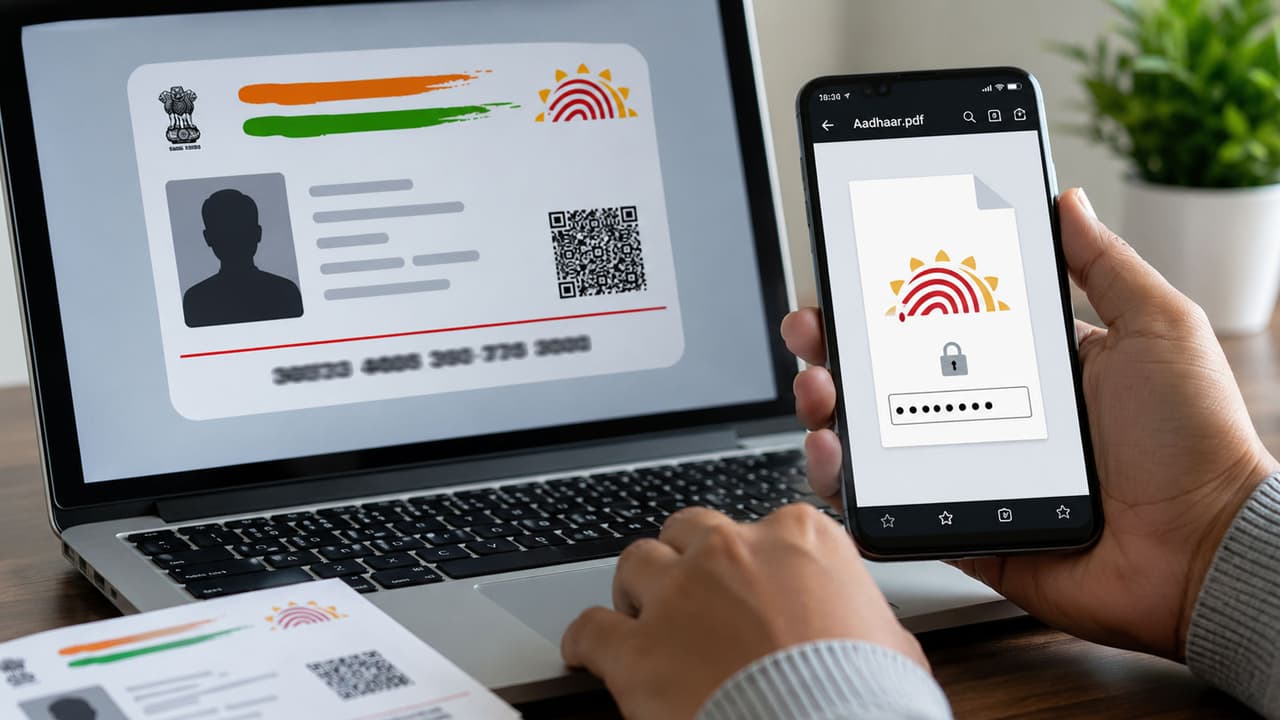
Why Aadhaar is Important: Know why Aadhaar is important, its main benefits, use in government schemes, banking, DBT, e-KYC, security tips and when and where it is mandatory to give Aadhaar.
Aadhaar Benefits: Aadhaar is used for many purposes, from opening a bank account to availing benefits of government schemes, getting a mobile SIM and proving digital identity. Although Aadhaar is not necessary everywhere, it is the most used identity card. Let us know why Aadhaar is important, how it works, in which cases it is used the most.
What is Aadhaar?
Aadhaar is a 12 digit unique identification number issued by the Government of India. It is issued by the Unique Identification Authority of India (UIDAI). Aadhaar registers a person’s name, date of birth (or age), address, photograph and biometric information (fingerprint and iris scan). Its objective is to give a unique digital identity to every citizen.
Why is Aadhaar important?
1. Makes it easier to verify identity
The biggest feature of Aadhaar is that it is the most accepted identity card in the entire country. For example, if you want to open a bank account in a new city, then Aadhaar can be useful in providing proof of your identity and address.
2. Help in getting benefits of government schemes
Aadhaar is used to verify the identity of the beneficiary in the schemes of the Central and many state governments. This helps in delivering benefits to the right person and identifying fake beneficiaries.
3. Makes digital services easier
With the help of Aadhaar based e-KYC and online identity verification, many services are completed faster than before. As-
- banking service
- some financial services
- digital document verification
4. Help in Direct Benefit Transfer (DBT)
In many government schemes, subsidies and other benefits are sent directly to the bank account. With Aadhaar based identification, the benefits reach the right person without the interference of any third person.
5. Common identity across the country
Earlier, different identity cards were used in different states. Aadhaar provided a uniform digital identity across the country, which increased convenience in many services.
Read this also- Why do spam calls come?
Is it necessary to give Aadhaar everywhere?
No. As per Supreme Court decisions and applicable rules, use of Aadhaar is mandatory in some service-plans, while in many places it is just an identification option. In many cases, passport, voter ID or other valid identity cards are also valid.
How to use Aadhaar safely?
- Share Aadhaar number only with trusted institutions.
- Do not share OTP with anyone.
- Use only the official website or app of UIDAI.
- Keep Aadhaar information updated from time to time.
- If necessary, use Masked Aadhaar, in which the complete Aadhaar number is not visible.
Read this also- Why does internet run slow?
When was Aadhaar implemented?
- The Aadhaar project in India started on 28 January 2009, when the Central Government formed UIDAI (Unique Identification Authority of India).
- On 29 September 2010, Aadhaar number was issued to a citizen for the first time in Nandurbar district of Maharashtra.
- In 2016, Parliament passed the Aadhaar Act 2016. After this Aadhaar got legal recognition.
Facts and figures related to Aadhaar
- According to UIDAI, more than 140 crore Aadhar cards have been issued in India. It is one of the largest digital identity systems in the world.
- Aadhaar number is of 12 numbers and is different for every person. Aadhaar number of two people cannot be same.
- The World Bank has included the Aadhaar project in the world’s largest digital identity program.
- Aadhaar based e-KYC has made the identity verification process faster and more digital than before in many places.
- UIDAI keeps adding new features for the security of Aadhaar from time to time, such as Masked Aadhaar, Biometric Lock/Unlock and Online Verification Service.
Content Source: UIDAI, Ministry of Electronics and Information Technology (MeitY), Government of India – Direct Benefit Transfer (DBT) Portal, based on Supreme Court decision 2018, World Bank.