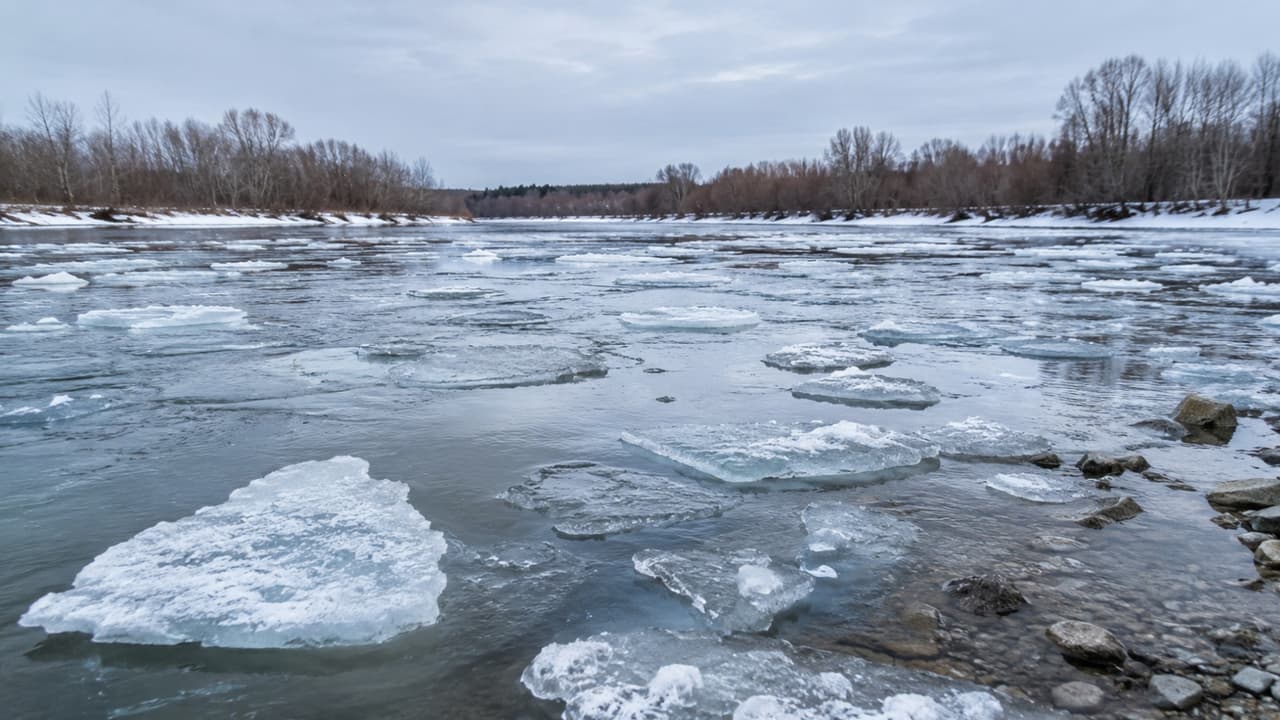
Why Ice Floats: Why doesn’t ice sink in water? Know the science behind density, the unique structure of water and Archimedes’ principle, which is also essential for life on Earth.
Why Ice Does Not Sink: Whenever we pour water into a glass and put a piece of ice in it, it starts floating on top. We often see heavy things sinking in water, but ice is made of water only, then why does it float instead of sinking? The answer is density and unique structure of water. This is the reason ice floats on water. It is not just a science but also important for life on earth.
What is Density?
Density means how much substance-liquid is filled in a fixed space. Objects with higher density sink in water, but objects with lower density float on water. The same rule applies to snow as well.
Why does the density of ice decrease?
When water cools and freezes at 0°C, its molecules form a special type of open crystal structure. In this new structure, more space is created between the water particles than before. Due to this the volume of ice increases, but its weight remains the same. That is, the same weight starts occupying more space, hence the density of ice becomes less than that of water. This is why ice floats on water.
Read this also- Why do trees provide oxygen?
Why is this quality of water considered so special?
Most products shrink when cooled and become solid, and their density increases. Therefore they sink in their liquid form. But water is an exception to this rule. When water becomes ice, its volume increases and density decreases. This is the reason why ice floats on water.
What would happen if the ice capsized?
This question is interesting. If the ice sank in water, the ice that forms on the surface of lakes and ponds in winter would sink to the bottom. Gradually the entire reservoir could freeze over. In this condition, it becomes difficult for fish, plants and other organisms living in water to survive. But because ice floats, it acts as an insulator. The water below remains warm and liquid, due to which aquatic creatures remain alive even in winter.
Read this also- Why does a rainbow form?
Does ice remain completely above water?
No. Only a small part of the ice is visible above the water. About 90% of its part remains under water and only about 10% part is visible above.
How can we understand this at home?
Fill a glass with water and add some ice cubes to it. You will see…
- The ice does not sink completely.
- Some part of it remains above water.
- As the ice melts, the label of the water remains approximately the same.
- This is an excellent example of Archimedes’ Principle and the law of density.
Content Source: NASA Earth Observatory, US Geological Survey (USGS), Encyclopaedia Britannica, National Snow and Ice Data Center (NSIDC), Khan Academy.