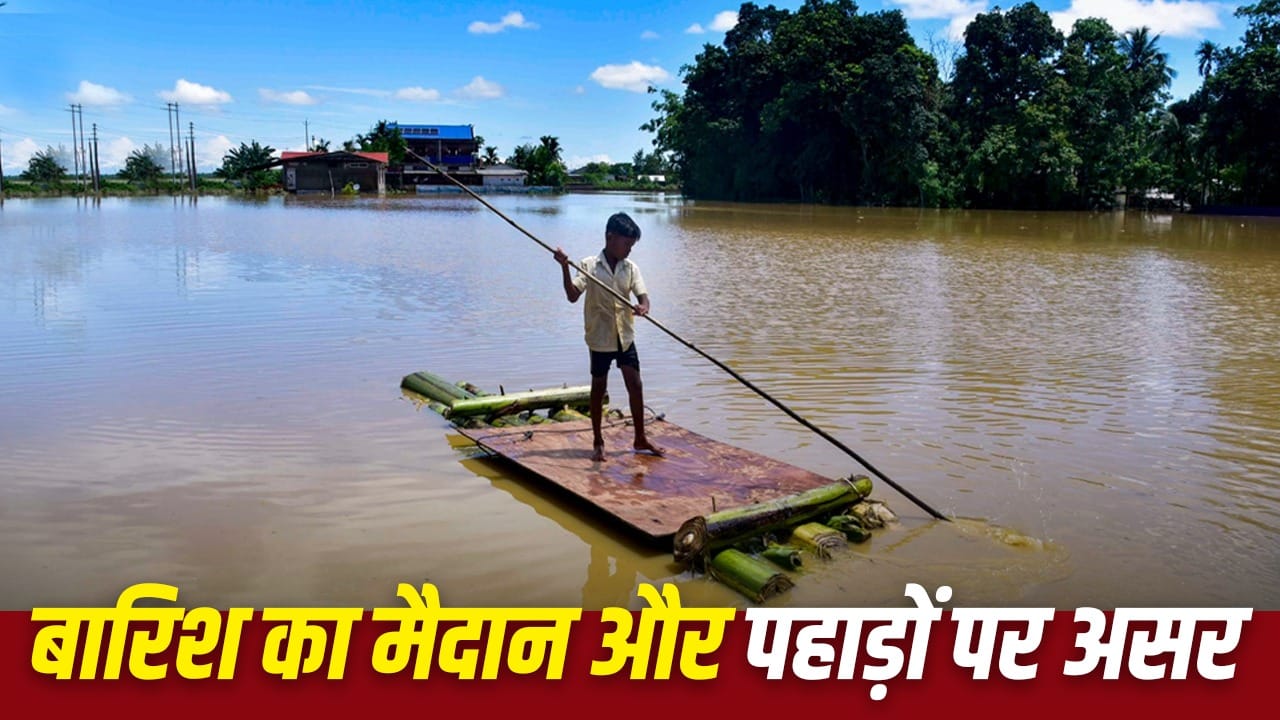
Monsoon rain is normal in the plains, but it becomes fatal in the hilly areas.
Normal monsoon rains often provide relief in the plain states. But in Himalayan and other mountainous regions this rain sometimes becomes fatal. Flood has created havoc in Assam. This area falls in both plains and hilly areas. Whereas in Uttarakhand, Himachal Pradesh, Jammu and Kashmir, Sikkim, Arunachal Pradesh and the mountainous parts of the Western Ghats, incidents of landslides, flash floods, road collapse and house collapse occur every year. Such incidents are happening this year also. Let us understand why the normal monsoon rains in the plains become fatal for the mountains?
The land in the plains is relatively flat. There the rain water spreads, seeps into the soil or slowly reaches the drains and rivers. The land in the mountains is sloping. Water doesn’t stop. It flows downwards at a fast speed. The strong current carries away soil, stones, trees and debris with itself. Small streams can be seen taking the form of raging rivers in no time. For this reason, even short duration heavy rains in the mountains become dangerous.
Moisture coming from Bay of Bengal is dangerous for the mountains
Another important aspect is that nowadays a large amount of moisture is coming from the Bay of Bengal towards North and North-West India. This system is causing rain in states like Delhi, Uttar Pradesh, Himachal Pradesh and Uttarakhand. This rain is quenching the thirst of the crops in the plains. While we are getting relief from the heat, these rains cause huge problems in the mountains. In fact, when these moist winds hit the high slopes of the Himalayas, they rise rapidly. The air becomes cold. And cause excessive rain in a very small area. Then many things happen which we cannot even imagine. The rain which provides relief in the plains is seen taking a frightening form in the hilly areas.

Many rocks are layered, broken and weak. Photo: Pexels
Himalaya is geologically young and weak
The Himalayas are counted among the newest mountain ranges in the world. It is still going through geological changes even today. Many of the rocks here are layered, broken and weak. These rocks slide easily due to earthquake, erosion and water. When rain water fills the cracks of the rocks, their mutual grip becomes weak. Soil also becomes heavy when it gets wet. Then the soil, stones and trees present on the slope start sliding downwards.
The biggest danger is landslides
Landslides are common in the mountains during monsoon. Soil absorbs water due to continuous rain. Its ability to bear weight reduces. The balance of the slope gets disturbed and a large part of the land shifts. Roads are closed due to landslides. Vehicles get buried. Houses are seen being damaged. Stoppage of electricity, water and communication services is also common. In many places, villages are cut off from the outside world. Landslides are not caused only by very heavy rains. Sometimes even normal rainfall for several days completely saturates the soil. After this, even light rain, vehicle vibration or small earthquake is enough to cause landslides.

The rain on the mountains brings debris, the picture is of Doda in Jammu and Kashmir. Photo: PTI
Small rivers and streams suddenly swell
In mountainous areas, the slope of rivers and drains is higher. Therefore water flows downwards very fast. It may take time for water to rise in a plain river, but a mountain stream may swell within a few minutes or hours. This is called flash flood. Along with water, it also includes boulders, wood, soil and debris. This mixture is very destructive. It can break bridges, cut roads and wash away houses built on river banks. Many settlements in the mountains are situated near river valleys or drains. Tourism facilities are also often developed along the river banks. These places become more at risk during rains.

Picture of Marigaon, Assam.
Cloud burst increases the danger manifold
There are many incidents of cloud bursts in the mountains. This means excessive rainfall in a very small area in a very short period of time. Due to this, drains and small rivers suddenly get filled. Cloud burst is an extreme weather phenomenon different from the normal monsoon. Nevertheless, the structure of the hilly areas is such that the effects of both normal rain and cloud burst can be serious. It is also difficult to predict rainfall in the mountains, because the weather can change rapidly from one valley to another.

Deforestation makes it scary
Trees and plants are the natural protectors of the mountains. Their roots bind the soil. Vegetation also reduces the direct impact of rain drops. Forests help water to seep slowly into the ground. When forests are cut down, the soil is left exposed. Rain water washes it away easily. The slope is weak. More silt and debris reaches the rivers. Due to this, the river bed may rise and the risk of floods increases. Road construction, hotels, hydropower projects, mining and unplanned urbanization put pressure on forest cover in many areas. Development is necessary, but it is time to plan it keeping in mind the capacity of the mountain.

Situation after flood in hilly areas.
even a small mistake is costly
Mountains have to be cut for mountain roads. If cutting is not done in a scientific manner, the slope may become unstable. If the cut debris is dumped on a river or slope, it flows down during the rains. Adequate drains, retaining walls and slope protection structures are required on roadsides. Without these, water can seep under the road. Due to this the road may sink or the entire part may be washed away. Road closure during monsoon does not just mean stopping of travel. Due to this, hospitals, ration, medicines, relief materials and emergency services are also affected.
Also read: Why does Assam drown every year? Know the 5 major reasons for floods
Rain pattern is changing
Due to climate change, the pattern of rainfall is changing in many places. There may be drought for a long time, then very heavy rains in a short period of time. Such concentrated rainfall is more dangerous for the mountains. Due to increase in temperature, more moisture can remain in the atmosphere. This may increase conditions of intense rainfall. It has different effects on snow, glaciers, lakes and slopes in the Himalayan regions. However, climate change is not the sole cause of every disaster, but it can exacerbate pre-existing risks.
Also read:Neither the heat wave subsided nor the monsoon stopped… How many colors did the weather show in Delhi?