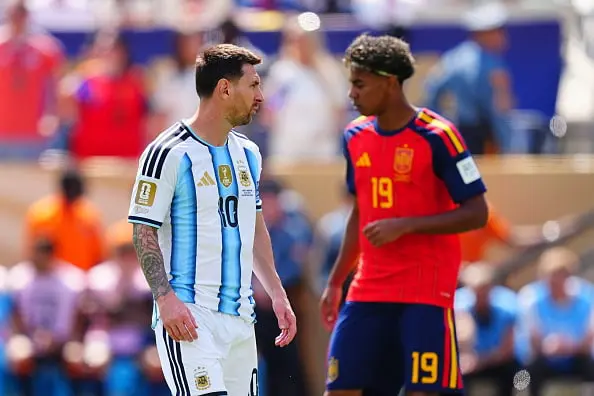
Spain needed a 116th-minute goal from substitute striker Ferran Torres to break 10-man Argentina’s hearts with a 1-0 win in the FIFA World Cup 2026 final at New York New Jersey Stadium.
While Torres’ goal was decisive in the end, the scoreline didn’t reflect Spain’s dominance during the course of 120 minutes. The result secured La Roja’s second World Cup title, and the first since 2010, where they incidentally beat the Netherlands in the final at Johannesburg after Andres Iniesta’s goal in extra time.
Let’s take a look at the reasons that swung the game in Spain’s favour:
Overreliance On Lionel Messi
Messi was surprisingly kept quiet by Spain. The Argentina captain, who scored eight goals prior to this contest, recorded an xG (expected goals) of 0.04 and failed to make a single key pass.
Spain’s Dominance In The Midfield
Throughout the tournament, Spain’s midfield dictated the tempo during matches, hardly allowing opponents long spells of possession. While Spain’s ability to move the ball quickly is no secret, their ball-winning traits also didn’t go unnoticed during the tournament.
Spain’s dominance in the midfield
Enzo Fernandez’s Red Card
Enzo Fernandez was shown a second yellow card for a cynical challenge on Pau Cubarsi, receiving his marching orders in the third minute of second-half stoppage time.
Playing with a player less was never going to work in Argentina’s favour, especially against a side like Spain that had conceded just one goal throughout the tournament.
Disaster struck six minutes into the second half of extra time as Spain finally made the most of their extra-man advantage, with Ferran in the right place at the right time to bury his shot into the roof of the net.
Lisandro Martinez’s Injury Disrupted The Balance
Lisandro Martinez and CristianRomero had formed a key partnership at the heart of Argentina’s defense during the tournament. However, Argentina was forced to take Martinez off due to an injury on the stroke of halftime.
His withdrawal forced Lionel Scaloni to throw veteran defender NicolasOtamendi into the action, despite the 38-year-old starting just one game, that too in the group stage. This changed the team’s overall balance, as Martinez had also shown his ball-carrying ability at this tournament.
Argentina’s Attack Was Virtually Non-Existent
Argentina had scored the most goals in the tournament before the final, netting 19 times. However, the team failed to register a single shot in regulation time, let alone a shot on target. Argentina finished the game with just two shots in total.
In contrast, Spain had 20 shots in regulation time, with 12 of them on target. Spain registered an xG of nearly 1.94 compared to Argentina’s 0.17.