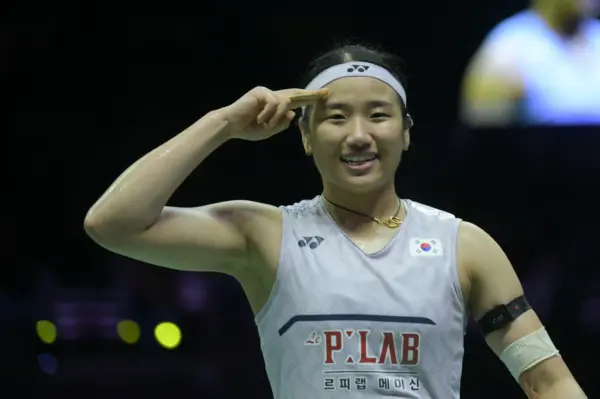
There are players who win because they are gifted. There are players who win because they are physically superior. And then there are those who learn to win because losing, at some point, becomes unacceptable.
An Se-young belongs to the third category. On Sunday, inside a packed Indira Gandhi Indoor Stadium in New Delhi, the South Korean did something that has increasingly become familiar in women’s badminton: she found a way to win.
Akane Yamaguchi stood across the net, one of the few players who understands better than most what it takes to survive against An. But even the Japanese former world no. 1 could not stop her. An won 21-17, 21-14 to clinch her second BWF World Championships title. The victory came three years after her first world crown and two years after she became Olympic champion in Paris. By then, the numbers were extraordinary. But numbers alone do not explain An Se-young.
To understand the player who now owns the Olympic, World Championships, Asian Games and Asian Championships titles, one has to go back to the beginning, before the trophies, before the world no. 1 ranking and before she became the face of South Korean badminton. Because An Se-young was not simply born a champion. She was built.
The girl who arrived early
An’s story began in Gwangju, South Korea, where badminton entered her life at a young age. She followed her father’s passion for the sport and quickly discovered that what started as an introduction could become an obsession. The progression was remarkably fast. At just 13, she was already competing internationally. By 2015 and 2016, she was collecting junior titles and establishing herself as one of Korea’s most exciting young prospects.
Then came 2017. At 15, An became the first middle-school student to make South Korea’s senior national badminton team. That achievement alone tells a story. Most teenagers at that age are still trying to understand their own game. An was being thrown into an environment filled with established international players. She did not immediately dominate. And that was important. The early years exposed her to a level of badminton where talent was not enough. She had to learn how to deal with stronger opponents, longer rallies, pressure situations and the psychological demands of competing against players who had spent years at the top. Her first senior international title eventually came at the 2018 Irish Open. A year later, everything accelerated.
2019: The world started noticing
The New Zealand Open became the first major sign that An was ready for something bigger. She defeated China’s Li Xuerui, the 2012 Olympic champion, in the final. It was not simply another trophy. It was a statement. An went on to win the Canada Open, Akita Masters, French Open and Korea Masters in 2019. Her ranking surged into the world’s top 10 and the BWF named her the Most Promising Player of the Year. Suddenly, the teenager from Gwangju was no longer a prospect. She was a threat.
But elite sport rarely follows a straight line. The COVID-19 pandemic disrupted her momentum. Then came the Tokyo Olympics in 2021. An arrived in Tokyo as one of the rising names in women’s badminton. But her Olympic debut ended in the quarterfinals, where she lost to China’s Chen Yufei. For a young player with enormous expectations, it could have become a psychological setback. Instead, it became another layer in the making of An Se-young.
She learned. She adjusted. And she kept moving. Later that year, she reached her first Super 1000 final at the Denmark Open and then produced one of the most impressive stretches of her young career at the Indonesia badminton festival in Bali. She won the Indonesia Masters. Then the Indonesia Open. Then the BWF World Tour Finals. Three tournaments. Three titles. The message was becoming impossible to ignore. An Se-young was coming.
The knee that changed everything
In October 2023, during the Asian Games final against Chen Yufei, An suffered a serious injury to her right knee. She still won. She effectively finished the match while compromised physically, producing one of the defining acts of resilience in her career.
But the victory came at a cost. The injury threatened everything that was supposed to come next. Paris was less than a year away. The Olympics had always been one of the ultimate targets. Now, suddenly, the question was not whether An could win Olympic gold.
It was whether she would even be able to arrive in Paris at full strength. The months that followed were filled with uncertainty. She returned to competition but was not always the same player. There were lingering problems with her knee, questions over her fitness and legitimate doubts about whether the world’s best women’s singles player could reach the biggest stage at her best.
An, however, kept going. That became the recurring theme of her career. Keep going.
Paris: The reward for everything before it
On August 5, 2024, at the Porte de La Chapelle Arena, An Se-young stood one match away from Olympic immortality. Across the net was China’s He Bingjiao. The match itself lasted less than an hour. The journey to it had lasted years. An won 21-13, 21-16.
Olympic gold. For South Korea, it was the country’s first women’s singles badminton gold since Bang Soo-hyun won at the 1996 Atlanta Games. For An, it was something even more personal.
She had become Olympic champion after spending months wondering whether her injured knee would allow her to compete at all. The celebration, however, was followed by an unexpected moment of honesty. An criticised the handling of her injury by the national team setup, saying the problem had initially been underestimated and that she had been forced to play through pain.
Her comments triggered a wider conversation about South Korea’s badminton system and the treatment of its athletes. It was another revealing chapter in the making of An Se-young. She was no longer simply a young athlete expected to follow the system. She had become a champion willing to challenge it. And that required another kind of courage.
The champion who kept evolving
The years after Paris did not make An invincible. They made her more complete. There were injuries. There were losses. There were moments when opponents found ways to push her. But the defining characteristic remained the same: An adapted.
That is perhaps the most important part of her story. Her game is not built around one spectacular weapon. It is built around layers. Movement. Stamina. Defence. Shot quality. Patience. Court coverage. Mental resilience. And, increasingly, the ability to understand exactly when to accelerate.
By 2026, An had become the player everyone else was studying. Yet even she arrived at the World Championships in New Delhi with another physical question hanging over her. A left-foot injury had forced her to withdraw from the Japan Open in July. She admitted that pain remained but insisted she was ready to chase another world title. She was not bluffing.
New Delhi: another chapter
The World Championships offered another test. An had to navigate the pressure of being the defending champion and the world’s no. 1 player while carrying the expectations that come with being the favourite. In the quarterfinals, she defeated China’s Han Yue 21-19, 21-12. Then came Wang Zhi Yi in the semifinals. And finally, Yamaguchi.
It was an appropriate opponent for the final chapter of this particular stage of An’s career. Yamaguchi had been one of the defining rivals of her rise. Their battles represented two different approaches to the same sport, speed, precision and relentless movement against an opponent whose ability to absorb pressure had become almost legendary. This time, An was better.
21-17. 21-14. World champion again. Her second world title. And another piece of history.
With the victory, An now owns the four biggest individual titles available in women’s badminton: the Olympics, World Championships, Asian Games and Asian Championships. But perhaps the more remarkable achievement is what those titles represent. They are not four isolated victories. They are four stages of the same transformation.
The unfinished story
At 24, An Se-young has already achieved what many badminton players spend their entire careers chasing. Olympic champion. Two-time world champion. Asian Games champion. Asian champion. World no. 1. Yet the most interesting part of her career may still be ahead. Because An is no longer chasing recognition. She is chasing longevity. She is chasing consistency. She is chasing the version of herself that can remain at the top even after opponents have spent years trying to decode her game.