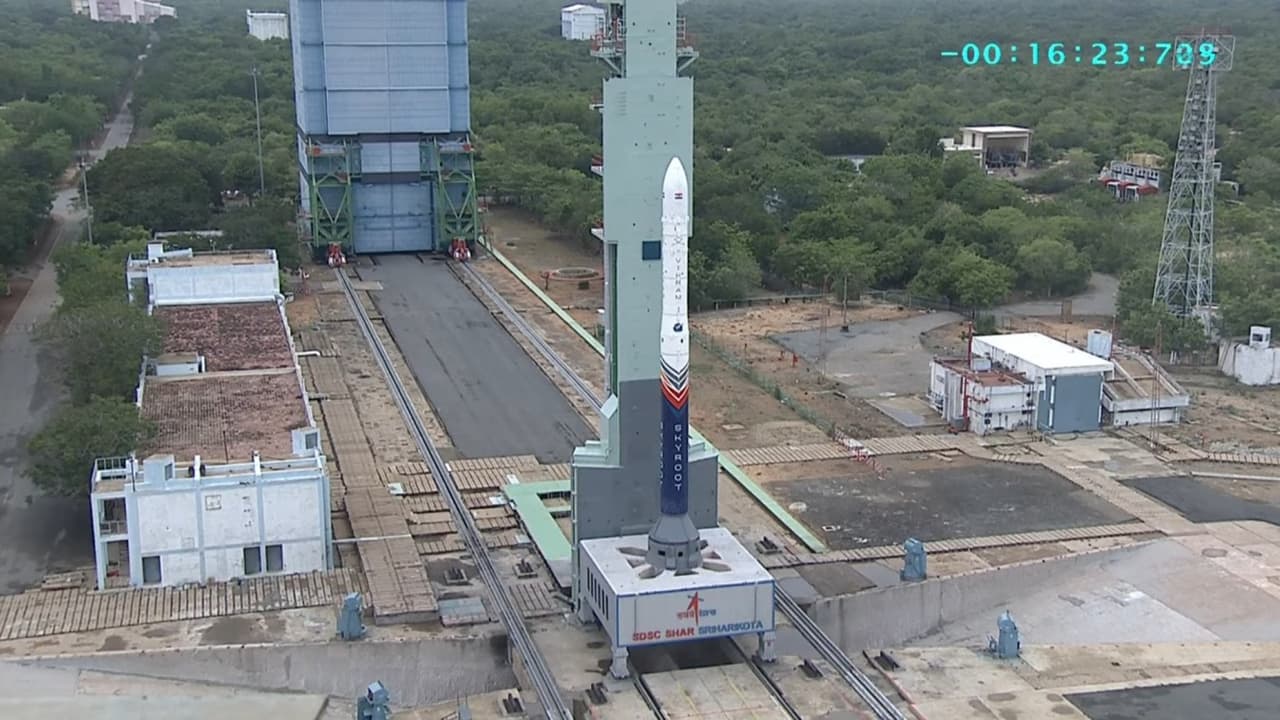
Secret flight of Vikram-1 created history! Will the secret data of ‘Mission Aagaman’ and the powerful Vikram-II cryogenic engine arriving in 2027 change India’s dominance in space forever? Know the secret of this space mission.
Commercial Satellite Launch: A new history has been written in India’s space sector. Skyroot Aerospace’s Vikram-1 successfully flew as the country’s first privately developed orbital rocket, proving that India is no longer limited to government space missions only. But the biggest question after this historic launch is – is this just the beginning? Is Skyroot now preparing to challenge companies like SpaceX, Rocket Lab in the global launch market? Let us know what is the next roadmap of Skyroot after the success of Vikram-1.
Mystery of ‘Mission Arrival’: 15 minutes that changed the definition of space
In the world of space, every second is a heartbeat. Those 15 minutes after take-off were extremely tense, when Vikram-1 was moving forward through the Earth’s atmosphere. But the hard work of Skyroot engineers paid off and the rocket successfully placed the customer’s payloads into a 450 km Low Earth Orbit (LEO). This mission was not just a test, but it is like a secret weapon that will open the way for future commercial operations. The data collected during this flight reveals the true strength of the rocket’s propulsion, avionics, telemetry, guidance and control systems. Now the question is, will Skyroot be able to convert this success into a big business?
Scroll to load tweet…
History is made… but the real story begins now!
‘Mission Aagaman’, launched from the Satish Dhawan Space Center in Sriharikota, gave a new identity to India’s private space industry. About 15 minutes after take-off, Vikram-1 successfully placed all its planned payloads and orbital experiments into a Low Earth Orbit (LEO) of approximately 450 km. With this, India has joined the select countries where a private company has successfully launched an orbital vehicle. But experts believe that this achievement is not just a successful mission, but the door to a huge business opportunity for the years to come.
After all, why is ‘Mission Arrival’ being considered so important?
The first flight of each new rocket is not just a launch, but the foundation for an entire future launch series. During ‘Mission Arrival’, Skyroot tested the rocket’s propulsion system, avionics, telemetry, guidance, navigation and control systems under realistic space conditions. The data obtained from this mission will help make future commercial launches more safe, reliable and economical. This is why this flight is being considered the most important technical test for Skyroot.
From Vikram-S to Vikram-1… how big a leap?
Vikram-S, launched in 2022, was only a sub-orbital test vehicle, intended to demonstrate the technology. But Vikram-1 is a completely different class of rocket. It is an orbital launch vehicle capable of delivering satellites to low Earth orbit. This means that Skyroot has now moved towards becoming a company that provides actual satellite launch services and not just a technology showcase.
Scroll to load tweet…
What is the biggest strength of this rocket?
Modern engineering has a big role behind the success of Vikram-1. It uses a 3D-printed rocket engine, a lightweight but strong carbon composite structure and a high-capacity solid-fuel booster. These techniques reduced the weight of the rocket, speeded up the manufacturing process and also reduced the cost. This is why Skyroot is claiming to offer services at competitive prices in the small satellite launch market.
New market of space: Is the rideshare adventure about to begin?
After the success of Vikram-1, now Skyroot is preparing to create a stir in the commercial space market. Now the day is not far when customers from India and abroad will stand in queue to send their satellites into space. Skyroot is working on two very specific strategies:
- Dedicated Launch: Where only one customer will be able to book the entire rocket.
- Rideshare Mission: Where many small payloads will travel together to space.
Be it earth observation satellites, communication spacecraft, or scientific research payloads – Skyroot is ready for every challenge. But the real suspense lies in its next step.
Mega-project of 2027: Secret upgrade of Vikram-II and cryogenic engine!
If you thought Vikram-1 was Skyroot’s final destination, you need to think again. Behind the scenes, Skyroot is working on its most powerful and secret weapon—Vikram-II, which is planned to be launched in 2027. The capabilities of Vikram-II are going to be more than double that of Vikram-1. It will be capable of carrying heavy payloads of up to 900 kg in Low Earth Orbit (LEO) and 600 kg in Sun Synchronous Orbit (SSO). But its biggest suspense element is its cryogenic engine. This engine will be more advanced and efficient than the propulsion system of Vikram-I.
As the global demand for small satellites is increasing, Vikram-II is going to prove to be a big trump card for Skyroot in winning international contracts and complex government missions. This space battle has now become very interesting!
Is India now going to become a new challenge in the global space race?
The demand for small satellites is continuously increasing around the world. Hundreds of new satellites are being launched every year in areas such as communications, internet, defence, agriculture, climate studies and Earth observation. At such a time, this is a big opportunity for an Indian private company like Skyroot. If Vikram-II is also successful and commercial launches begin regularly, India could become not just a consumer of space technology but also a major provider of global launch services.
What does this mean for India?
The success of Vikram-1 is not just a rocket launch, but a symbol of the confidence, technical capability and global ambition of India’s private space sector. Skyroot’s commercial missions and the development of Vikram-II in the coming years will determine what role India plays in the global space economy. What is certain for now is that ‘Mission Aagaman’ has taken a new flight – and this journey has only just begun.