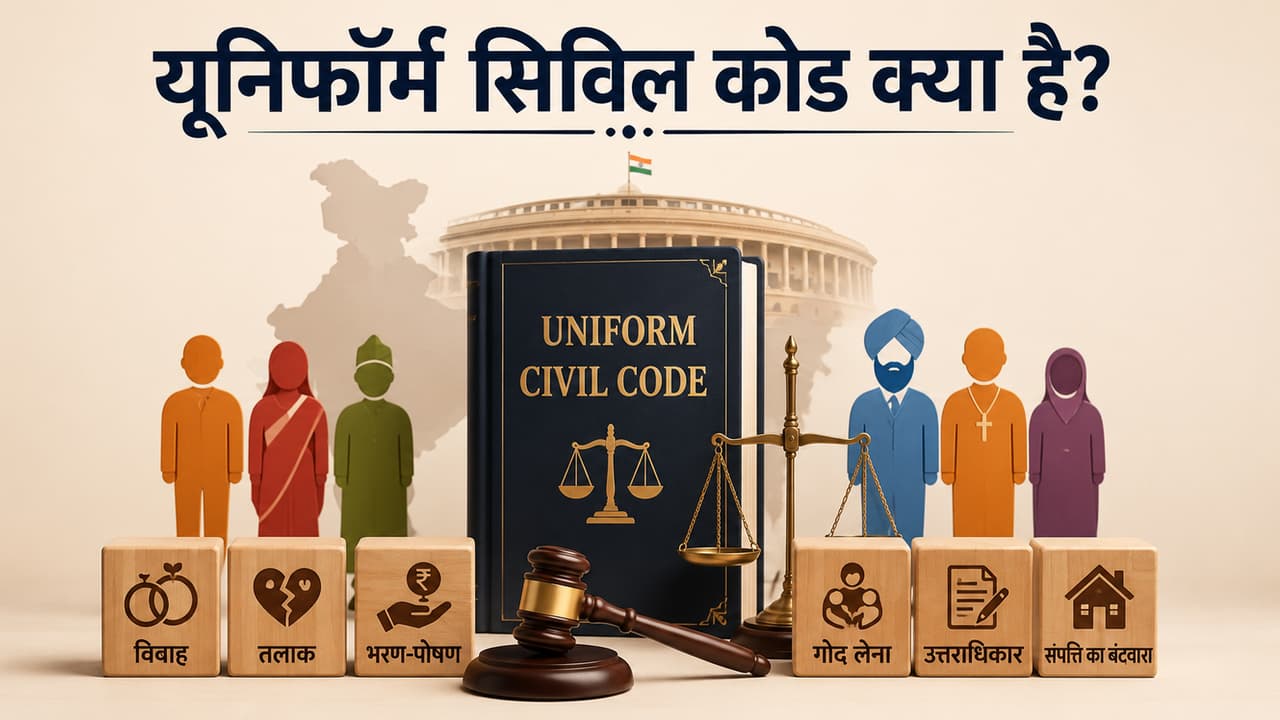
Madhya Pradesh has become the fourth state to pass the UCC bill. Know what Uniform Civil Code is, why it is needed and why it is being opposed.
UCC Explained: Madhya Pradesh has become the fourth state in India to pass UCC bill after Uttarakhand, Gujarat and Assam. On July 21, 2026, BJP’s Mohan Yadav government passed the Uniform Civil Code (UCC) bill. Its purpose is to implement uniform civil law for all citizens in place of personal laws of different religions. This law deals with matters like marriage, divorce, adoption, inheritance and division of property. BJP says that this will give equal rights to all citizens, while the opposition is calling it an issue related to religious freedom. Let us know what is UCC?
What is Uniform Civil Code (UCC)?
Uniform Civil Code is a law in which the same rules will apply to all citizens of India in civil matters like marriage, divorce, maintenance, adoption, inheritance and division of property. Currently in India, different religious communities have their own personal laws for these matters. As –
- Hindu Marriage Act and other related laws apply for Hindus.
- Muslim personal law applies in many personal matters of the Muslim community.
- Separate laws exist for Christian and Parsi communities.
Why is UCC required?
1. Equal laws for all citizens
Article 14 of the Constitution gives everyone the right to equality under law. BJP’s central government says that there should be similar rules in civil matters also.
2. Strengthening women’s rights
Political experts believe that with uniform civil law, women will get more equal rights in matters of marriage, divorce and property.
3. Simplifying the legal system
Having a uniform law instead of separate individual laws will make the legal process easier.
Why is UCC being opposed?
The opposition opposing UCC says…
- India is a country with different religions and cultures.
- Different communities have their own religious traditions and personal laws.
- Article 25 of the Constitution gives the right to religious freedom.
- Therefore, before any change, there should be a discussion with all the communities and their consent should be taken.
What subjects are covered in UCC?
In the states of India where UCC is implemented, these subjects will be included under this law…
- Marriage
- Divorce
- Maintenance
- Adoption
- Inheritance
- Succession
- Guardianship
Note: UCC is not concerned with religious worship, festivals, religious ceremonies or faith, but with civil matters.
Madhya Pradesh becomes the fourth state with UCC bill
UCC bill has so far been passed in 4 states of India. These states are – Uttarakhand, Gujarat, Assam and Madhya Pradesh. The UCC bill was passed in the Madhya Pradesh Assembly on 21 July 2026.
Is UCC applicable anywhere in India?
Goa is often considered a state where relatively uniform rules apply in most civil matters under the Goa Civil Code, which dates back to the Portuguese era. However, there are some special exceptions. Additionally, Uttarakhand has passed a Uniform Civil Code law at the state level.
What is the difference between UCC and Criminal Law?
Uniform laws are already applicable in the entire country for criminal laws like theft, murder, fraud etc. UCC deals only with personal and family civil matters. For example, suppose citizens of two different religions go to court regarding marriage, divorce or division of property. In the current system, different personal laws may apply to them. After the implementation of UCC, the same civil law will apply to both in such cases.