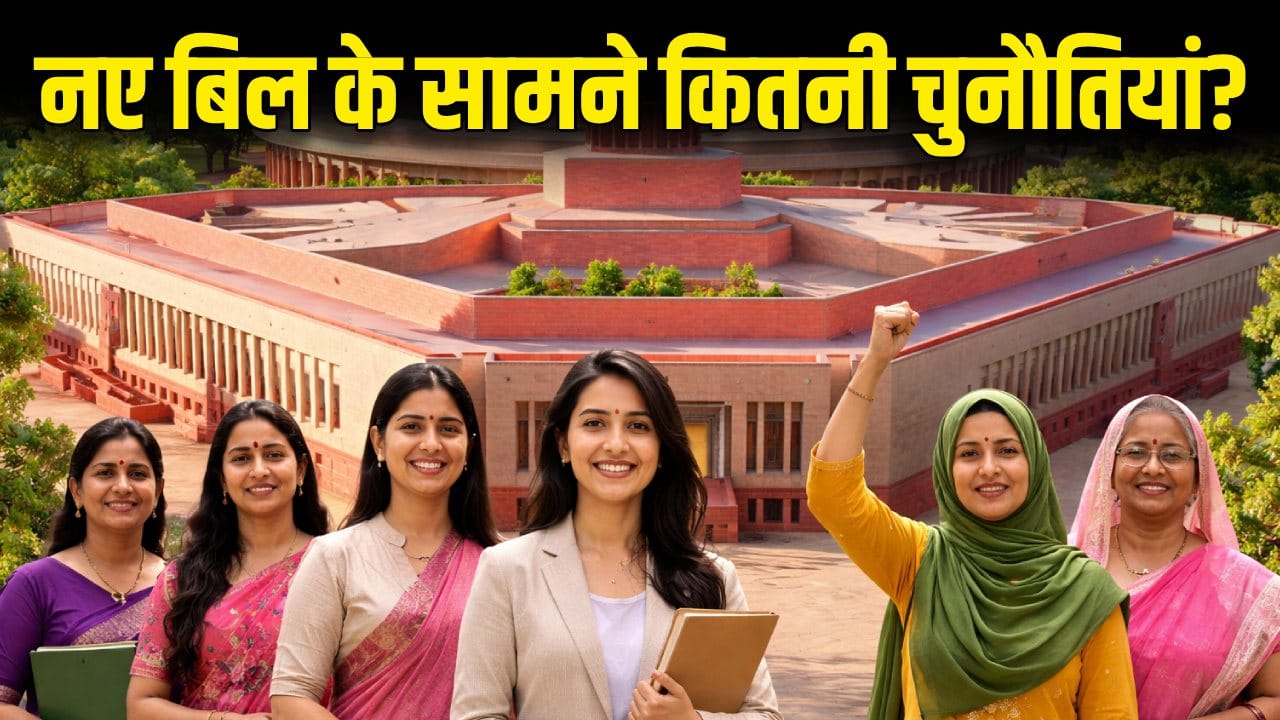
In the year 2023, the Central Government introduced a new bill on women’s reservation, it was named Nari Shakti Vandan Act.
The issue of women’s reservation has been under discussion for a long time in Indian politics. Its objective is clearly to increase women’s participation in politics. Half of the country’s population is women, but their number in the Parliament and Legislative Assemblies is relatively very less or we can even say that it is negligible. To overcome this deficiency, not only the discussion on the Women’s Reservation Bill started but several attempts were also made, but this bill could not be passed completely. Now the Nari Shakti Vandan Act has raised hopes of increasing the representation of women.
It will be interesting to see what its true nature will be revealed? But, let us now know that this bill had come before also, it has come again. What is the difference between all these bills? What will happen if it is implemented?
The first women’s reservation bill came 30 years ago
For the first time the Women’s Reservation Bill was introduced in 1996. It was called the 81st Constitution Amendment Bill. In this, there was a proposal to reserve 33 percent seats for women in the Lok Sabha and state assemblies. At that time there was a United Front government in the country. After this it was re-introduced several times but every time the bill could not reach its destination. In the year 2010, this bill was passed by the Rajya Sabha but it could not be passed in the Lok Sabha and the matter got stuck again.
There were some disputes on the old bill
There were many differences of opinion regarding the old bill. Some parties said that there is no separate reservation for women from backward classes. He believed that its benefits would be limited only to certain sections. Some leaders also said that political parties themselves should give tickets to women. There is no need to make a law. There was also opposition to the rotation of seats. Changing seats in every election can reduce the connection of leaders with their area. Due to some such reasons, this bill kept coming and getting stuck again and again.
Local reservation experience
Women reservation is already implemented in India at the Panchayat and Municipal body level. Under the 73rd and 74th constitutional amendments, one-third seats were reserved for women. Many states have increased it to 50 percent. Its impact has been positive to some extent. Lakhs of women have entered local politics. He worked on issues like education, cleanliness and health. On the basis of this experience, the demand for reservation in Parliament also became stronger.
Now the turn of Nari Shakti Vandan Act
In the year 2023, the central government introduced a new bill on women’s reservation. It was named Nari Shakti Vandan Act. This bill was brought in the special session of Parliament. This bill has been passed by both Lok Sabha and Rajya Sabha. It received widespread political support. Many parties welcomed it. Recently, former President Pratibha Devi Patil and BSP chief Mayawati have also supported the latest bill.
What are the major provisions in the new bill?
There is a provision for 33 percent reservation in the new bill also. This will apply to both Lok Sabha and State Legislative Assemblies. Women belonging to Scheduled Caste and Scheduled Tribe will also get the benefit of reservation. The reservation period has been fixed at 15 years. If needed, it can be extended further.
What is the difference between old and new bills?
The biggest difference between the old and new bills is in the process of implementation. The new bill will not come into effect immediately.For this, first there will be a census in the country. Then delimitation will be done. Delimitation means there will be a new determination of seats. The number of seats in the Lok Sabha and Legislative Assemblies will increase. Reservation will be implemented only after both these processes. Therefore, it may take some time for its implementation. This has also become the reason for criticism.
Questions are also being raised on rotation of seats
A provision for rotation of seats has been made in the new bill, that is, the reserved seats will change in every election. This will give opportunities to women from different fields but it may affect continuity. Many experts believe that this may affect long-term development plans. Because by frequently changing the area, the leaders will focus on the setting and not on the work.
Got benefit from change in political circumstances
The year 1990s was the era of coalition governments. At that time it was difficult to reach consensus on any major decision. Today there is a government with a strong majority at the Centre. Therefore it became easy to pass this bill. Apart from this, social awareness on women’s issues has also increased. This also got support for this bill.
What are the special features of the new bill?
This bill is being considered a big step towards women empowerment. With this, the number of women in Parliament will increase rapidly. At present the share of women in the Lok Sabha is around 14 percent. If reservation is implemented it will increase to 33 percent. This will increase women’s participation in policy making. Many studies show that with the participation of women, more attention can be paid to social schemes and the common people will get direct benefits from it.
Challenges and some questions too
Some questions are also being raised regarding this bill. The biggest question is the delay in implementation. It is not clear when the census and delimitation will take place. The second issue is that of separate reservation for backward class women. This demand still continues. The third issue is that of political training and opportunity. Merely reserving a seat is not enough. Political parties will also have to bring women forward in leadership.
social impact is also certain
The impact of this bill will not be limited to politics only. This will strengthen the position of women in the society. This will become an inspiration for girls. There will be a change in the role of decision making in families also.
Women’s share in Parliament in Rwanda is 60 percent
Women reservation or quota system is implemented in many countries of the world. In Rwanda, the share of women in the parliament is more than 60 percent. Even in countries like Nepal, Bangladesh and Pakistan, seats are reserved for women. This step in India is considered to be in line with the global trend.
In this way it can be said that the Women’s Reservation Bill is a big step in India’s democracy. Its objective is to give equal rights to women. The objective of the old and new bills is the same but there is a difference in the process. Now the most important thing is its implementation at the right time. When women reach Parliament and Legislative Assemblies in large numbers, then the nature of Indian politics will also change. And it will be pleasant.
Also read: Justice Verma resigns, Justice Yadav retires. What will happen now to the judges facing impeachment?