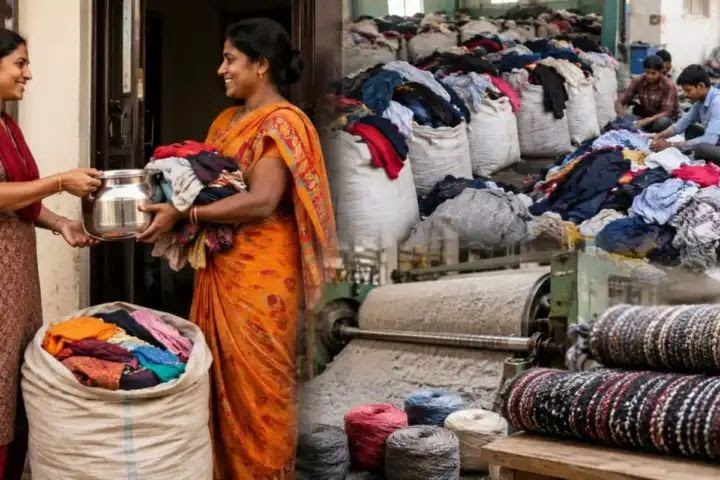
In almost every city, town and village of India, you must have seen such women who roam from street to street calling out to give old clothes and take utensils in return. Most of the people give away the old clothes kept in their house and get a steel plate, bowl, bucket, box or other household items.
This work has been going on for years and even today lakhs of families are a part of it. But very few people know what happens to these clothes after leaving the house. Are they thrown away directly, stored in a warehouse or are they reused?
The truth is that there is an entire business of used clothes, which involves thousands of traders, recycling units, second hand markets and small industries. Clothes are used differently according to their quality. This is the reason why your old clothes often do not end up in the garbage, rather they become useful to people again in some form or the other. This provides employment and also benefits the environment.
The clothes are sorted first.
Women who collect clothes from house to house do not keep them with them for long. They sell them to big traders, wholesale markets or warehouses. After reaching here, first of all the clothes are sorted properly. The clothes which are in good condition are kept separate. Those who have slight deficiencies are kept in the second category. At the same time, excessively torn, worn or damaged clothes are separated. In this entire process, the quality of clothes matters most because their further use is decided on this basis.

Good clothes reach second hand market
The clothes that are still fit for wear are cleaned and, if necessary, lightly repaired and sent back to the market. In many cities of India, there are big markets for second hand clothes where good quality clothes are available at very low prices. Low income families, labourers, students and many needy people shop from such markets. Many times second hand clothes coming from abroad are also sold in similar markets. In this way the same cloth is used by many people.
New threads emerge from spoiled clothes
The clothes which are no longer fit for wearing are also not considered waste. These are sent to the recycling unit, where they are cut into small pieces with the help of machines. After this the fibers are separated from them. These fibers are cleaned and made into thread again. This thread is later used to make many new products. Through this process, clothing waste is significantly reduced and old clothes are reused.

It is used in making these goods
The threads prepared from recycling are not only used in making rugs or carpets. Mops, blankets, mattress fillings, cushions, cleaning cloths and many other industrial products are also made from them. Some industries also use these fibers in making packing material and insulation. That is, the cloth which is no longer fit for wearing becomes a part of some other thing and then becomes useful to the people.
Not all clothing recycling is the same
Cotton, wool and other natural fiber fabrics are relatively easy to convert back into thread. But recycling of polyester, nylon and mixed fabric clothes is a bit difficult. Such clothes are separated and processed with the help of modern machines. The textile industry is constantly working on new technology so that more and more clothes can be reused.
It is also used in many industries
The fiber prepared from recycling is also used in many big industries. They are used in filling of car seats in automobile industry, cushions and stuffing in furniture manufacturing companies, packing material and many industrial products. This reduces the need for new raw materials and also reduces the cost of production. This is the reason why the demand for old clothes is not limited to the second hand market only.

It is also beneficial for the environment
Every year, millions of tonnes of old clothes are thrown away as waste across the world. If these are thrown directly into the garbage, the landfills fill up rapidly and pollution increases. Whereas by reusing and recycling old clothes, less water, less energy and less raw materials are required to make new clothes. This also reduces carbon emissions and saves natural resources. It has also been believed in many scientific studies that reusing and recycling clothes is a better option for the environment.
This business is related to the livelihood of millions of people
The business of old clothes is not limited to recycling only. People collecting clothes from door to door, wholesalers, sorting workers, second hand market shopkeepers, recycling factory workers and artisans making carpets and rugs are all involved. Lakhs of people get employment from this entire network. In India too, many new initiatives are being taken to reduce textile waste and promote recycling.
What happens to your old clothes?
When you exchange utensils for old clothes, it is not just a simple deal. A complete system works behind this. The good clothes again reach the needy and the clothes which are completely spoiled are made into new threads to make carpets, blankets, mops and many other useful items. This means that your old clothes do not get destroyed, but after getting a new life, they continue to be useful to people in some form or the other. This is why recycling of old clothes is today considered an important step towards environmental protection and sustainable lifestyle.