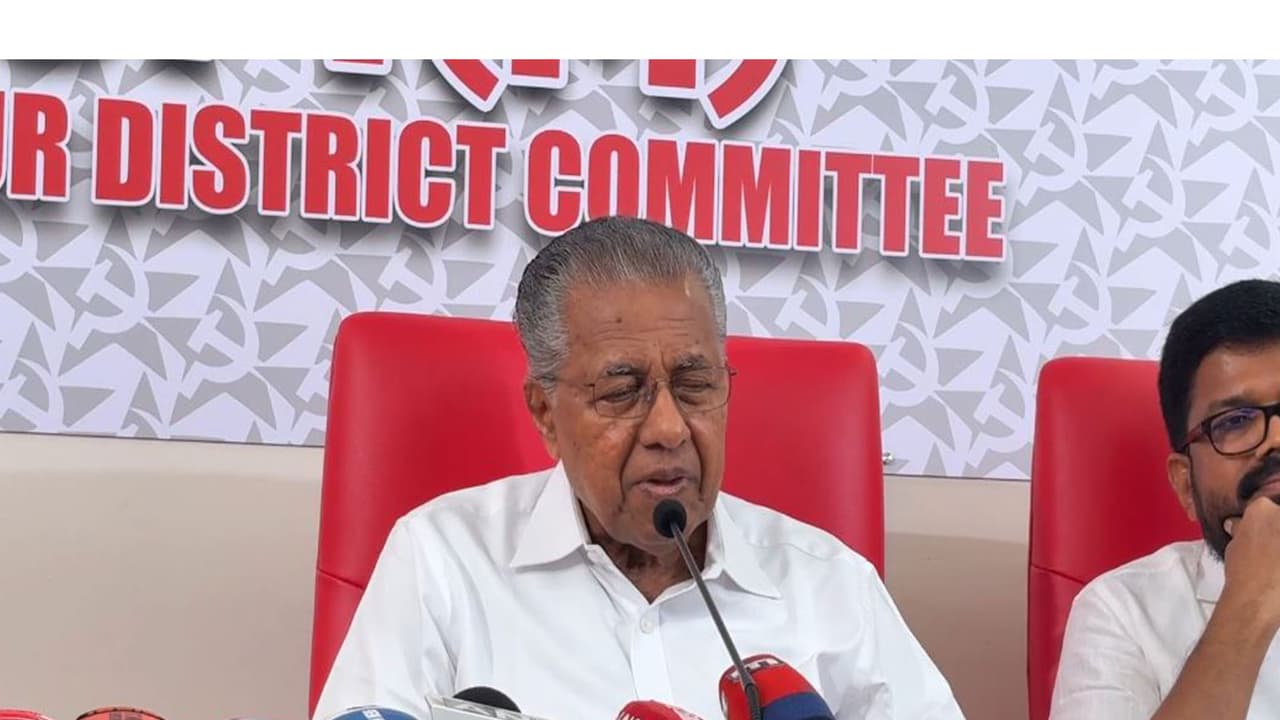
Kerala opposition leader Pinarayi Vijayan has condemned the directive to sing the full Vande Mataram, calling it an RSS agenda. He demands its withdrawal, accusing the UDF government of succumbing to ideological pressures and compromising secularism.
Opposition Condemns ‘RSS Agenda’ in Vande Mataram Directive
Escalating the political row over national symbols and state ceremonies, Keralam opposition leader Pinarayi Vijayan has strongly condemned the directive requiring Vande Mataram to be sung in its entirety during Independence Day celebrations. Calling the policy a direct imposition of the Rashtriya Swayamsevak Sangh (RSS) agenda, Vijayan demanded that the decision be withdrawn immediately.
The controversy stems from practices surrounding official state functions, including the recent swearing-in ceremony of the United Democratic Front (UDF) cabinet, where the full rendition of Vande Mataram was incorporated. Traditionally, only the first two stanzas of the song have been widely adopted and accepted alongside the national anthem to maintain inclusivity and reflect India’s secular fabric.
Reiterating historical consensus on the matter, Vijayan emphasised that the nation has never endorsed the mandatory recitation of the entire composition. “The RSS policy of singing Vande Mataram in full is not accepted by the country. The decision should be withdrawn,” Vijayan stated. “All that is needed is the first couplet.”
Vijayan also aimed at the state leadership, specifically targeting VD Satheesan and the UDF administration, asserting that adopting the full version runs counter to the historic secular stance traditionally maintained by the Congress party.
Accusing the current state leadership of political compliance, Vijayan claimed that the administration’s willingness to embrace the move highlights a deeper alignment with ideological pressures. “The extent to which the government has succumbed to the RSS agenda has been seen since the time of the oath-taking,” Vijayan remarked, arguing that modifying established protocols to include the full song alienates certain sections of the public and compromises the secular integrity of state celebrations.
Government Order and ‘Har Ghar Tiranga’ Campaign
The controversy erupted after Kerala Chief Secretary Bishwanath Sinha issued a letter on August 6 following a communication from the Union Ministry of Culture regarding the Har Ghar Tiranga campaign, scheduled from August 9 to 17 this year.
The letter said the 2026 edition of the campaign, launched in 2022 under Azadi Ka Amrit Mahotsav, had been integrated with the third phase of the nationwide commemoration of 150 years of Vande Mataram, as approved by the National Implementation Committee chaired by Union Home Minister Amit Shah. It further stated that the Government of India’s instructions regarding the recitation of Vande Mataram would be followed in full.
Legislative and Historical Context
The development comes just over a week after Parliament passed the Prevention of Insults to National Honour (Amendment) Bill, 2026, extending to Vande Mataram the protection provided to the national anthem under the 1971 law. The Bill seeks to make obstruction or insult to the national song Vande Mataram a criminal offence during the Monsoon Session of Parliament.
Authored by Bankim Chandra Chatterjee in his 1882 novel Anandamath, Vande Mataram played a monumental role in India’s freedom struggle, serving as a rallying cry for nationalists.
However, debates surrounding its public recitation date back to the pre-independence era, specifically during the 1937 Indian National Congress session led by Jawaharlal Nehru, Subhas Chandra Bose, Maulana Abul Kalam Azad, and Rabindranath Tagore. While the opening stanzas invoke patriotism and praise for the motherland, later verses contain explicit imagery and references that led minority leaders and secular intellectuals to express reservations about mandating the song in pluralistic public spaces. Consequently, the Constituent Assembly of India designated Jana Gana Mana as the National Anthem, while Vande Mataram was granted equal status as the National Song, with official practice generally observing the first two stanzas to preserve communal harmony.
The latest remarks by Vijayan highlight how cultural nationalism and state protocols continue to be flashpoints in Indian regional politics. (ANI)
(Except for the headline, this story has not been edited by Asianet Newsable English staff and is published from a syndicated feed.)