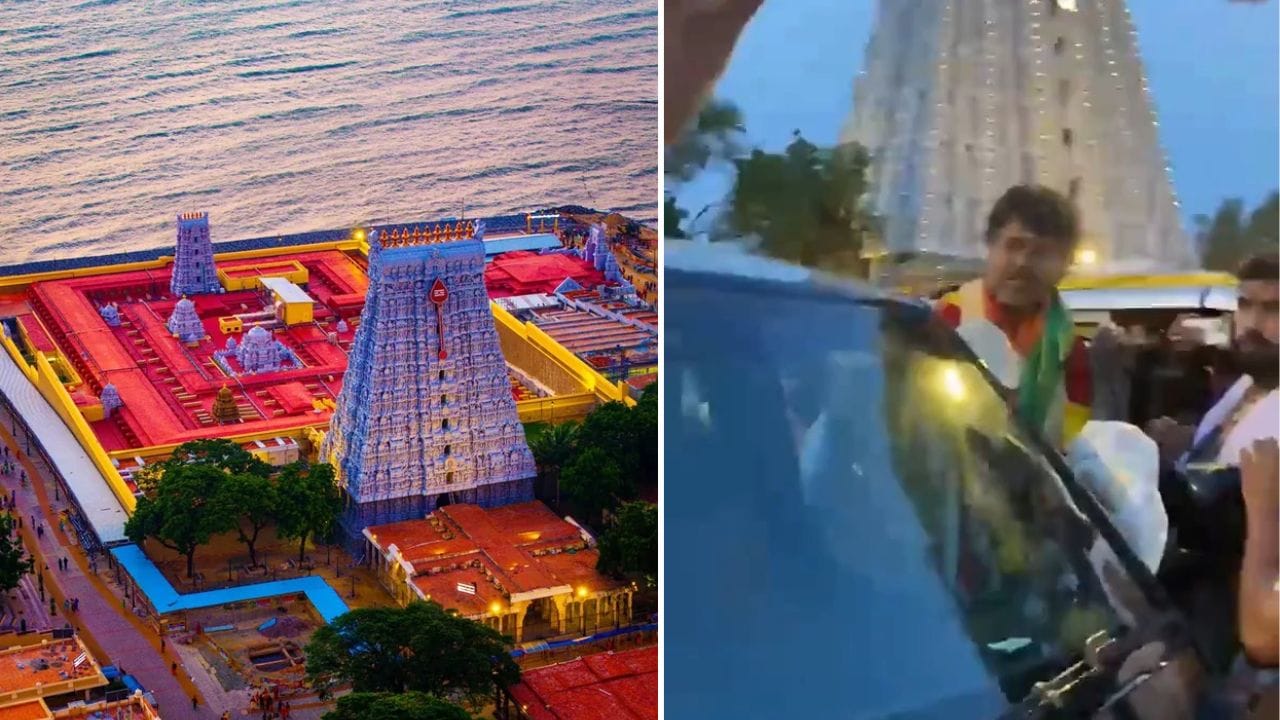
New Delhi: Tamilaga Vettri Kazhagam president Vijay reached Tiruchendur Murugan Temple in Thoothukudi district for special early morning prayers after travelling from Chennai via Madurai. He drove nearly 150 km by road to reach the coastal shrine where Lord Murugan is worshipped as Senthilandavar, one of the six sacred Arupadaiveedu abodes in Tamil Nadu. Dressed in traditional silk veshti and shirt, he was welcomed with vel spear honours and kumba mariyathai amid heavy police security managing large crowds chanting his name and TVK slogans.
The visit to this ancient coastal temple, linked with a 2,000-year-old legacy and Tamil devotional literature, carried both personal faith and political significance ahead of the 2026 Tamil Nadu assembly elections. It is one of the most revered Murugan shrines on the Bay of Bengal, drawing thousands of devotees daily for early morning darshan and cultural reverence while retaining strong spiritual importance across Tamil Nadu pilgrimage circuits and remains a key symbol of Murugan devotion and heritage. Explore more about this temple here.
About Tiruchendur Murugan Temple
Tiruchendur Murugan Temple, also known as Arulmigu Subramaniya Swamy Temple, stands on the Bay of Bengal in Tamil Nadu’s Thoothukudi district. The shrine is located around 40-55 km from Thoothukudi city and is regarded as the second among the Arupadaiveedu, the six sacred abodes of Lord Murugan.
Ancient Tamil texts such as Thirumurugatruppadai mention its spiritual importance, placing it firmly within early Tamil devotional history. Legends describe Lord Murugan defeating the demon Surapadman here and later worshipping Lord Shiva in gratitude, while divine architect Mayan is believed to have designed the original structure.
Key features of Tiruchendur Murugan Temple
The temple is known for its 157-foot, nine-tier rajagopuram and its rare coastal setting, making it the only major Murugan shrine located by the sea. It was originally built on sandstone reefs and later expanded by Pandya and Chera rulers.
Historical accounts mention Portuguese involvement during conflicts in the 17th century, followed by recovery of the main idol by devotees. The temple complex was reconstructed in black granite over 72 years, with Kumbhabhishekam completed in 1941.
Its western-facing entrance is another unusual feature among South Indian temples. During the 2004 tsunami, the sea reportedly retreated without damaging the shrine, strengthening local faith in its divine protection.
The Tiruchendur Murugan Temple continues to stand as a living symbol of devotion, history and coastal faith, drawing pilgrims across generations.