Metals and mining major Vedanta Ltd will announce its Q4 earnings on Wednesday, April 29, 2026. Ahead of quarterly earnings, Vedanta released its Q4 business update early this month.
The company reported record output across multiple businesses. In aluminium, the company recorded quarterly aluminium production at 613 kilotonnes, up 2% YoY realised mainly due to operational efficiencies. Meanwhile, alumina production was highest-ever on a quarterly and yearly basis at 882 kilotonnes, up 104% YoY and 11% QoQ.
Zinc India reported its best-ever mined metal production at 315 kilotonnes, up 2% YoY and 14% QoQ driven by higher ore production & better grades, while saleable silver production stood at 176 metric tonnes, up 11% QoQ in line with lead production.
As per experts, Vedanta could report 20% to 24% YoY rise in consolidated revenue at ₹48,750 to ₹49,940 crore, while its net profit could jump between 128% and 135% YoY to ₹7,950 to ₹8,190 crore. High profitability could be supported by favourable metal prices for aluminium, zinc and silver. However, production costs could surge during the quarter due to supply constraints.
Vedanta reported ₹40,455 crore in revenue in Q4FY25 and ₹3,483 crore in net profit during the same period. Vedanta has set May 1, 2026 as the record date for restructuring into five separate listed entities. In an exchange filing the company said eligible shareholders will receive one share each of Vedanta Aluminium Metal (VAML), Talwandi Sabo Power (TSPL), Malco Energy, and Vedanta Iron and Steel for every one share held in Vedanta.
Ahead of the Q4 result announcement, Vedanta shares closed 0.4% lower at ₹739. So far this year, Vedanta shares have gained over 22% amid a substantial jump in precious and base metal prices in global markets.
Technical outlook
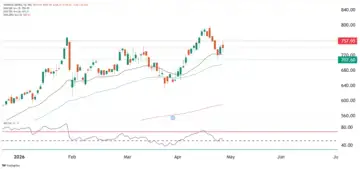
Vedanta Limited is currently in a short-term consolidation phase after a sharp upmove, with price pulling back from the ₹795 zone and finding support near the 20-day EMA . The broader structure remains constructive as the stock continues to trade above its 50-day and 200-day moving averages, indicating that the primary trend is still intact despite recent profit booking.
In the near term, ₹750-₹760 acts as immediate resistance, while ₹700-₹720 remains a strong support band. A decisive move above resistance could resume the uptrend toward recent highs, whereas a breakdown below the 20-day EMA may lead to a deeper retracement toward the 50-day average.
Options outlook
The at-the-money (ATM) strike for Vedanta’s 26 May expiry is 740, with a combined option premium of ₹16. This implies that the market is anticipating a move of about ±2.2% from the closing price on 29 April.
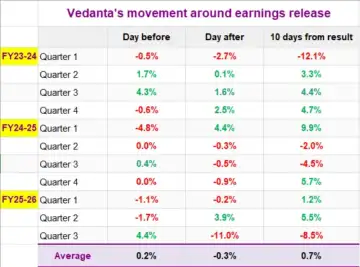
Let’s examine how Vedanta has reacted to its quarterly earnings announcements over the years to gain insights into its price movements.
Options strategy for Vedanta
Given the implied move of ±2.2% from the options data, traders can initiate either a long or short volatility trade, taking into account the price movement. To trade based on volatility, a trader can take a Long or Short Straddle route.
Straddles are the options strategies that are primarily used on the basis of volatility. In simple terms, in a Long Straddle, a trader can buy an ATM call and a put option of the same strike and expiry of Vedanta, looking for a move of more than ±2.2% on either side.
On the other hand, the Short Straddle capitalises on the fall in volatility. In a Short Straddle, a trader sells both the ATM call and a put option of the same strike and expiry. This strategy is deployed when the trader believes that the price of Vedanta after the earnings will be confined in a range of ±2.2%.
Additionally, traders expecting further bullish momentum can consider directional spreads such as the bull put spread and the bull call spread.