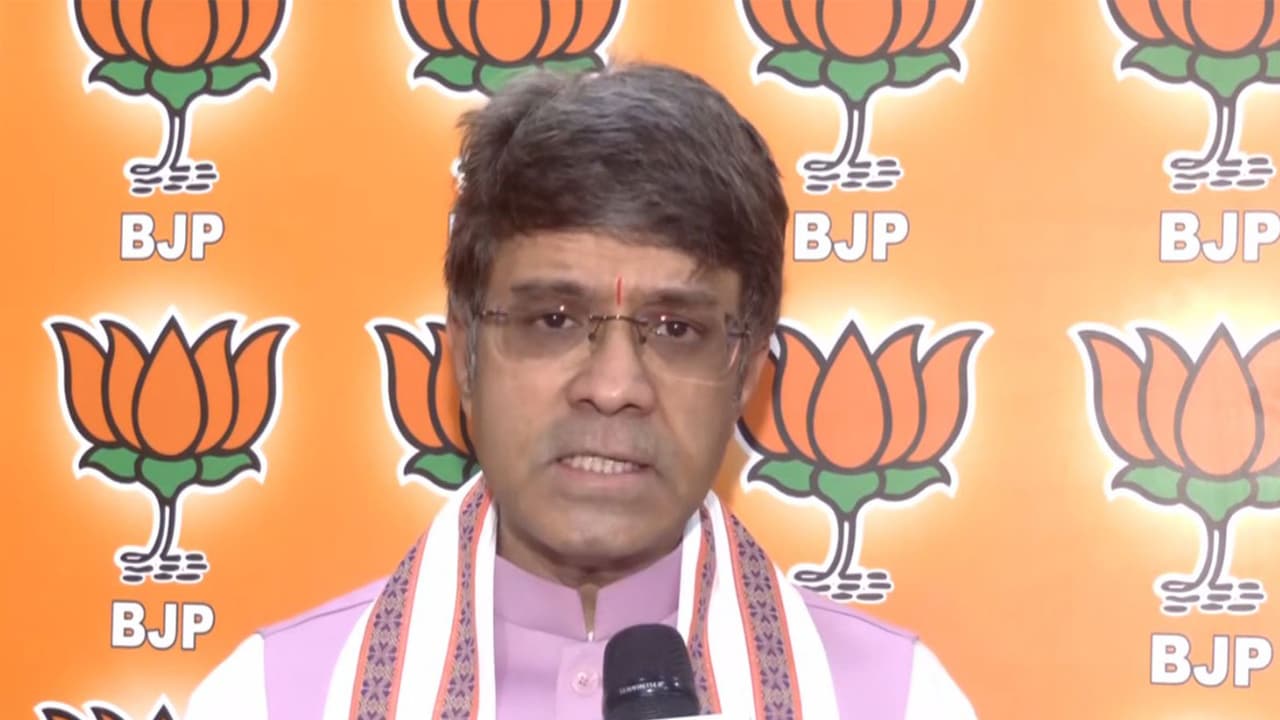
BJP spokesperson CR Kesavan criticised Congress MP Shashi Tharoor over his remarks on the full rendition of Vande Mataram being too lengthy. Kesavan alleged this dishonours freedom fighters and reflects Congress’s historical disdain for the song.
BJP Slams Tharoor Over Vande Mataram Remarks
BJP spokesperson CR Kesavan on Tuesday counterattacked Congress MP Shashi Tharoor, who questioned the practical feasibility of mandating the full six-stanza composition of Vande Mataram, arguing that requiring audiences to stand for over three minutes alongside other ceremonial anthems pushes the limits of human endurance. He criticised senior Congress MP Shashi Tharoor over his remarks that the full original rendition of Vande Mataram, which takes 3 minutes and 10 seconds, is too lengthy for people to stand through respectfully and patiently.
Responding to Tharoor, Kesavan alleged that the Congress’ position on the national song was at odds with the sacrifices of freedom fighters who, he said, gave their lives for the country’s independence while uttering “Vande Mataram”. In a post on X, he said, “Senior Congress leader states that the full original rendition of Vande Mataram which takes 3 minutes and 10 seconds is too lengthy for people to stand through respectfully and patiently. Is this not extremely ironic coming from the servile Congress party, which for more than 75 long years has patiently and sycophantically been kowtowing to the Nehru-Gandhi first family. Such callous remarks deeply dishonour and disrespect the selfless sacrifices of generations of freedom fighters who patriotically gave up their lives uttering “Vande Mataram” for our nation’s independence.”
Tharoor Cites ‘Human Endurance’ and Practicality
Tharoor noted that while the National Anthem (Jana Gana Mana) takes a concise 52 seconds, reciting the complete Vande Mataram takes 3 minutes and 10 seconds. Coupled with regional state anthems, protocol could force attendees to stand motionless for up to 12 minutes per event. “Do we really expect audiences to stand still and respectfully for six minutes before and after every function?” Tharoor asked, questioning whether compulsory duration truly fosters genuine national respect or merely physical fatigue.
Kesavan Alleges Historical Disdain from Congress
Kesavan accused the Congress party of historical disdain toward the song and pointed to long-standing ideological tensions over the composition, alleging that Congress’s hesitance stems from appeasement politics and discomfort with traditional national symbols.
He alleged that the Congress had shown disdain towards Vande Mataram over the years, claiming that the party’s approach continued from Jawaharlal Nehru to Rahul Gandhi. “From Nehru’s Congress which truncated Vande Mataram to Rahul Gandhi, bitter disdain and antipathy of the Congress party against Vande Mataram, persists. In a letter dated June 21, 1948 to Dr. Syama Prasad Mookerjee, Jawaharlal Nehru with his Macaulay colonial mindset said Vande Mataram’s tune was not suitable for foreign orchestra and bands. Nehru demeaned Vande Mataram stating it was unfit to be our National Anthem,” said Kesavan.
He praised Prime Minister Narendra Modi for restoring the respect and honour of Vande Mataram. He said, “We are truly thankful to PM @narendramodi ji for restoring the respect and honour of Vande Mataram and making sure it is rendered in its glorious original form at public events – and for the first time ever at the Red Fort this Independence Day. PM Mod ji has ensured a fitting tribute to the generations of brave heroes and heroines who selflessly sacrificed for our nation’s freedom.”
Nehru’s 1948 Letter on National Anthem Choice
Kesavan also referred to a letter dated June 21, 1948, written by Jawaharlal Nehru to Dr Syama Prasad Mookerjee, claiming that Nehru had stated that the tune of Vande Mataram was not suitable for foreign orchestra and bands.
In a letter dated June 21, 1948, to Dr. Syama Prasad Mookerjee, Prime Minister Jawaharlal Nehru explained why Jana Gana Mana was selected provisionally over Vande Mataram as the National Anthem. Nehru noted that while Vande Mataram held immense emotional value from the freedom struggle, its tune was less suited for orchestral and military band arrangements required internationally.
Former Prime Minister Jawaharlal Nehru outlined the government’s provisional adoption of Jana Gana Mana over Vande Mataram for official orchestral renditions, stating, “Personally I do not think Vande Mataram is at all feasible as a national anthem chiefly because of its tune which does not suit orchestral or band rendering. Our National Anthem has to be played by foreign orchestra all over the world… Vande Mataram is of course intimately connected with our entire national struggle and we are all emotionally attached to it… but I personally think that a song which represents poignant longing for freedom is not necessarily a song which fits in with the achievement of freedom.”
The Song’s History and Truncation
Written by Bankim Chandra Chattopadhyay in his 1882 novel Anandamath, Vande Mataram became a central anthem during the Indian independence movement. In 1937, the Indian National Congress under Jawaharlal Nehru adopted only the first two stanzas as the official national song, omitting later verses that contained devotional references to Goddess Durga. This decision was aimed at addressing concerns that the religious imagery might alienate non-Hindu communities. Critics from the BJP frame this truncation as a historical compromise or “appeasement,” while defenders view it as a secular choice to ensure inclusivity in a diverse nation.
Controversy Over National Honour Amendment Bill
Earlier, President Droupadi Murmu had given her assent to the Prevention of Insults to National Honour (Amendment) Bill, 2026, extending statutory protection under the law to the national song Vande Mataram. Congress MP Shashi Tharoor, however, has raised questions over the practical implications of requiring the full rendition of the song at official functions
In a post on social media on Tuesday, Tharoor said the amendment had been passed by Parliament without discussion and now requires the full version of the National Song to be sung at the beginning and end of official functions, in addition to the National Anthem.
Tharoor said he respected both Vande Mataram and Jana Gana Mana, adding that he could sing the first two stanzas of Vande Mataram, but not the remaining four. He said those additional stanzas had not been required at official functions until now.
The Congress MP then raised what he described as a practical concern over the amount of time audiences would have to stand during official programmes. According to Tharoor, Jana Gana Mana requires audiences to stand respectfully and focus their attention for about 52 seconds. The full rendition of Vande Mataram, he said, takes around three minutes and 10 seconds.
Historic First for Vande Mataram at Red Fort
As India prepares to mark its milestone 80th Independence Day, the historic ramparts of the Red Fort are set to witness a historic first alongside a strong national focus on youth power. In a major shift for the national event on August 15, the National Song ‘Vande Mataram’ will be sung from the ramparts of the Red Fort for the very first time. (ANI)
(Except for the headline, this story has not been edited by Asianet Newsable English staff and is published from a syndicated feed.)