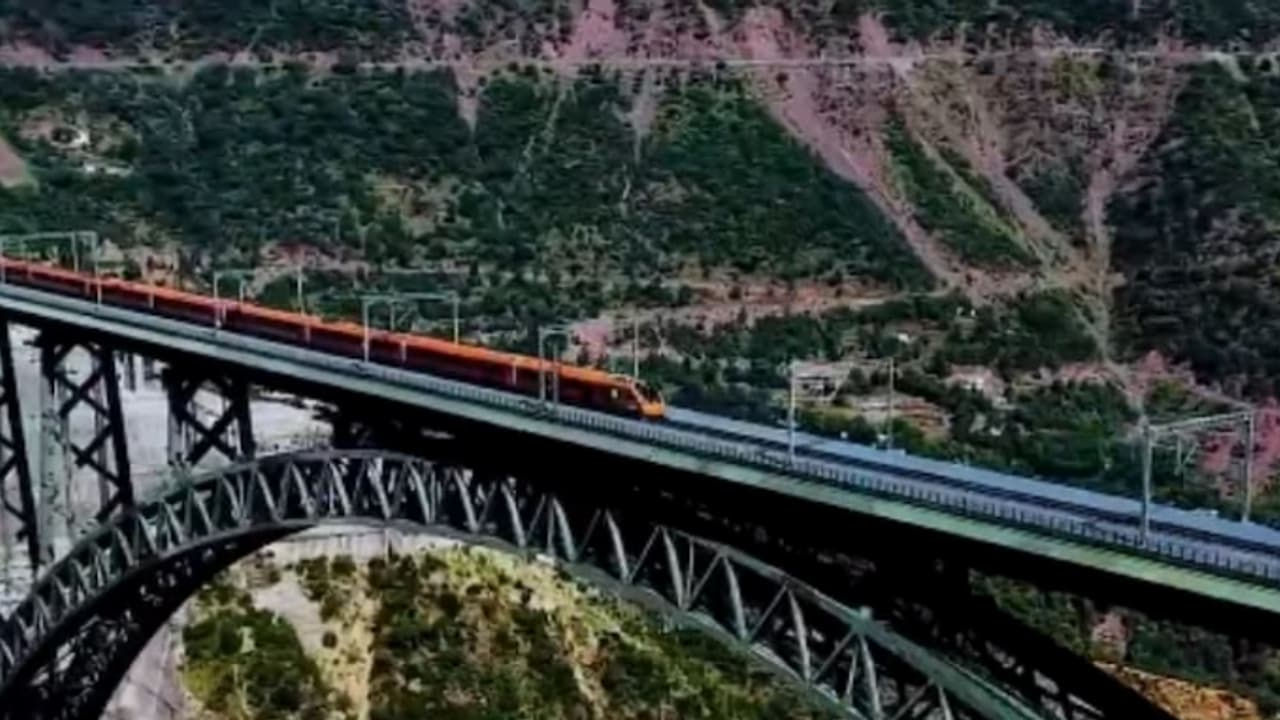
A Vande Bharat Express successfully crossed the world’s highest railway bridge over the Chenab River and India’s first cable-stayed Anji Bridge in Jammu and Kashmir at 100 kmph. This milestone occurred during a test run on the 111-kilometer Katra-Banihal section of the USBRL project.
A Vande Bharat Express has achieved a major milestone in Jammu and Kashmir, crossing the world’s highest railway bridge over the Chenab River at 100 kmph. The train also crossed the Anji Bridge, India’s first cable-stayed railway bridge, at the same speed during a successful test run on the Katra-Banihal section. The development marks another significant step in the expansion of rail connectivity to the Kashmir Valley.
The speed enhancement was tested on Thursday after the maximum permissible speed on the 111-km Shri Mata Vaishno Devi Katra-Banihal broad-gauge section was increased from 75 kmph to 100 kmph. The section falls under the Jammu division of Northern Railway and is an important component of the Udhampur-Srinagar-Baramulla Rail Link (USBRL) project.
Senior Divisional Commercial Manager Uchit Singhal said, “The maximum permissible speed on the 111-km-long Shri Mata Vaishno Devi Katra-Banihal section has been increased from 75 kmph to 100 kmph.” He added that Vande Bharat Express trains 26401/26404 created a new record by crossing both the Chenab Bridge and Anji Bridge at 100 kmph.
The dramatic moment was captured on video and shared by Railway Minister Ashwini Vaishnaw on X. Sharing the footage, Vaishnaw wrote, “100 km/h over India’s engineering pride! 🇮🇳” The Railway Ministry also described the run as the first time Vande Bharat crossed the Chenab Bridge at 100 km/h.
Watch the viral video here:
Scroll to load tweet…
Also Read: “Nicest Passenger Train”: US Filmmaker Praises Bengaluru-Hyderabad Vande Bharat, Food And Comfort
The Chenab Railway Bridge, located near Reasi, is the world’s highest railway bridge and stands as one of the most challenging engineering structures on the USBRL route. The section also features the Anji Khad Railway Bridge, India’s first cable-stayed railway bridge. The Katra-Banihal stretch passes through rugged terrain across the Pir Panjal and lower Himalayan ranges, with deep valleys, steep slopes, rivers and complex geological formations.
Building the railway line required advanced engineering solutions, including long tunnels, high-level bridges and specialised infrastructure. The 111-km section has 33 tunnels, adding to the technical complexity of the route. The Chenab Bridge itself rises 359 metres above the riverbed and spans 1,315 metres, according to government information.
The Railway Ministry approved the increase to 100 kmph after prescribed safety conditions were completed in August. Earlier, trains were permitted to operate at up to 85 kmph between Katra and Sangaldan and 75 kmph between Sangaldan and Banihal. The higher permissible speed is expected to make operations smoother, reduce travel time and offer faster and more comfortable journeys.
The latest development adds another chapter to the transformation of rail connectivity in Jammu and Kashmir. Prime Minister Narendra Modi had flagged off the Katra-Srinagar Vande Bharat Express on June 6, 2025. With the Katra-Banihal section now cleared for speeds of up to 100 kmph, the latest trial highlights the growing operational capabilities of the USBRL network and the remarkable engineering structures along the route.
Also Read: World’s Fastest Trains 2026: Shanghai Maglev To India’s Vande Bharat, See Complete List