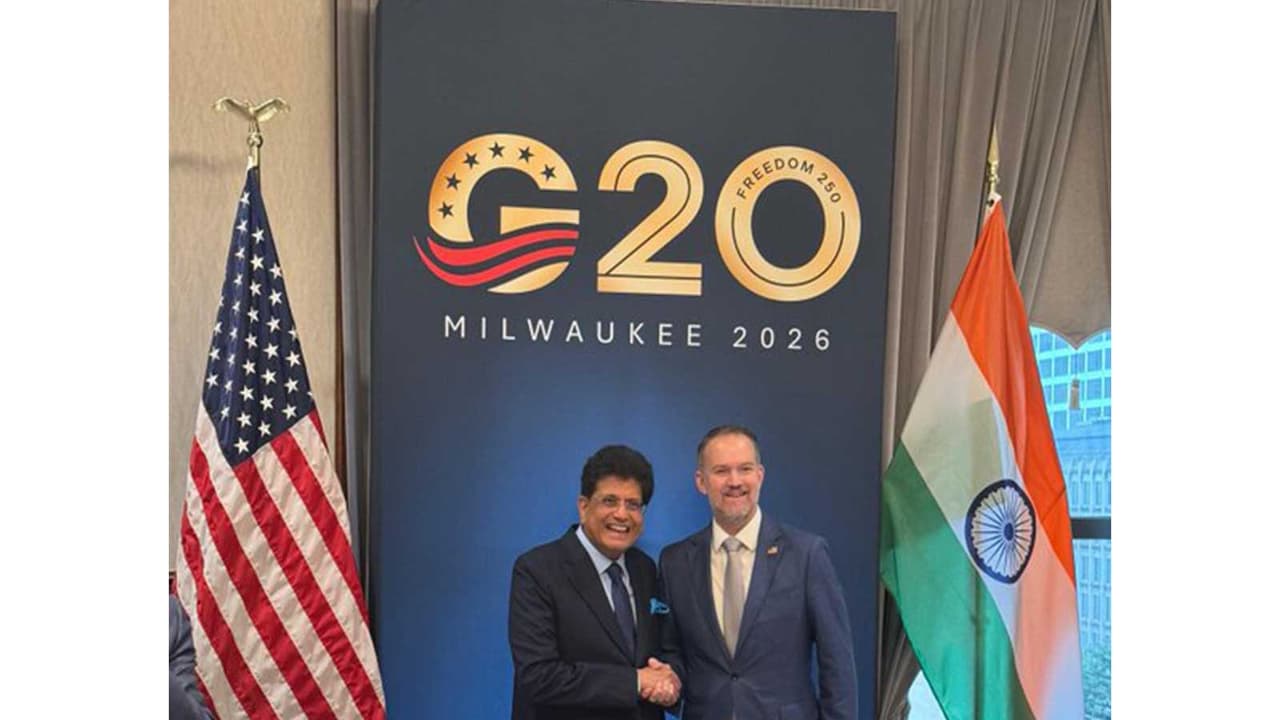
US Trade Representative Jamieson Greer opened a G20 trade ministers’ meeting calling for reform, setting priorities like MFN and steel overcapacity. Union Minister Piyush Goyal is leading India’s engagement and holding key bilateral talks.
US Pushes for Urgent Trade Reform
The speech was otherwise a call for the world to rethink how trade is governed. Greer said the world’s economies had responded to years of imbalances “mostly with talk”, adding that he wanted delegates to leave with “a clearer sense of urgency” and a recognition of the need for action. He set out four priorities for the US presidency of the G20: the “weaponisation” of food, structural excess industrial capacity, the Most-Favoured-Nation (MFN) principle and forced labour in supply chains.The most notable of these was MFN, the rule that requires countries to offer the same trade terms to all partners. Greer called it a cornerstone of the system but said it should be re-examined, arguing that when applied unconditionally, it limits countries’ ability to respond to distortive policies and changing market conditions.On excess capacity, he noted that G20 leaders pledged to tackle the problem in 2016, and ten years on, it is an even greater distortion. He added that the US had acted over the past year, using tariffs and bilateral deals to cut its trade deficit and make supply chains more resilient.He also pre-empted calls to take such discussions elsewhere, noting that while delegates often say contentious issues belong at the World Trade Organization in Geneva, “Geneva is just another city on a lake. And so is Milwaukee.” Drawing on the venue’s history, Greer recalled a 1959 speech by John F. Kennedy in the same ballroom warning of lost American competitiveness, and said his concerns remained relevant 67 years later.He also used architecture as a metaphor, citing Lina Bo Bardi, Wang Shu and Frank Lloyd Wright, noting that the lesson was that building for the future neither means discarding the past nor leaving old ideas unchanged, describing delegates as “possible architects of a new international economic order”.
Focus on Steel and US Manufacturing
Earlier in the day, G20 ministers toured a Rockwell Automation plant in Milwaukee, which Greer said was intentionally selected to showcase US factories and show the kind of economy the Trump administration wants to build, adding that the goal was for delegates to “see what we’re trying to protect.” He acknowledged the talks would not settle every issue, noting it took almost 50 years to get from the GATT to the WTO itself. Delegates are also slated to attend a reception at the Harley-Davidson Museum on the second evening.Building directly upon these discussions, Union Commerce and Industry Minister Piyush Goyal, who is steering New Delhi’s economic engagement at the gathering, joined trade ministers from the world’s major economies as they commenced the high-level talks. The gathering unfolds as the United States drives for coordinated action against global steel overcapacity and proposed changes to international trade rules.
‘Milwaukee Framework’ on Steel Excess Capacity
The opening day’s most tangible development emerged from a session of the Global Forum on Steel Excess Capacity, where participating nations endorsed a fresh framework targeting overproduction. Greer stated that the “Milwaukee Framework” would seek stronger coordinated action against excess capacity, encompassing measures addressing trade remedies, the monitoring of steel supply chains and enhanced scrutiny of transhipment.When asked if countries had agreed to increase tariffs on Chinese steel, Greer replied that individual governments would determine their own course. “Well, every country will do what they think is appropriate,” Greer said. “We want to coordinate those measures. The United States has taken robust measures, and it probably makes sense for other countries to do that too.”
India’s Bilateral Engagements and Stance
This steel-focused initiative forms part of a broader US agenda for the ministerial, which also aims to eliminate forced labour from global supply chains, update the Most-Favoured-Nation principle, oppose the weaponisation of trade in food and tackle structural excess capacity and production.Representing the nation at the ministerial, Goyal is conducting critical bilateral engagements on the sidelines. New Delhi has articulated its stance, stating it will work toward “a rules-based, open, inclusive, transparent, equitable and non-discriminatory multilateral trading system, with the World Trade Organization at its core, while ensuring adequate policy space for developing countries.” This position carries significant weight given that the United States has placed the update of the Most-Favoured-Nation principle firmly on the Milwaukee agenda.
India-US Trade Deal in Focus
The meeting coincides with efforts by New Delhi and Washington to advance negotiations for an India-US Bilateral Trade Agreement and finalise an interim trade deal. The Commerce Ministry noted that Goyal will engage bilaterally with his US counterpart “as part of ongoing efforts to advance a balanced and mutually beneficial India-US Bilateral Trade Agreement (BTA) and finalise an interim deal in line with the Joint Statement of 7 February 2026”.Trade discussions gained additional political momentum on Wednesday following a telephone conversation between Prime Minister Narendra Modi and US President Donald Trump, during which they reviewed bilateral cooperation encompassing trade, defence, energy and emerging technologies.Ahead of the formal ministerial discussions, Goyal met CEOs and senior executives of American manufacturing and technology firms at a roundtable hosted by the National Association of Manufacturers. He urged American manufacturers to deepen their footprint in the country, collaborate with small and medium enterprises, and explore co-investments geared towards advanced manufacturing and resilient supply chains, observing that the economic partnership was broadening beyond traditional commerce to embrace investment, manufacturing, technology, innovation and resilient supply chains.
Other Nations and Summit Conclusion
The event has also served as a platform for a series of parallel bilateral discussions. Canadian International Trade Minister Maninder Sidhu is attending the sessions and is slated to meet with Greer and the Indian representative on Thursday as Ottawa pursues an economic partnership agreement. Canada has indicated it will leverage the Milwaukee meeting to project itself as an “open, predictable and rules-based” trading partner while striving to diversify its trade partnerships.Russia is represented at the talks by Economic Development Minister Maxim Reshetnikov, alongside participation from Japan and other major economies.The Milwaukee meetings will continue on Thursday with further ministerial sessions, culminating in an afternoon press conference by Greer before delegates convene for their concluding session. The G20 unites major developed and emerging economies, serving as a critical forum to address frictions over trade, industrial policy and supply chains ahead of the G20 leaders’ summit scheduled to be hosted by the United States later this year.(Except for the headline, this story has not been edited by Asianet Newsable English staff and is published from a syndicated feed.)