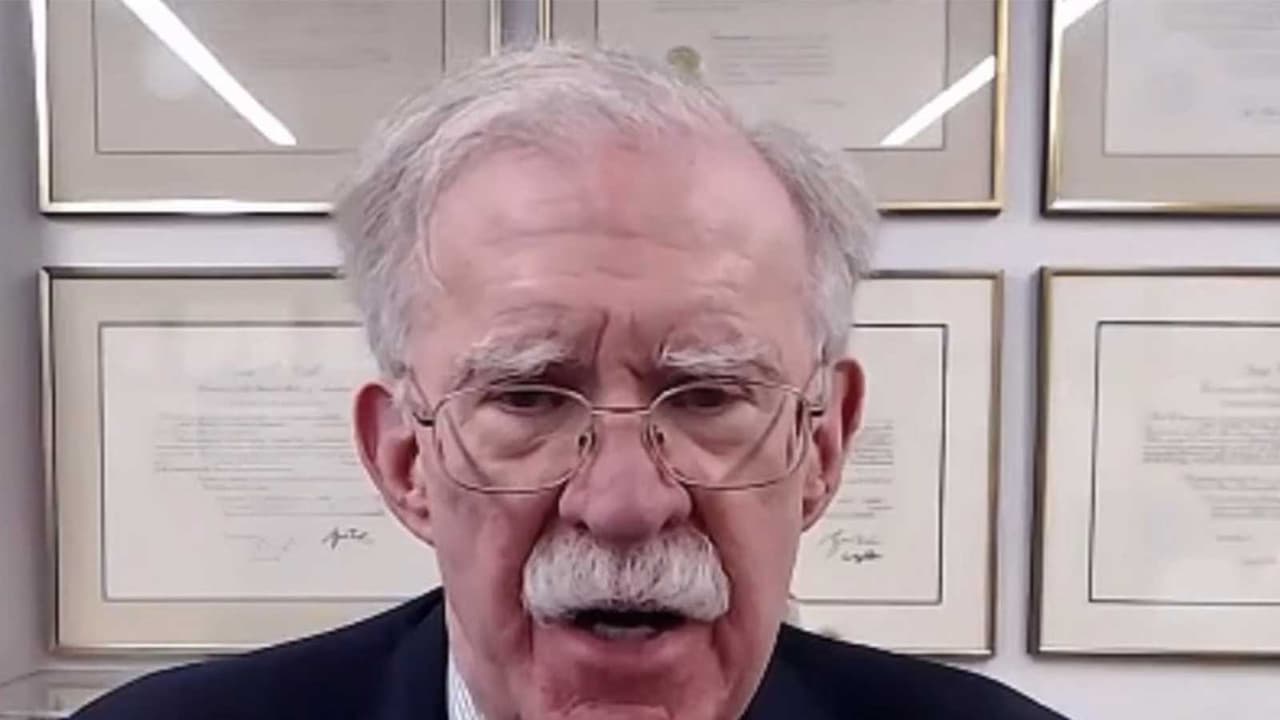
Former US NSA John Bolton has sharply criticised the new US-Iran deal, calling it ‘very favourable to Iran’. He warned it repeats past mistakes and fails to guarantee unrestricted navigation through the crucial Strait of Hormuz.
John Bolton, former US National Security Advisor to President Donald Trump, has sharply criticised the newly signed US-Iran agreement, calling it “very favourable to Iran” and warning that it repeats the same structural mistakes that plagued previous deals regarding Tehran’s nuclear programme. In an interview with ANI, Bolton argued that the agreement grants Iran significant economic and strategic concessions while failing to fully secure Washington’s core objective of guaranteeing unrestricted navigation through the Strait of Hormuz.
He said that the MoU does not restrict Tehran from charging tolls or imposing conditions on the maritime traffic through the vital naval route. “I think the deal is very favourable to Iran, and the one issue that mattered most to Trump, which is opening the Strait of Hormuz, is not fully resolved by this deal,” Bolton said. “I mean, we’ll see what happens, we’ll see whether Iran tries to charge tolls, for example, or imposes other conditions on maritime traffic. This agreement does not prohibit that,” he added.
Bolton on Trump’s Motivation
Bolton suggested that President Trump was motivated primarily by concerns over rising energy prices and the economic impact of a prolonged conflict in the region. “I think Trump has put himself in a very difficult position. It was clear he wanted out of the war; he’s worried about the price of gasoline in the United States, he wanted to release more Gulf oil into international markets to get global prices down and therefore the price in the United States, and he didn’t really care what he gave up to get it,” Bolton said.
‘A Repeat of Past Mistakes’
According to Bolton, the agreement contains generous terms for Iran, including sanctions relief and access to economic benefits, while imposing restrictions on US force deployments and potentially limiting Israel’s freedom of action. “It’s more than the Iranian regime ever could have hoped for,” he said.
Drawing parallels with the 2015 Joint Comprehensive Plan of Action (JCPOA), Bolton warned that Tehran has repeatedly secured economic concessions without fulfilling long-term nuclear commitments. “Whether it’s Iran or North Korea, these rogue states try to bargain on their nuclear programs in the same way. The first thing they say is give me a lot of tangible economic benefits upfront, and in return for those benefits down the road, I will agree to limitations on the nuclear program,” he said.
“Iran and North Korea get the economic benefits, but somehow they just never get around to putting the restrictions on their nuclear program. We have bought this horse now five or six different times with Iran alone, and Trump has just bought it again,” Bolton added.
Addressing concerns about the impact on US-Israel relations, Bolton said the broader strategic partnership between Washington and Jerusalem would likely survive the current disagreement. However, he warned that renewed oil revenues could allow Tehran to rebuild its military and regional influence. “Once it can sell oil again on the international markets, that revenue stream will resume, and the regime will not use it for the benefit of the Iranian people. It will use it to re-entrench itself in power, rebuild the Revolutionary Guard, rebuild the terrorist proxy network, rebuild the nuclear program, and the threat that was posed when the attacks began will simply appear again,” he said.
Bolton also expressed deep scepticism over Iranian assurances that it would not pursue nuclear weapons. “Iran is happy to say it won’t acquire nuclear weapons, but it is just lying when it says it,” he remarked.
Strait of Hormuz the ‘Central Test’
While acknowledging that the agreement has already been signed, Bolton said Washington should now insist on strict compliance by Tehran during the ongoing 60-day negotiation period. He stressed that freedom of navigation through the Strait of Hormuz must remain the central test of Iran’s commitment.
“The Strait of Hormuz is an international waterway, and that means there is a right of innocent passage through the strait for all commercial vessels. That means no tolls, no restrictions,” he said. “And if Iran varies from that conduct, then I think the deal’s off. That’s what I’d advise him,” Bolton added.
The Agreement and Its Defense
His comments came after US Vice President JD Vance defended the agreement, saying it had already helped restore maritime traffic through the Strait of Hormuz and contributed to declining oil and gasoline prices while opening a path toward a broader settlement with Iran.
Earlier on Wednesday, US President Donald Trump and Iranian President Masoud Pezeshkian virtually signed a 14-point Memorandum of Understanding (MoU) aimed at ending hostilities between the two countries, reopening the Strait of Hormuz and launching a 60-day process to negotiate a final agreement on sanctions and Iran’s nuclear programme. Trump signed the memorandum during a dinner hosted by his French counterpart Emmanuel Macron on Wednesday, and Pezeshkian also signed the document, bringing it into immediate effect.
The agreement provides for an immediate and permanent cessation of military operations, including in Lebanon, and commits both sides to concluding negotiations on a comprehensive deal within 60 days, with an option for extension by mutual consent. (ANI)
(Except for the headline, this story has not been edited by Asianet Newsable English staff and is published from a syndicated feed.)