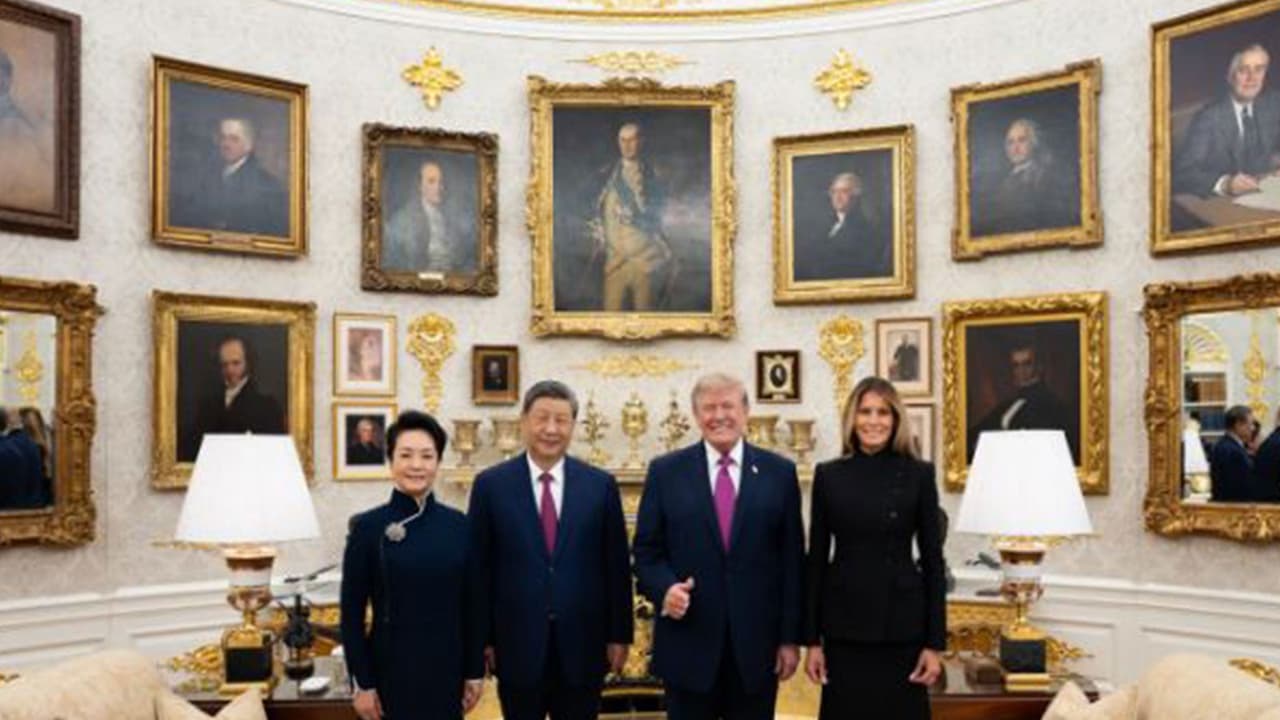
The US and China agreed to favourable tariff treatment for USD 30 billion of goods and established a dialogue on emerging technologies during Xi Jinping’s three-day summit with Donald Trump, a White House fact sheet said.
The United States and China agreed on more favourable tariff treatment for USD 30 billion of non-sensitive goods in each direction and established a new dialogue on emerging technologies during Chinese President Xi Jinping’s three-day summit with US President Donald Trump, according to a White House fact sheet.
Trade and Investment Agreements
According to the White House, the two countries operationalised the US-China Board of Trade and the US-China Board of Investment, which were chartered during the May 2026 summit in Beijing. Under the Board of Trade, Washington and Beijing reached consensus on recommendations for more favourable tariff treatment for USD 30 billion of non-sensitive goods in each direction. The board also launched a working group focused on addressing market access barriers in the agricultural sector.
Key Exports and Imports
As per the document, US exports covered under the arrangement include agricultural goods, fish and seafood, logs and wood, cosmetics and medical devices, while US imports include small appliances, toys, holiday decorations and children’s car seats. The fact sheet said China would import at least 10 million metric tonnes of US coal in 2027 and 2028. The Board of Investment will discuss investment opportunities and impediments and provide a structured channel to address commercially meaningful investment-related issues.
The two countries also continue work on supply chain shortages involving rare earths and other critical minerals, to ensure shipment levels return to appropriate levels, as per the fact sheet.
Strategic and Geopolitical Discussions
The US and China agreed to build a “constructive relationship of strategic stability” based on “respect, fairness, and reciprocity,” while supporting each other as hosts of the G20 and APEC. Trump and Xi also discussed Russia, North Korea and Iran. They agreed that Iran can never have a nuclear weapon and that “no country or institution can impose tolls on international waterways.”
Dialogue on Emerging Technologies
On emerging technologies, the two countries agreed to use the term “super intelligence” for applicable technologies and established the US-China Super Intelligence (SI) Dialogue to exchange views on its risks and benefits.
The next SI exchange is scheduled to take place by November 2026, while the two countries will also establish a bilateral communication channel for SI incidents.
Summit Conclusion and Future Meetings
The leaders also recalled the US-China alliance during World War II, and Trump advocated for trilateral arms control negotiations between the United States, Russia and China. The three-day summit between Xi and Trump concluded on Friday (local time), while Xi later returned to Beijing on Saturday (local time).
The US President said he looked forward to his next meeting with Xi, with the two leaders scheduled to meet again in China in November and at the G20 summit in Miami in December. In a post on Truth Social, Trump said, “President Xi and Madam Peng have just left D.C., heading for China. The meeting was one of Friendship, Strength, and Success, for both China and the U.S.A. We will be meeting again in November, in China, and then at the G20 in December, in Miami, Florida. Much has been, and will be, accomplished. I look forward to our next meeting!”
Xi Jinping’s three-day visit to the US marked his second meeting with Trump in less than six months. This marked the first visit to the White House by a Chinese President in more than a decade — and the first time a Chinese leader has made two formal state visits to the United States. (ANI)
(Except for the headline, this story has not been edited by Asianet Newsable English staff and is published from a syndicated feed.)