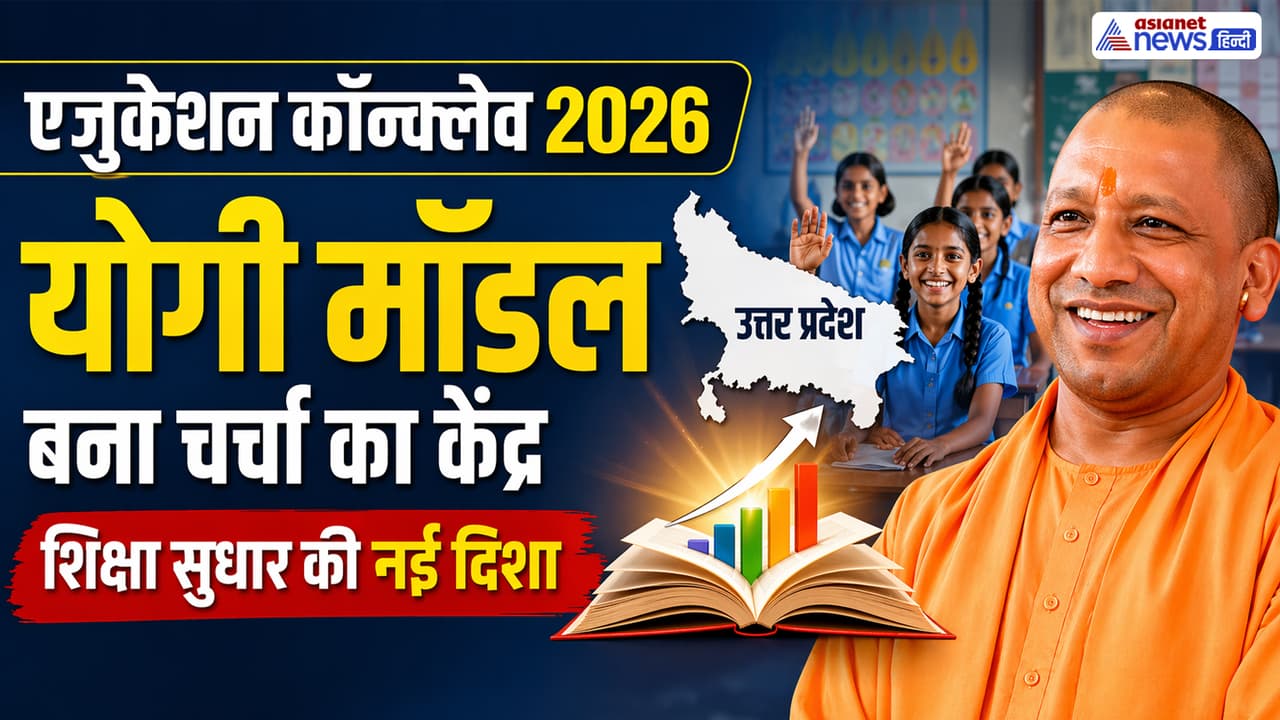
In the Education Conclave 2026, the Yogi model of Uttar Pradesh emerged as a prime example of education reform. A major change was seen in the education system in the state through FLN, AI, EdTech, continuous evaluation and teacher empowerment.
Lucknow. The ‘Yogi Model’ of Uttar Pradesh emerged prominently in the Education Conclave 2026 organized for education reform in the country. At this national forum organized by Central Square Foundation (CSF), Additional Chief Secretary, Basic and Secondary Education Department, Partha Sarathi Sen Sharma presented in detail the changes in the education system of the state. The model of Uttar Pradesh was especially discussed among the policy makers, education experts and administrative officials of different states participating in the program.
New changes in education: Focus on FLN, ECCE, AI and EdTech
Along with improving the evaluation system, important topics like Foundational Literacy and Numeracy (FLN), Early Childhood Education (ECCE), Artificial Intelligence (AI) and use of EdTech were discussed in detail in the conclave. Under ‘Nipun Bharat Mission’, experiences and successful models of different states were shared, which helped in finding better ways for education reform.
Shift from goal based learning and continuous assessment
Additional Chief Secretary Partha Sarathi Sen Sharma said that education reform in Uttar Pradesh has been taken forward on the basis of clear goals, continuous evaluation and strong teacher system. ‘Goal based learning’, regular assessment and teacher-centric approach have given a new direction to the education system. Instead of keeping the schemes limited to papers only, they have been effectively implemented on the ground, due to which the quality of education has improved.
Teacher Empowerment and Accountability System Initiative
He said that the state government has laid special emphasis on supporting teachers and increasing their participation. The progress of the students is being continuously monitored through mentor cadre like ARP (Academic Resource Person), communication through cluster meetings and ‘taalika’. This has made the education system more accountable and result-oriented.
Corrective Assessment and Real-Time Monitoring
The evaluation system in the state has been developed as a tool of improvement rather than as a medium of punishment or reward. Its objective is to identify the weaknesses of the students and overcome them, thereby improving the actual learning outcomes. Schools that are finding it difficult to achieve proficiency are being provided with ongoing guidance and support.
Education system strengthened by technology
Effective use of technology has established real-time connectivity between the administration and teachers. This has made it possible to take quick decisions and implement plans effectively. This system has emerged as a major strength of the education system.
Expansion of successful models and institutional strengthening
The emphasis is on identifying successful processes and practices and implementing them across the state, rather than limiting the strategy to just ‘Nipuna Vidyalayas’. This is promoting the expansion of the education model as well as institutional strengthening.