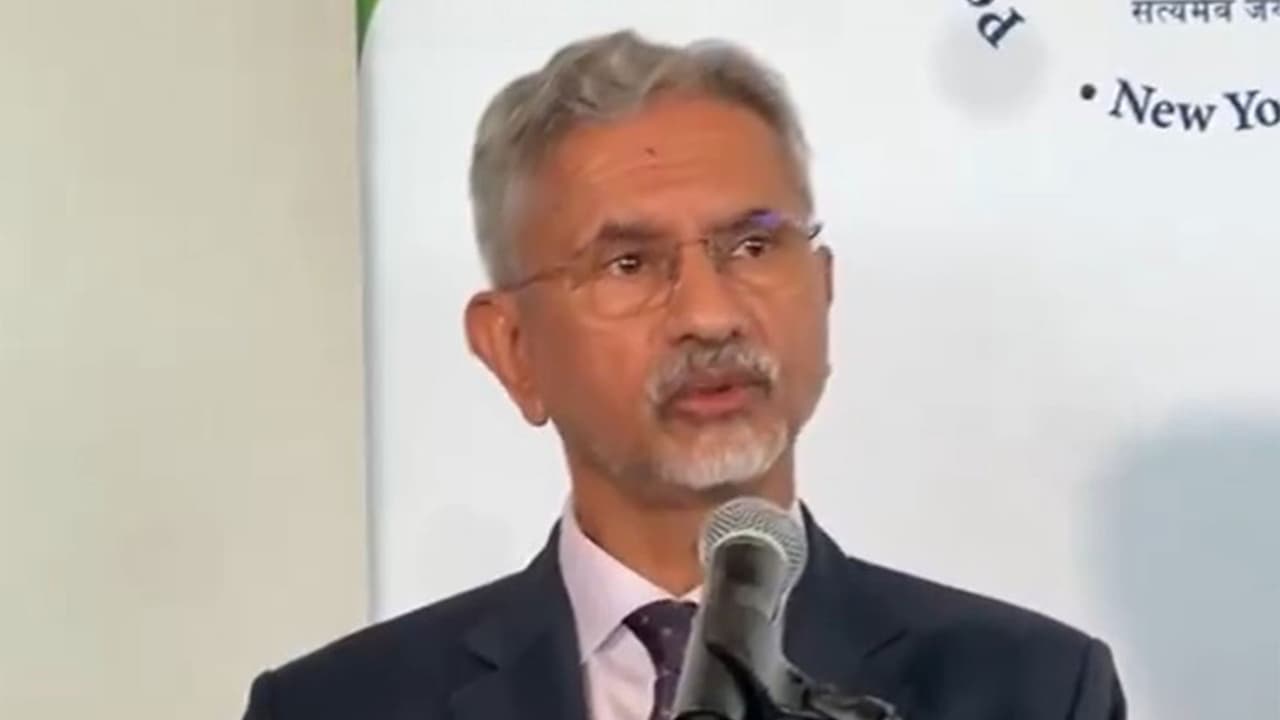
EAM S Jaishankar said India will prioritise countering terror financing, maritime security and responsible AI use as its agenda for the UNSC 2028-29 term, during the launch of its campaign for a non-permanent seat at the UN Headquarters.
External Affairs Minister S Jaishankar on Monday (local time) said India will prioritise countering terror financing, enhance maritime security and the responsible use of emerging technologies, including Artificial Intelligence (AI), as part of its agenda for the United Nations Security Council (UNSC), if elected as a non-permanent member for the 2028-29 term.
Countering Terror Financing
Addressing member states at the UN Headquarters during the launch of India’s campaign for a non-permanent seat on the UNSC, Jaishankar said terrorism continues to be one of the world’s most pressing challenges and called for greater international focus on dismantling its financial networks. Jaishankar said India remains committed to countering terror financing and would encourage “objective and evidence-based proposals” for the listing of terrorist groups.
“Even as the world strives to sustain growth and promote prosperity, some long-standing challenges continue to confront us. Significant among them is terrorism. For far too long, our efforts have concentrated on countering its symptoms. But that would only give us limited results unless we are focused on constricting its resource base. Our commitment is to concentrate on countering terror financing and encourage objective and evidence-based proposals for the listing of terrorist groups,” he said.
Enhancing Maritime Security
Highlighting maritime security as another key priority, the External Affairs Minister said recent developments have reinforced the need to ensure the safe and uninterrupted flow of global maritime commerce in accordance with international law. Jaishankar said India has consistently contributed to maritime security through search and rescue operations, humanitarian assistance and disaster relief (HADR), capacity building and the sharing of best practices.
He noted that India’s International Fusion Centre has anchored a cooperative network covering the entire Indian Ocean region and said New Delhi would work to ensure maritime security receives the attention it deserves at the Security Council.
“In an era where supply chains connect our economies, the world is also increasingly focused on securing the maritime commerce. Recent events have only underlined the need to do so. The challenge begins with ensuring adherence to relevant international law… Our collective interest is in maintaining safe and unimpeded flow of maritime commerce where required. Nations with requisite capabilities must cooperate to combat piracy as well,” EAM said. “The safety of seafarers is another major concern thrown up by developments in the country, promoting search and rescue missions, providing humanitarian assistance and disaster relief, HADR, and encouraging capacity building while sharing best practices. These have all been facets where India has long been at. Our International Fusion Centre anchors a cooperative network that covers the entire Indian Ocean region. We will endeavour to ensure that these issues get the attention they deserve in the Singapore Council,” he added.
Responsible Use of Emerging Technologies
On emerging technologies, Jaishankar said Artificial Intelligence presents both opportunities and risks, requiring a human-centric approach to its governance. He said India has proposed the MANAV framework for AI, representing “Moral and ethical systems, Accountable governance, National sovereignty, Accessible and inclusive, and Valid and legitimate systems.”
“As the world evolves, striking a balance between the benefits and risks of technology gains relevance. The reason is that technology itself is impacting our daily existence in a more profound manner. Artificial Intelligence represents its cutting edge today. India has put forward a human-centric vision of AI that draws on both its capabilities and on India’s traditions. Our work for that is MANAV, which is an acronym for ‘Moral and ethical systems, Accountable governance, National sovereignty, Accessible and inclusive, and Valid and legitimate systems’,” said Jaishankar.
Referring to India’s efforts to bridge the global digital divide, Jaishankar said the country remains committed to ensuring inclusive access to AI technologies. As a nation that has contributed to bridging the global divide, the global digital divide, we stand equally committed in respect of AI. That is why the recent AI Impact Summit in India was based on a vision of ‘AI for All’. Equally important, we are also determined to counter the misuse of AI and the threats it may pose to international peace and security.” Jaishankar said. (ANI)
(Except for the headline, this story has not been edited by Asianet Newsable English staff and is published from a syndicated feed.)