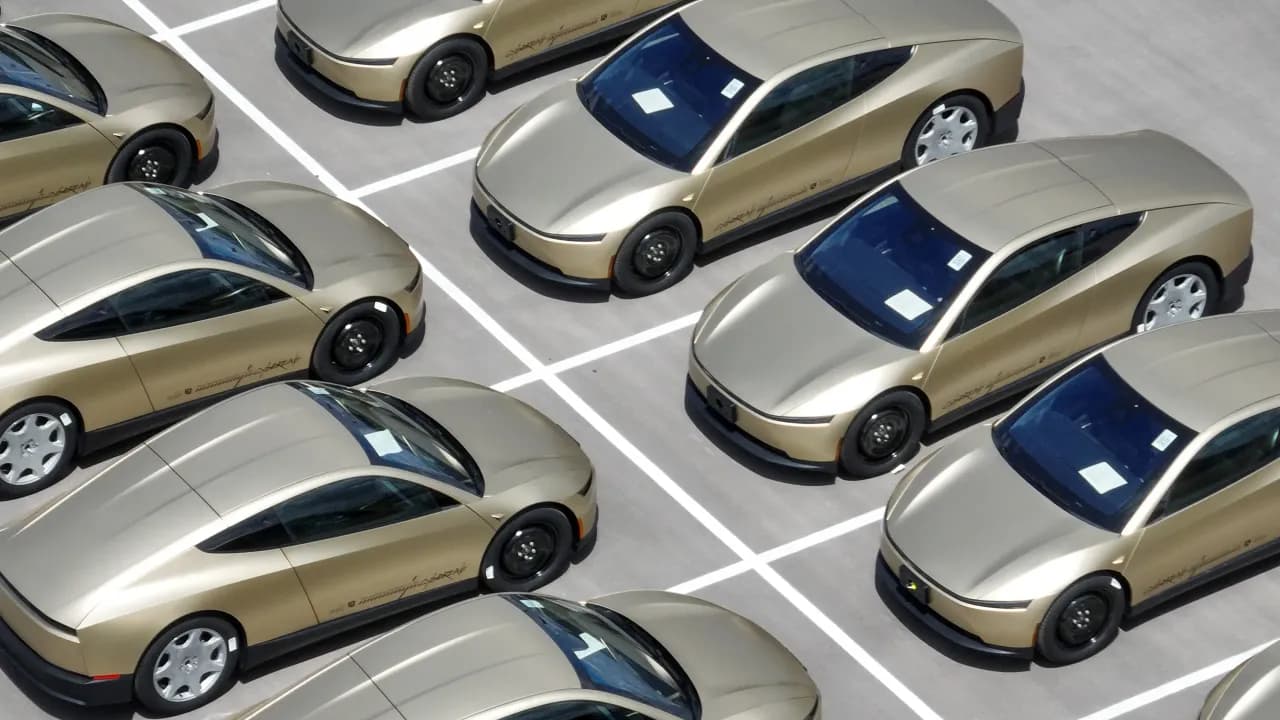
The direct integration of Starlink into the Cybercab autonomous vehicle is intended primarily for navigation, customer service and fleet management, Tesla AI chief Ashok Elluswamy said.
- Tesla prepares to scale its robotaxi fleet with the Cybercab — a purpose-built, steer-by-wire vehicle designed without a steering wheel or pedals.
- Currently, its robotaxi fleet includes Model Y vehicles.
- Earlier on Tuesday, the company announced that it has expanded its robotaxi service to Tampa and Orlando in Florida.
Tesla Inc.’s (TSLA) Cybercabs will rely on SpaceX’s (SPCX) Starlink integration for purposes besides safety, company AI chief Ashok Elluswamy said.
The direct integration of Starlink into the Cybercab autonomous vehicle is intended primarily for navigation, customer service and fleet management, the executive said, adding that it is not intended for safety purposes.
Shares of Tesla Inc. (TSLA) rose nearly 4% on Tuesday morning before trimming some gains. At the time of writing in afternoon trading, the stock was up 2.84%.
Starlink Integration On Cybercab
Tesla posted a detailed cutaway rendering of the Cybercab on Monday, highlighting “Starlink Integration” as one of several hardware elements alongside the FSD computer, multiple external cameras, antennas and interior microphones.
X user Chuck Cook called the integration “a big deal” and suggested it could become a de facto hardware requirement going forward. He noted that while Tesla vehicles have historically operated safely without constant connectivity, Starlink could improve dynamic rerouting, traffic updates, and fleet-wide sharing of real-time information such as potholes, road closures, or accidents in areas with weak cellular coverage.
“It is still not required for safe operation of the vehicle. Connectivity is primarily meant for navigation, customer service and, in general, fleet management.” Elluswamy replied to Cook.
Tesla has long maintained that its Full Self-Driving (FSD) and Automated Driving System (ADS) software rely primarily on onboard cameras, sensors and computing power, unlike some competitors who rely more heavily on cloud-based mapping and real-time data.
Tesla prepares to scale its robotaxi fleet with the Cybercab — a purpose-built, steer-by-wire vehicle designed without a steering wheel or pedals for unsupervised autonomous operation. Currently, its robotaxi fleet includes Model Y vehicles. Earlier on Tuesday, the company announced that it has expanded its robotaxi service to Tampa and Orlando in Florida.
But robotaxis continue to be plagued by safety concerns. Federal regulators received reports of at least 15–17 incidents involving the vehicles between since the start of robotaxi operations in mid-2025 and early 2026, including low-speed collisions with fixed objects such as poles, fences, and trees, as well as rear-end strikes on stationary robotaxis.
How Did TSLA Retail Traders React?
On Stocktwits, retail sentiment around TSLA stock stayed within the ‘bullish’ territory over the past 24 hours, while message volume rose from ‘low’ to ‘normal’ levels.
Users are now awaiting the company’s second-quarter earnings, slated for after-market close on Wednesday.
Another cheered the company’s decision to launch the robotaxi service in more parts of Florida.
TSLA stock has fallen 16% year-to-date.
For updates and corrections, email newsroom[at]stocktwits[dot]com.