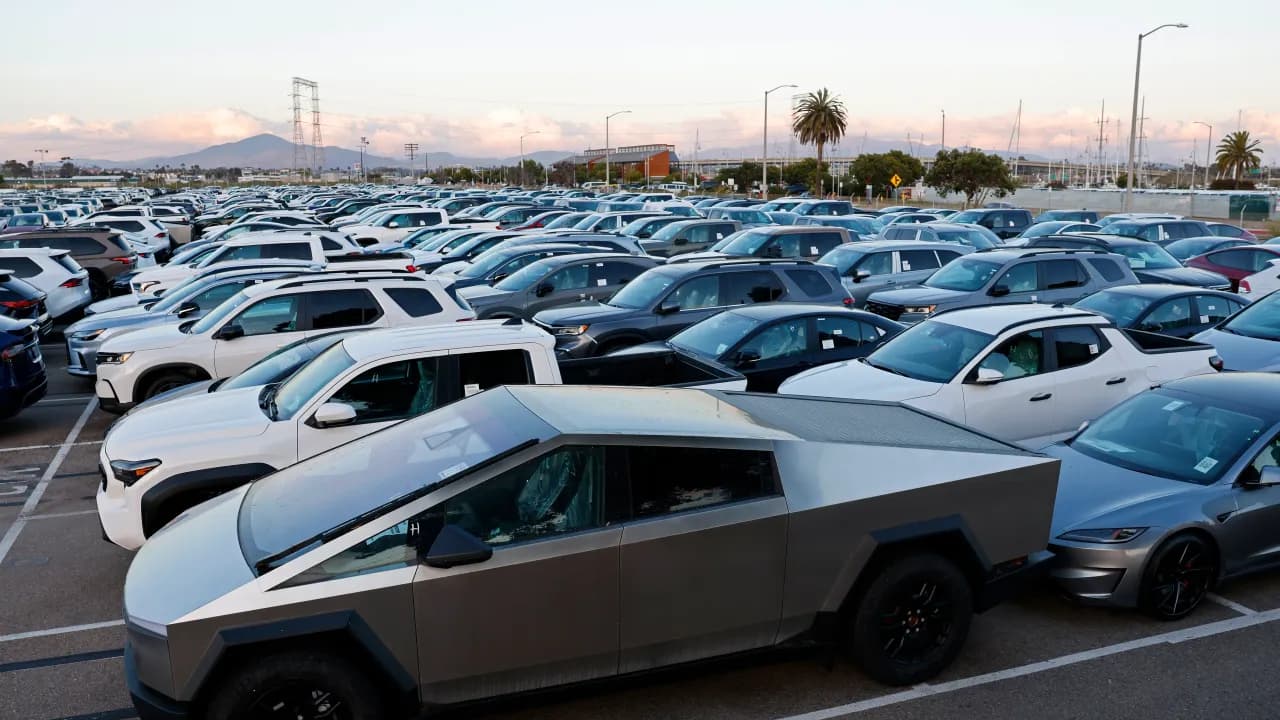
Wall Street analysts are raising their estimates for the second quarter, pointing to improving sales trends in key markets while noting Tesla’s strategic pivot away from traditional vehicle production.
- Current analyst views for Q2 2026 cluster in a 400,000-420,000 range, above last year’s figure.
- The NHTSA probe into a Tesla crash from last week continues to weigh on investor sentiment.
- RBC Capital, UBS and Goldman Sachs expect Tesla Q2 deliveries to exceed 400,000 units.
Shares of Tesla Inc (TSLA) fell 6% on Tuesday as investors digested mixed signals ahead of the company’s expected second-quarter vehicle delivery report in early July and absorbed the news of a new federal probe into a fatal Tesla crash.
Wall Street analysts are raising their estimates for the quarter, pointing to improving sales trends in key markets while noting Tesla’s strategic pivot away from traditional vehicle production. The moves come against the backdrop of a challenging 2025, when Tesla delivered 384,122 vehicles in the second quarter — down 14% year-over-year. Current analyst views for Q2 2026 cluster in a 400,000–420,000 range, above last year’s figure, and more than the 358,023 vehicles delivered by the company in the first quarter of this year.
The range of forecasts reflects ongoing debate over whether near-term vehicle volume growth can coexist with Tesla’s heavier emphasis on autonomy and robotics. While some analysts see the Model S/X wind-down as a headwind for traditional sales, others view the broader AI-focused strategy as a long-term positive. Tesla is scheduled to release official Q2 production and delivery figures in the first week of July.
TSLA Q2 Deliveries: Wall Street Weighs In
RBC Capital Markets analyst Tom Narayan projects 405,000 vehicles for Q2, above the Visible Alpha consensus of 401,000. He maintains an ‘Outperform’ rating and $475 price target. Narayan noted that the discontinuation of Model S and X production in Q2 reflects a deliberate shift toward robotaxi and humanoid robot initiatives, which could pressure traditional private vehicle sales going forward.
UBS raised its Q2 forecast to 405,000 units, representing 5% year-over-year growth and 13% sequential improvement. The firm said expectations sit in a 400,000–420,000 band and could come in higher if Tesla finishes the quarter strongly. It keeps a ‘Neutral’ rating and $364 price target.
Baird, meanwhile, projects 392,900 deliveries. The firm has an ‘Outperform’ rating and $522 price target. It highlighted a potential SpaceX-Tesla merger over the next 12–18 months as the “ultimate endgame” for Elon Musk, citing benefits of greater scale for both companies. Other near-term catalysts include Optimus robot updates, full self-driving regulatory progress in Europe, robotaxi expansion in the U.S., and the Tesla Semi rollout, it added.
Goldman Sachs previously lifted its estimate to 420,000 vehicles from 405,000, citing stronger-than-expected sales data in China, the U.S., and especially Europe, where year-over-year growth has been robust. Through May, quarter-to-date deliveries were tracking down mid-teens year-over-year, but recent trends suggest outperformance versus the roughly 400,000 consensus, it said. Goldman maintains a ‘Neutral’ rating with a $375 price target.
Fatal Tesla Crash Continues To Weigh On Sentiment
On June 19, a Tesla Model 3 driven by 44-year-old Michael Butler veered off a residential road, went airborne, and slammed into a brick home in Texas at high speed, killing 76-year-old Martha Avila inside. Butler told investigators that an automated driver-assistance system was engaged at the time. On Monday, it was reported that the National Highway Traffic Safety Administration (NHTSA) has opened a probe into the incident.
Tesla quickly pushed back on the narrative. In a post on X, the company’s head of AI and Autopilot software, Ashok Elluswamy, stated that vehicle data showed the driver had manually overridden the system by pressing the accelerator to 100% in a residential area, reaching 73 mph during the crash, with the pedal still depressed afterward.
How Did TSLA Retail Traders React?
On Stocktwits, retail sentiment around TSLA stock stayed within the ‘extremely bearish’ territory over the past 24 hours, while message volume remained at ‘low’ levels. According to the platform’s internal data, retail chatter around TSLA has jumped 493% over the past 30 days.
A Stocktwits user highlighted safety concerns around Tesla’s full self-driving technology, which is key to its self-driving aspirations.
Another user opined that investors are pulling out of TSLA stock to invest in Elon Musk’s rocket manufacturing company, SpaceX, which recently debuted on the Nasdaq.
TSLA stock has fallen 13% this year owing to multiple catalysts, including first-quarter delivery numbers trailing Wall Street expectations and a sharp increase in the firm’s capital expenditure outlook for 2026 as it focuses on AI and robotics.
For updates and corrections, email newsroom[at]stocktwits[dot]com.<