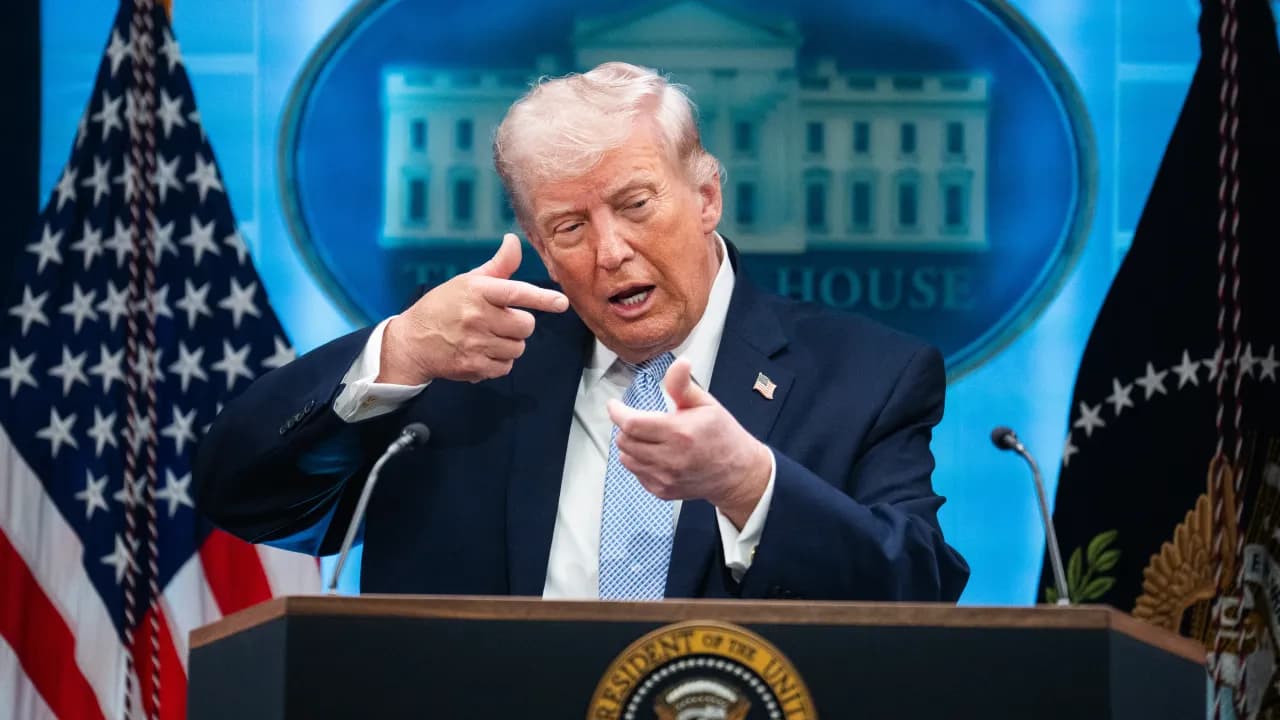
President Donald Trump touted falling crude prices and rising equities as signs that ongoing Middle East negotiations are calming investors.
- Trump said the U.S. remains committed to peace and expects a ceasefire involving Israel, Lebanon and Hezbollah.
- Brent crude reportedly slipped back toward prewar levels after the U.S. and Iran signed a peace deal.
- Major U.S. benchmark ETFs traded higher, with QQQ leading gains, while Treasury bonds also advanced.
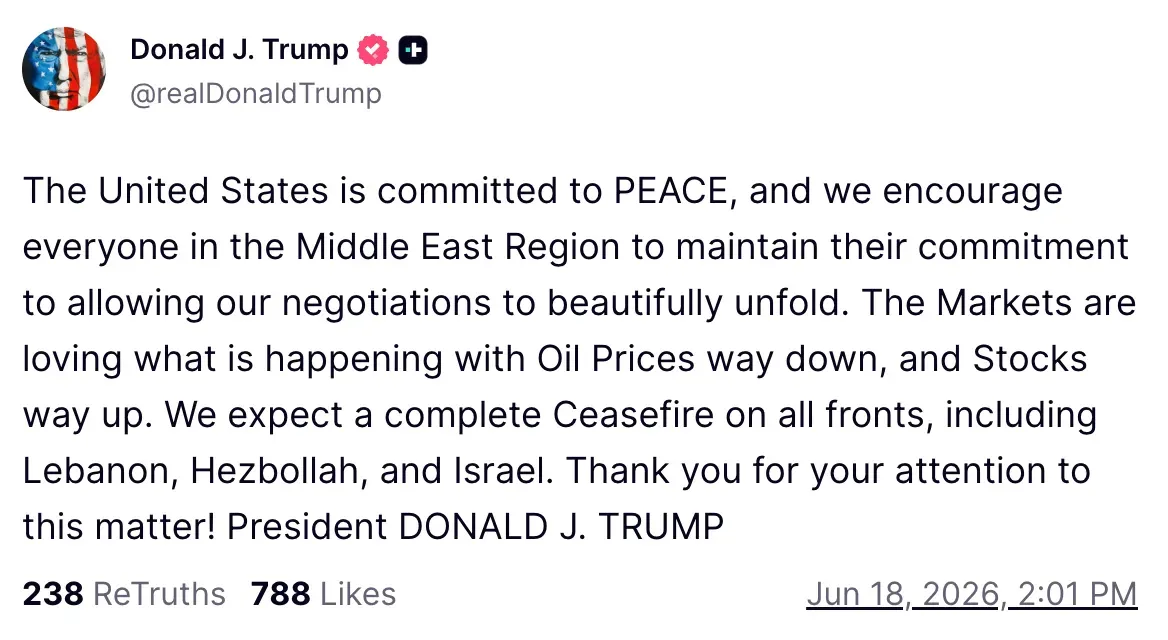
President Donald Trump said on Thursday that markets are “loving” the fact that oil prices are falling and stocks are rising as negotiations in the Middle East unfold. He added that he expects a broader ceasefire involving Israel, Lebanon and Hezbollah.
At the time of writing, U.S. equities tracking major benchmark indexes were in positive territory. The SPDR S&P 500 ETF Trust (SPY), which tracks the S&P 500, was up 1.1%, while the Invesco QQQ Trust (QQQ) gained 2.6%. The SPDR Dow Jones Industrial Average ETF (DIA) added 0.3%, and the iShares 20+ Year Treasury Bond ETF (TLT) advanced about 0.45%.
Trump Says Peace Efforts Are Boosting Markets
President Donald Trump said on Thursday that the U.S. remains committed to securing peace in the Middle East and expressed optimism that ongoing negotiations will lead to a broader ceasefire across the region.
In a post on Truth Social, Trump urged parties in the Middle East to remain committed to allowing negotiations “to beautifully unfold.”
Trump also pointed to the market’s reaction to recent developments, saying, “The Markets are loving what is happening,” with oil prices “way down” and stocks “way up.”
His comments came as investors closely monitored geopolitical tensions and their potential impact on energy markets and risk assets.
The president added that he expects “a complete Ceasefire on all fronts,” specifically mentioning Lebanon, Hezbollah and Israel. Trump did not provide further details on the status of the negotiations or a timeline for any agreement.
Oil Prices Ease On Improved Supply Outlook
Brent crude oil fell back to prewar levels on Thursday, according to a report in Barron’s, after the U.S. and Iran signed a preliminary peace deal. Investors are shifting their focus to the prospect of higher global oil supplies following the reopening of the Strait of Hormuz, a development that could also help bring down retail gasoline prices.
At the time of writing, Brent crude futures (CO1) were down 0.5% at $79.80 a barrel, while U.S. West Texas Intermediate crude slipped 0.6% to $76.59 a barrel, according to Koyfin.
U.S.-Iran Agreement Includes Shipping, Sanctions Relief
According to a 14-point memorandum of understanding signed on Wednesday night, Tehran agreed to reopen the Strait of Hormuz in return for Washington lifting its blockade on Iranian ports and easing sanctions on the country’s oil exports. Iran also pledged not to develop or acquire nuclear weapons.
However, uncertainty remains over the longer-term status of the waterway. Under the agreement, commercial vessels will not be charged for the first 60 days. Trump later told reporters that the Strait would remain “toll-free” after that period, though that commitment was not explicitly included in the memorandum, Barron’s reported.
SPY, QQQ, DIA: What Retail Sentiment Says
Retail sentiment was ‘bullish’ for benchmark-tracking ETFs, including the SPDR S&P 500 ETF Trust (SPY), the Invesco QQQ Trust (QQQ) and the SPDR Dow Jones Industrial Average ETF (DIA), while the iShares 20+ Year Treasury Bond ETF (TLT) had a ‘neutral’ reading at the time of writing.
Read Also: SPCX Bull Case Strengthens — Oppenheimer Raises SpaceX Target, Sees More Upside After Cursor Deal
For updates and corrections, email newsroom[at]stocktwits[dot]com.<