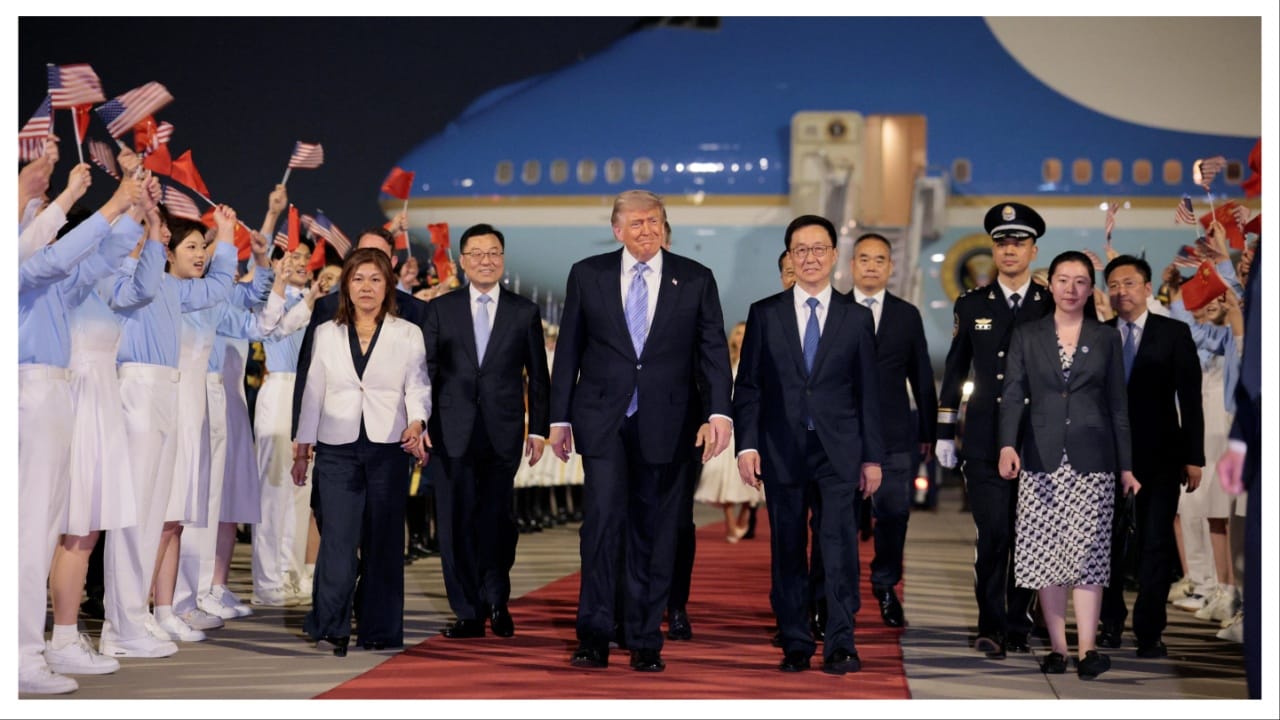
New Delhi: US President Donald Trump arrives in Beijing on Wednesday for a two-day summit that is expected to shape the next phase of relations between the United States and China. His trip marks his first visit to China since 2017 and comes at a time when tensions remain high between the world’s two largest economies.
Ahead of Trump’s arrival, China have publicly laid down four “red lines” that it said should not be challenged in China-US relations.
BREAKING: President Trump is greeted by a formal state welcome and massive fanfare in Beijing ahead of his meeting with Chinese President Xi Jinping. pic.twitter.com/7kVYWrEhsu
— Fox News (@FoxNews) May 13, 2026
The main talks between Trump and Chinese President Xi Jinping are scheduled for Thursday and Friday. A state banquet and several official events are also part of the visit. In a post shared by the Chinese Embassy in Washington, Beijing identified four red lines as Taiwan, democracy and human rights, political systems and China’s development rights as issues it considers non-negotiable.
The four red lines in #China–#US relations must not be challenged. #ChinaUSRelations #ChinaDiplomacy pic.twitter.com/4kmNeEWLGH
— Chinese Embassy in US (@ChineseEmbinUS) May 12, 2026
Taiwan set to be key flashpoint
The Taiwan issue is expected to dominate discussions during the summit, especially after the Trump administration approved a $11 billion weapons package for Taiwan last December. This will be the largest deal of its kind in recent history.
China has once again opposed US military support to Taiwan ahead of the talks. They consider the self-governed island part of its territory and have repeatedly criticised Washington’s defence ties with Taipei.
“We firmly oppose the United States engaging in any form of military ties with China’s Taiwan region,” China’s Taiwan affairs office spokesperson Zhang Han said in Beijing, according to Reuters. She described Taiwan as the “core of China’s core interests”.
The US officially follows the “One China” policy, acknowledging Beijing’s position on Taiwan without formally recognising Chinese sovereignty over the island. At the same time, American law allows Washington to support Taiwan’s defence capabilities.
Trade, AI and Iran also on agenda
Trade is expected to remain US President‘s main focus during the visit, as before leaving Washington, he said the US wants China to increase purchases of American products, including soybeans, beef and aircraft.
The two countries are also likely to discuss export controls on rare earth minerals, restrictions on advanced computer chips, and growing competition in artificial intelligence. The conflict involving Iran and the recent disruption around the Strait of Hormuz are also expected to cast a shadow over the talks, although Trump downplayed the issue before boarding Air Force One.
As Trump lands in Beijing, he receives a formal welcome that includes Chinese Vice President Han Zheng, senior officials, a military honour guard and hundreds of students. He was joined by a large American delegation that included Tesla CEO Elon Musk, Apple chief Tim Cook, Nvidia CEO Jensen Huang, BlackRock CEO Larry Fink and Meta executive Dina Powell McCormick, along with senior aides and business leaders.