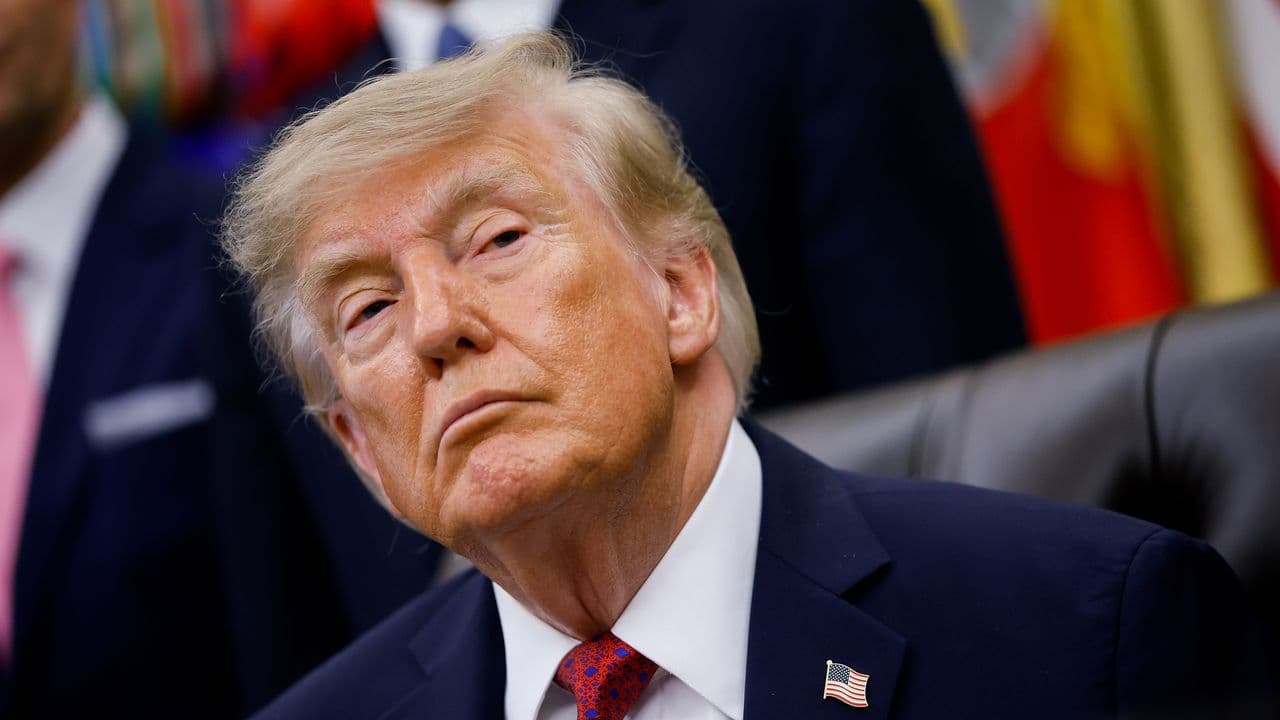
President Donald Trump demanded that the Federal Reserve slash borrowing costs to “1% or less” after policymakers voted unanimously to raise interest rates by 25 basis points.
- The Federal Open Market Committee unanimously voted to increase the benchmark federal funds rate by a quarter percentage point to a target range of 3.75%–4%.
- President Trump lashed out on social media, demanding the Fed rapidly cut interest rates to 1% or lower in a Truth Social post.
- Central bank Chair Kevin Warsh and Fed officials cited elevated inflation, driven by persistently high energy costs and global geopolitical tensions, as the main catalyst for the rate hike.
President Donald Trump on Wednesday called for much lower rates shortly after the central bank approved an interest rate increase in defiance of his repeated demands.
In a statement posted on social media, Trump said U.S. benchmark rates “should be 1%, or less,” pointing to strong economic investment and national creditworthiness as justification for immediate action.
“LOWER THE INTEREST RATES FOR THE UNITED STATES OF AMERICA, AND FAST!” Trump posted on Truth Social.
The demand came immediately after the Federal Open Market Committee voted 12-0 to raise the benchmark federal funds rate by a quarter percentage point to a range of 3.75% to 4%. The move marks the central bank’s first rate increase since 2023.
Friction Over Central Bank Independence
The decision places renewed pressure on Federal Reserve Chairman Kevin Warsh, whom Trump appointed earlier this year while encouraging him to maintain institutional independence.
Bringing interest rates down to the 1% target sought by the president would require steep, historic cuts that policymakers typically reserve for severe financial crises. Trump renewed arguments that higher borrowing costs put the nation at a global disadvantage and linked the issue to international trade imbalance.
“We are ‘carrying’ almost every country in the World, and that cannot go on any longer,” Trump wrote.
The president has previously suggested cutting off trade with nations running a surplus with the U.S. unless borrowing costs are lowered, though economists remain skeptical on how such measures would lower interest rates for consumers.
Persistent Inflation Drives Policy Shift
Central bank officials said the rate hike was necessary after August economic data showed consumer prices rising faster than expected. Policymakers noted that while economic fundamentals remain strong, inflation continues to hover above the 2% target level.
Federal Reserve officials pointed to ongoing geopolitical conflicts, including high energy costs tied to the military conflict with Iran, alongside recent administration tariff policies, as key factors complicating the inflation outlook.
“There is no hiding from hot spots around the world, and our judgment about what is the most likely, or least likely, of the geopolitical situation has changed,” Warsh stated.
Rate Projections Show One More 2026 Hike
According to the updated dot plot, 16 out of 18 policymakers anticipate at least one additional borrowing cost increase before the end of this year.
Four members signaled two more quarter-point increases, lifting the median projection to 4.1% from June’s 3.8% estimate. For 2027, the central tendency remains held at 4.1%, although eight participants projected benchmark borrowing rates rising to 4.4%.
In after-hours trading, the SPDR S&P 500 ETF (SPY), which tracks the S&P 500 index, was up 0.2%, the Invesco QQQ Trust (QQQ) added 0.1%, and the Dow Jones ETF (DIA) slipped 0.1%. Retail sentiment around the S&P 500 ETF on Stocktwits was in the ‘ extremely bearish’ territory.
For updates and corrections, email newsroom[at]stocktwits[dot]com.<