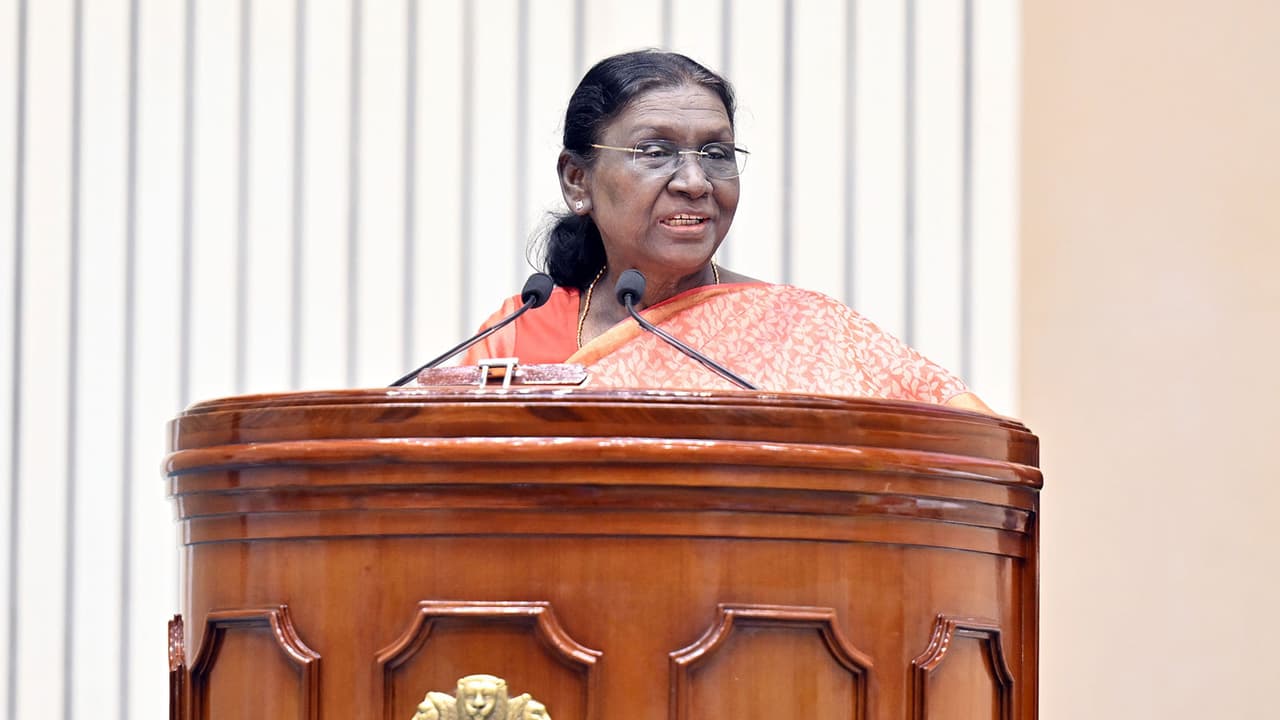
President Murmu highlighted tribal reverence for nature at a climate conference, advocating for blending traditional knowledge with modern tech. Union Minister Manohar Lal stressed a balanced approach to development and environmental protection.
President Murmu on Tribal Wisdom and Climate Action
President Droupadi Murmu on Sunday addressed the valedictory session of the two-day International Conference on “The Future of Environment and Climate Dynamics” at Vigyan Bhawan, recalling her childhood in a remote rural area and highlighting the deep reverence for nature embedded in tribal life.
Speaking at the conference organised by the National Green Tribunal, President Murmu said many traditional communities across the world possess centuries-old knowledge, with resilience and climate adaptation forming part of their way of life. Recalling her own childhood, she said she had experienced first-hand the simplicity and resilience of tribal societies and their close relationship with nature.
A Personal Memory of Reverence
Sharing a personal memory, the President said her father would bring dry wood from a nearby forest for cooking. “Before cutting the wood into pieces suitable for burning, those handling it would bow before it.” As a child, she once asked her father why they bowed to wood that was already dry and was going to be burnt.
Her father explained that although the tree had dried up, the wood was still serving them; when the tree was alive, it provided air and oxygen, and even after becoming old and dry, it continued to be useful.
President Murmu said the incident reflected the sensitivity of tribal communities towards forests, trees and plants. Recalling a recent visit to her village with Prime Minister Narendra Modi, she said tribal communities were taught from childhood to respect nature and that even today forests continue to be worshipped in many tribal traditions.
Her remarks underlined the importance of traditional ecological knowledge at a time when the world is searching for effective responses to climate change. The President said traditional communities possess knowledge developed over centuries and that their practices of living with nature can complement modern climate action.
She emphasised that contemporary approaches involving biotechnology, artificial intelligence, predictive models and digital technologies should be combined with traditional knowledge, community-based adaptation and ecological restoration to build climate-resilient societies. She said climate action should not be limited to technological solutions, but must also draw upon the experiences of communities that have historically lived in close harmony with their ecosystems.
The President’s address highlighted how traditional practices, scientific innovation and community participation can come together in strengthening climate resilience and protecting ecosystems. The two-day conference brought together judges, legal experts, policymakers, scientists and delegates from India and abroad to deliberate on climate change, environmental governance, biodiversity, sustainable development and the future of environmental law.
President Murmu’s address placed the relationship between people, forests and nature at the centre of the broader discussion on building a sustainable and climate-resilient future.
Manohar Lal Calls for Balanced Approach
Union Minister for Power and Housing and Urban Affairs Manohar Lal on Sunday called for a balanced approach to development and environmental protection, stressing the need for sustainable cities, cleaner energy and environmentally responsible infrastructure as India’s urban and energy requirements continue to grow.
Addressing the valedictory session of the National Green Tribunal’s international conference on “The Future of Environment and Climate Dynamics”, Manohar Lal said he had returned to India the same day after attending a G20-related energy engagement in the United States. Referring to the international discussions, he highlighted the growing importance of energy transition and collective efforts to address climate and environmental concerns.
Manohar Lal also acknowledged the role of the NGT in India’s environmental governance and appreciated the participation of judges, legal experts, scientists, policymakers and delegates from different jurisdictions at the conference. He said platforms such as the international conference provide an opportunity to exchange experiences and examine how environmental concerns can be integrated into development policies.
The minister said India’s expanding urban landscape and rising energy demand require greater emphasis on sustainable urban planning, green infrastructure and cleaner sources of energy. He stressed that development and environmental protection need to progress together and called for coordinated efforts by governments, courts, tribunals, experts and other stakeholders to address the challenges posed by climate change and environmental degradation. (ANI)
(Except for the headline, this story has not been edited by Asianet Newsable English staff and is published from a syndicated feed.)