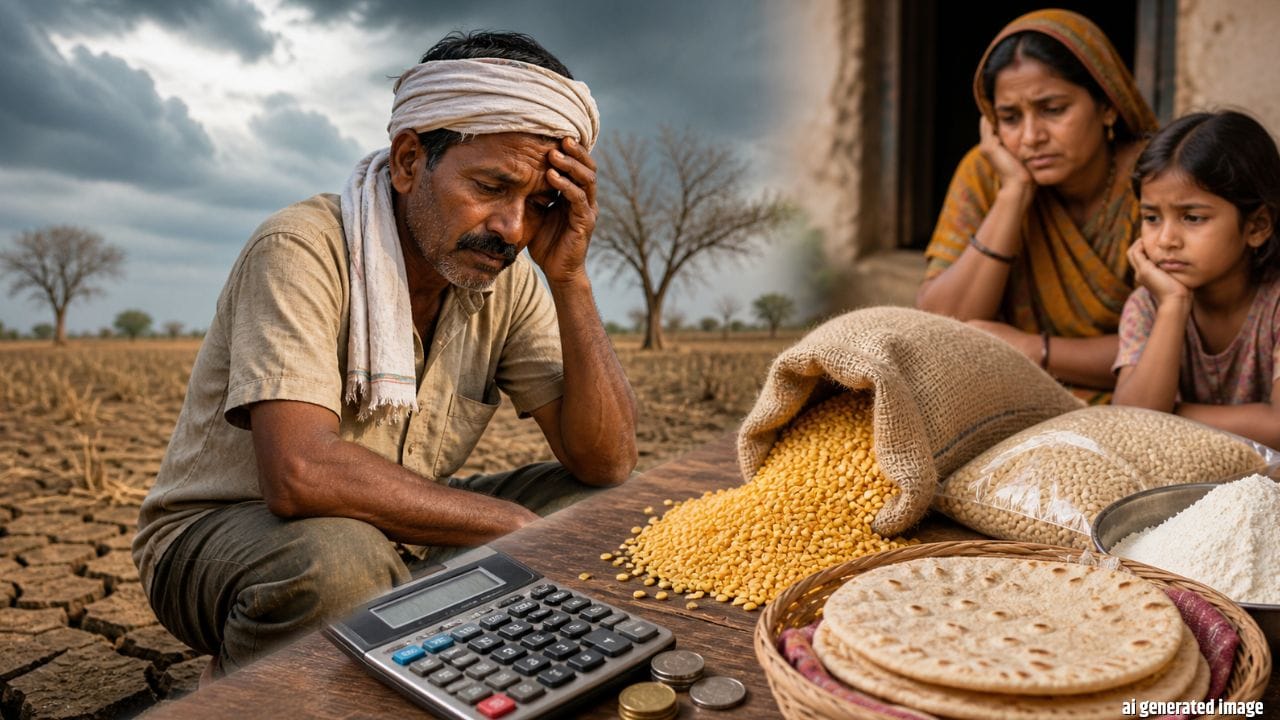
Lentils and bread can become expensive!
Image Credit source: ai generated
Rain in India is not just a change in weather, but it is a big switch that runs the entire economy. If the vegetable bill at your house suddenly increases in the coming days, the movement of clouds may be responsible for it. A large part of our economy still depends on agriculture. Good rains mean bountiful crops, better income in rural areas and stable prices of food items. But, if the monsoon weakens, its direct effect becomes visible on our plates in the form of expensive vegetables, pulses and edible oil.
At present there has not been any big jump in the inflation rate, but it is gradually moving upwards. Retail inflation (CPI) has increased to 3.4% in March 2026, which was 3.21% in February. According to the new 2024 base year, this is an increase for the third consecutive month. In such a situation, economists have warned that the overall inflation graph may go up this year, and this pressure is starting from the weather itself.
Shadow of ‘El Nino’, will fields dry up?
The biggest reason behind this concern is the latest estimate of the Meteorological Department (IMD). IMD has predicted the south-west monsoon of 2026 to be ‘below normal’ (92% of the long period average). Along with this, the threat of ‘El Nino’ has also come into the center of discussion. This is a seasonal change that is caused by unusually warming of the Pacific Ocean and due to which large parts of Asia are experiencing drought and extreme heat.
Statistics show that since 1980, 70% of ‘El Nino’ years have seen below normal rainfall in India. Global agencies also believe that the effect of El Nino will become visible by May-June and it may become quite strong by the end of the year. According to rating agency ICRA, this is one of the weakest initial estimates of the last 25 years. The agency estimates that if there is less rainfall, retail inflation may cross 4.5% in FY 2027 and agricultural growth rate may slip below the baseline of 3%.
Will there be heavy pressure on the pocket?
Weak rain directly means reduction in sowing and yield. Due to this, the supply chain of food items is affected and retail inflation increases. Deloitte India economist Rumki Majumdar believes that energy prices are already high due to global tensions. Now due to El Nino, there may again be pressure on food prices, which had only recently started to stabilize.
The Reserve Bank (RBI) has also expressed this possibility in its estimates for the financial year 2027. According to RBI, the inflation rate for the whole year may remain 4.6%, but in the third quarter (October-December) it may jump to 5.2%. This is the time when the effect of monsoon is visible on the crops and also the demand in the market is at its peak due to the festive season.
Do you need to panic?
However, every picture has two sides. SBI Research has emphasized that there is not always a direct relationship between less rainfall and inflation. History has shown that there have been times when inflation has increased despite normal rains (e.g. 8.43% food inflation in 2009 and 15.2% food inflation in 2011), and at times food inflation has remained quite low even during weak monsoons (e.g. 2013 and 2019).
The biggest relief is that there is sufficient buffer stock of grains in the country. Rice alone has a stock of 380 lakh metric tonnes (LMT), which is enough to compensate for any shortfall in the Kharif crop. Apart from this, what matters more than the total rainfall of the entire country is how much rainfall occurred in which areas. If rainfall remains normal in major farming states, the impact of inflation will be limited. Despite all these challenges, India’s GDP growth is expected to be between 6.8% to 7.1% on the basis of domestic consumption and investment.