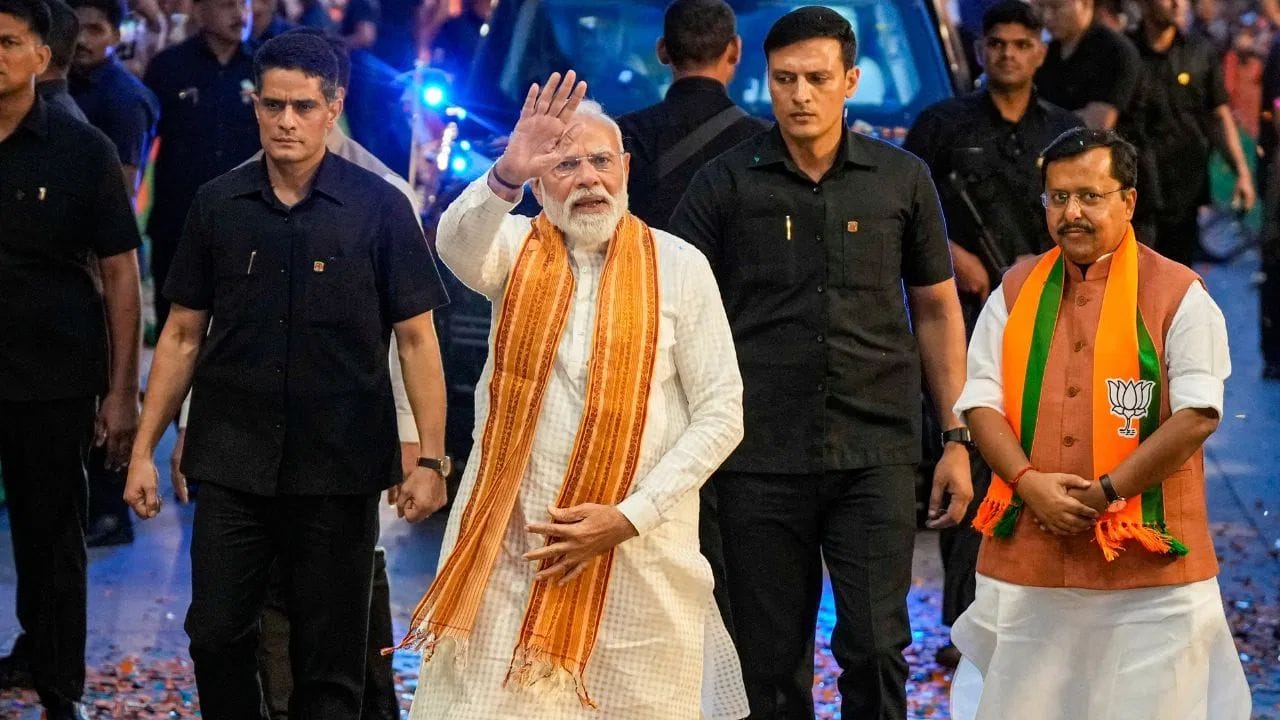
With the change of power in Bengal, many changes regarding the economy can now be seen in the state.
The BJP’s ‘double engine’ governance model, in which a single party rules both the Center and the state, has already changed the economic trajectory of Uttar Pradesh, Odisha and Assam. There has been a tremendous increase in capital expenditure in these three states under BJP rule. Where in Uttar Pradesh the capex increased from 15.7 percent to 19.2 percent of the previous governments. On the other hand, in Odisha it was 18.7 percent as against 12.3 percent. If we talk about Assam, it increased to 21.5 percent as compared to 0.4 percent during previous governments. Now, with BJP getting a historic mandate of 207 seats in the 2026 West Bengal Assembly elections, the same infrastructure-based development model is now going to be implemented in this state as well.
With this election result, TMC’s more than 15-year-old rule under the leadership of Mamata Banerjee has ended. With this, West Bengal has now come to what Elara Capital analysts are calling the next phase of India’s “Capex juggernaut”, which is now moving towards the east. The state’s capex (capital outlay), as a share of GSDP, is currently only 2 per cent, compared to 6.6 per cent in Odisha, 4.5 per cent in UP and 4.3 per cent in Madhya Pradesh. If BJP can repeat even a small part of its excellent record in other states here, this gap will narrow very rapidly.
Now will Bengal’s economy gain momentum?
The weakness that the new government has inherited on the economic front is very clear. West Bengal’s contribution to India’s GDP declined by 28 basis points between fiscal years 2018 and 2025, while Uttar Pradesh’s contribution increased by 20 basis points during the same period. Around 6,888 companies have left the state since 2012. BJP’s focus on factor reforms and infrastructure is aimed at stopping this exodus of companies.
The party’s manifesto outlines a comprehensive plan for this, which includes deep water ports at Tajpur and Kulpi, completion of the Kolkata Metro, restarting 61 stalled rail projects, building an industrial park at the historically important site of Singur, building new airports at Purulia, Malda and Balurghat, and making special efforts to revive the jute industry.
The Challenge of Economic Balance: Capex vs. Free Schemes
According to a report by MK Global Financial Service, the BJP’s own manifesto contains promises that will cost a lot—including Rs 3,000 per month to women, Rs 9,000 to farmers, unemployment allowance, and a 30 percent increase in the MSP of paddy. It is estimated that the recurring expenditure on these will increase by Rs 70100 billion, which will be about 3.4 percent of the state’s GDP.
This is part of a larger national trend. From 2023, states have moved away from the central government’s path of fiscal consolidation; The total fiscal deficit of the states in the financial year 2026 (estimated) is estimated to be 3.4 percent of GDP, whereas the target was 3.1 percent. Analysts say that the upper limit of 3 percent of fiscal deficit/GDP is now actually becoming the lower limit. This threatens the quality of productive expenditure, at a time when capital expenditure (capex) is accelerating.
What signal is the mandate of Bengal giving?
Elara Capital believes that its effects will spread far beyond Kolkata. With Odisha, Assam, Bihar, Chhattisgarh and now West Bengal coming under BJP rule, the party has strengthened its grip on eastern India to such an extent that there is no longer any debate about its national reach.
Due to emphasis on development, continuous ‘reverse migration’ (return of people) is also expected to start in Bengal. This may lead to short-term labor shortage in Kerala, Karnataka and Maharashtra, while increasing the use of machines in the agricultural sector.
For the markets, the decision reinforces policy continuity at the central level and further strengthens the BJP’s position ahead of the Uttar Pradesh Assembly elections due in February-March 2027. For West Bengal—which has the coast of the Bay of Bengal, mineral deposits and excellent human resources—the promise is that these long-dormant advantages are finally coming to fruition.
Mamata Banerjee’s 15 years of governance work
- The economic account of Mamata Banerjee’s 15-year tenure (2011–2026) presents a complex picture—in absolute terms, there has been considerable development, emphasis on public welfare, but also increased fiscal challenges.
- When TMC came to power in 2011, it inherited a difficult fiscal situation from the ‘Left Front’. In the decade and a half that followed, GSDP (Gross State Domestic Product) grew almost five times in absolute terms.
- NSDP (Net State Domestic Product) to reach approximately Rs 16.32 lakh crore by FY 2025. In the first term (2011-2016), the overall average growth rate was about 17 percent, thanks to agriculture and service sectors.
- There have been signs of growth slowing in recent years—Bengal’s growth rate in FY25 stood at about 9 percent, lagging behind Tamil Nadu, Uttar Pradesh and Maharashtra (11.8%-15.7%), and at times even lagging behind traditionally slow states like Bihar and Odisha.
- From a structural point of view, the share of West Bengal in India’s GDP has been continuously declining for a long time. In 1960, its share was about 10.5 percent, which came down to about 5.6 percent by 202324. This decline continued under many different political governments.
- During this entire time, the state accumulated a debt of about Rs 8 lakh crore. Which is much higher than many states of the country.
- On the welfare front, capex increased 18 times and according to the Multi Dimensional Poverty Index by 2023, the BPL population declined from nearly 25 per cent in 2010 to just under 12 per cent.
- Major schemes like Kanyashree, Sabuj Sathi and Roopashree boosted human capital and stimulated rural demand — but critics consistently highlighted the decline in industrial investment compared to other major states.