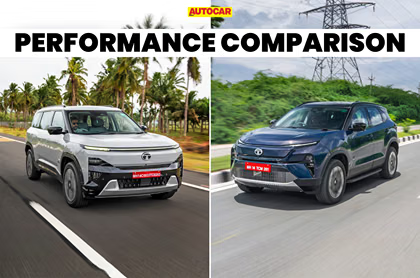
has offered its QWD dual-motor all-wheel-drive setup on the since its 2025 launch, and it has now made its way to the more compact , albeit in a slightly less powerful state of tune. Both retain the looks of their combustion-powered counterparts but use modified underpinnings to house the battery. So, which of these five-seat AWD electric SUVs is quicker in the real world?
The Harrier EV makes more power, but the Sierra EV is over 200kg lighter
| Tata Sierra EV AWD vs Harrier EV AWD: Specifications | ||
| Tata Sierra EV 75 QWD | Tata Harrier EV QWD 75 | |
| Battery capacity (kWh) | 75 | 75 |
| Electric motor setup | Dual | Dual |
| Power (hp) | 306 | 313 |
| Torque (Nm) | 504 | 504 |
| Kerb weight (kg) | 2,130 | 2,335 |
| Power-to-weight ratio (hp/tonne) | 143.7 | 134 |
| Torque-to-weight ratio (Nm/tonne) | 236.6 | 215.8 |
| Tyres | 225/55 (R19) | 245/55 (R19) |
| MIDC range (km) | 624 | 622 |
Both SUVs pair an induction motor at the front with a permanent magnet synchronous motor at the rear. However, it’s the Harrier EV’s motors that are more powerful. The front unit makes 158hp, while the rear motor develops 238hp. In comparison, the Sierra EV’s front and rear motors make 140hp and 209hp, respectively. This gives the Harrier EV a 7hp advantage in terms of combined output, though both SUVs offer an identical 504Nm of torque.
The Sierra EV’s trump card is its weight. Coming in at 2,130kg, the Sierra EV AWD is 205kg lighter than the Harrier EV AWD. This also means that it has the better power-to-weight and torque-to-weight ratios of the two. The Harrier EV also rides on wider 245-section tyres, while the Sierra EV is equipped with 225-section rubber.
Tata Sierra EV AWD vs Harrier EV AWD: Acceleration timings
The Sierra EV gets to 100kph nearly 0.8 seconds before the Harrier EV
| Tata Sierra EV AWD vs Harrier EV AWD: Acceleration timings (in seconds) | ||
| Tata Sierra EV 75 QWD | Tata Harrier EV QWD 75 | |
| 0-20kph | 1.05 | 1.26 |
| 0-40kph | 2.00 | 2.43 |
| 0-60kph | 2.99 | 3.62 |
| 0-80kph | 4.22 | 4.93 |
| 0-100kph | 5.95 | 6.74 |
| 0-120kph | 8.29 | 9.19 |
We tested both SUVs in their most aggressive ‘Boost’ mode, and the Sierra EV pulled ahead right from the start. With the same torque output and 205kg less to haul around, it was 0.21 seconds quicker to 20kph, with the gap only widening from there. The Sierra EV AWD crossed 100kph in 5.95 seconds, which was 0.79 seconds ahead of the Harrier EV AWD. At 120kph, the Sierra EV AWD’s lead had stretched to 0.90 seconds.
The Sierra EV’s lead peaked at 0.95 seconds by the time both SUVs reached 130kph, after which the Harrier EV began to close in. By 150kph, the gap had shrunk to just 0.45 seconds. The Sierra EV also completed the quarter-mile run in 14.48 seconds, which is 0.61 seconds quicker than the Harrier EV. In fact, even in ‘Sport’ mode, the Sierra EV’s 0-100kph time of 6.62 seconds beats the Harrier EV’s quickest time in ‘Boost’ mode.
Tata Sierra EV AWD vs Harrier EV AWD: Rolling acceleration timings
The Sierra EV stays ahead when accelerating on the move as well
| Tata Sierra EV AWD vs Harrier EV AWD: Rolling acceleration timings (in seconds) | ||
| Tata Sierra EV 75 QWD | Tata Harrier EV QWD 75 | |
| 20-80kph (in kickdown) | 3.32 | 3.89 |
| 40-100kph (in kickdown) | 3.96 | 4.32 |
The Sierra EV AWD’s performance advantage carries over once it’s on the move, too. It accelerated from 20kph to 80kph in 3.32 seconds, which is 0.57 seconds quicker than the Harrier EV AWD.
The margin narrows at higher speeds, with the Sierra EV taking 3.96 seconds to get from 40kph to 100kph. However, that’s still 0.36 seconds faster than the Harrier EV, making the Sierra EV the quicker of the two when overtaking.
Tata Sierra EV AWD vs Harrier EV AWD: Regenerative braking tests
The Harrier EV’s regen slows it down more effectively
| Tata Sierra EV AWD vs Harrier EV AWD: Regenerative braking (80-20kph) | ||
| Tata Sierra EV 75 QWD | Tata Harrier EV QWD 75 | |
| Level 1 distance (m) | 313.79 | 293.26 |
| Level 2 distance (m) | 177.44 | 161.42 |
| Level 3 distance (m) | 132.12 | 130.64 |
Both SUVs offer four regen levels, ranging from 0 (no regen) to 3 (max regen). However, the system isn’t progressive in either, working more like an on-off switch. Of the two, the Harrier EV AWD’s regen proved more effective at every level we tested.
On Level 1, it slowed from 80kph to 20kph in 293.26m, which is 20.53m shorter than the Sierra EV AWD. The gap on Level 2 is 16.02m between the two SUVs. This gap almost disappears on Level 3, where the Harrier EV needed just 1.48m less than the Sierra EV.
Tata Sierra EV AWD vs Harrier EV AWD: Prices
The quicker Sierra EV AWD is also the more affordable of the two
| Tata Sierra EV AWD vs Harrier EV AWD: Prices (Rs lakh) | ||
| Tata Sierra EV 75 QWD | Tata Harrier EV QWD 75 | |
| Price range (ex-showroom) | 25.99 | 26.79-29.29 |
The Sierra EV is offered with AWD only in its top-spec Empowered AWD A 75 variant, which is priced at Rs 25.99 lakh. That’s Rs 80,000 less than the most affordable Harrier EV AWD, with the range going up to Rs 29.29 lakh. The Harrier EV has more power and stronger regen, but the lighter Sierra EV is quicker in every acceleration test, and even gets to 100kph faster in ‘Sport’ mode. Add its lower price to the mix, and the Sierra EV AWD is the clear pick of the two.
Autocar India’s testing standards
Before conducting our performance tests, we check and maintain tyre pressure based on the manufacturer’s recommendation and ensure that the car is charged to 100 percent. The car is then tested in a controlled environment with two people on board, and the data is collected via highly accurate GPS-based timing equipment.