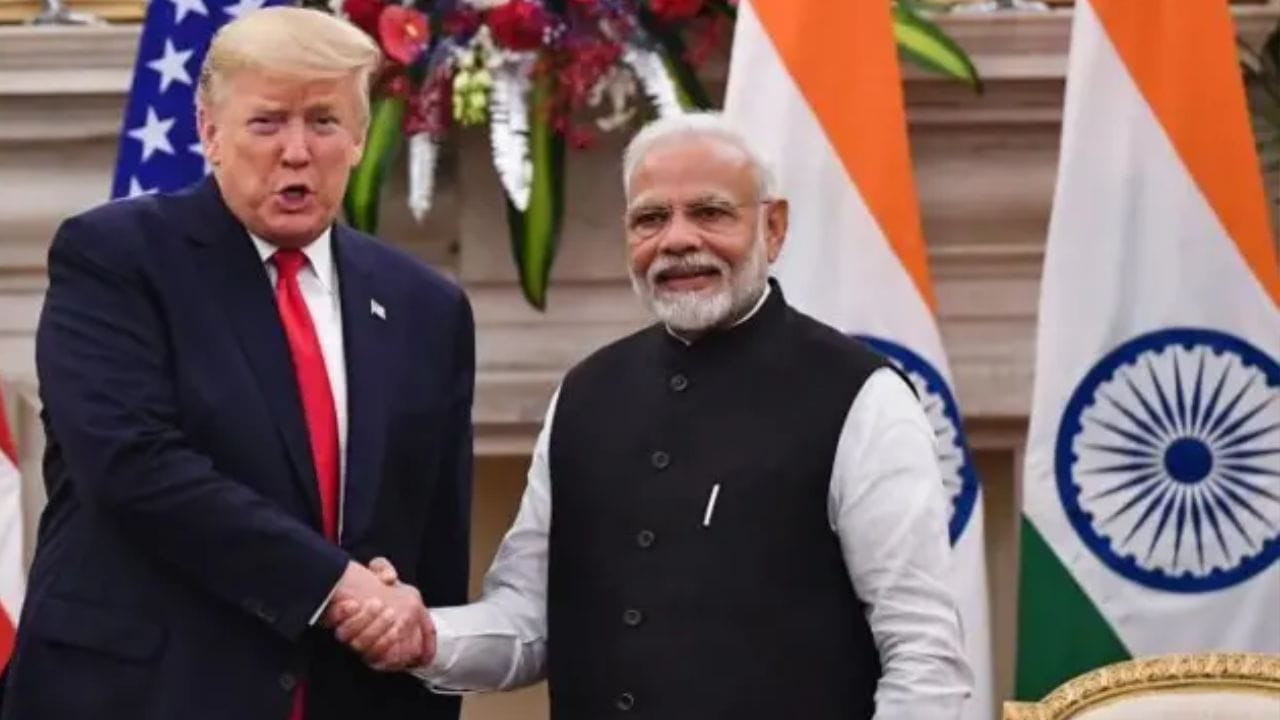
PM Narendra Modi and Donald Trump
India and the United States on Friday took a significant step forward by announcing the framework for an India-US trade agreement that aims to reduce tariffs, strengthen energy ties and boost economic cooperation. The joint statement of the two governments confirmed that although the framework paves a clear path forward, further negotiations will be required to finalize a comprehensive bilateral trade agreement.
Tariff reduced
US President Donald Trump had announced earlier this week that under the India-US trade agreement, the US will reduce the tariff on Indian goods from 50% to 18%. In return, India will have to stop purchasing Russian oil and reduce trade barriers. Half of the 50 percent tariff was imposed as a measure against India’s Russian oil imports, which Trump said were supporting Moscow’s war efforts in Ukraine. On Friday, Trump signed an executive order removing 25 percent of the tariffs. India has agreed to import oil from America and Venezuela.
The India-US Trade Deal will not only provide greater access to the US market for Indian products but also support our labor intensive sectors. Additionally, it will give a big boost to our digital infrastructure.#IndiaUSJointStatement pic.twitter.com/AAUB8x9MGM
— Piyush Goyal (@PiyushGoyal) February 7, 2026
Highlights of India-US deal
The India-US deal includes specific trade commitments. India has agreed to buy $500 billion worth of American goods over the next five years, including oil, gas, coking coal, aircraft and aircraft parts, precious metals and technology products such as graphics processing units used for AI and other data centers applications. India will reduce or eliminate duties on a range of US industrial and agricultural products, including dry grains, red sorghum, nuts, fresh and processed fruit, soybean oil, wine and spirits.
Farmers safe, country developed…
Dairy, fruits, vegetables, spices and other grains are protected in the India-US trade agreement.
This will protect the interests of domestic farmers, strengthen local agriculture with preferential access to such a big market and move towards self-reliant India. pic.twitter.com/X0bMisAgYn
— Piyush Goyal (@PiyushGoyal) February 7, 2026
18 percent tariff will remain applicable on major American imports
Under the India-US trade agreement, the US will maintain 18 per cent tariff on most goods imported from India, including textiles, apparel, leather, footwear, plastics, organic chemicals, home furnishings, handicrafts and some machinery. India will get tariff exemption on some aircraft and aircraft parts, as well as a lower tariff quota for import of auto components. Negotiations regarding generic drugs and their components will be done on the basis of the ongoing tariff investigation by the US.
Opportunities for Indian business
Indian Trade Minister Piyush Goyal welcomed the India-US Framework on X, calling it open access for Indian exporters to the $30 trillion US market, which will particularly benefit farmers, fishermen and MSMEs. Goyal said a formal trade agreement could be signed by March, after which India’s tariff cuts on US exports would become effective.
Under the decisive leadership of PM @NarendraModi ji, India has reached a framework for an Interim Agreement with the US. This will open a $30 trillion market for Indian exporters, especially MSMEs, farmers and fishermen. The increase in exports will create lakhs of new jobs. pic.twitter.com/xYSjxML6kt
— Piyush Goyal (@PiyushGoyal) February 7, 2026
Non-tariff barriers and standards
India also agreed to remove long-standing non-tariff barriers on agricultural products, medical equipment and communication equipment. The two countries aim to finalize within six months an agreement recognizing American or international safety and licensing standards for imported products. The US confirmed that it will consider India’s requests for lower tariffs in future negotiations. Both sides committed to cooperate in the enforcement of export controls on sensitive technologies and to address “third party non-market policies” in the context of China.
Future-ready partnership🇮🇳🤝🇺🇸
From addressing non-tariff barriers to aligning standards and advancing joint technology cooperation, the India US Trade Deal reinforces a shared commitment to facilitating trade, expanding market opportunities, and strengthening bilateral pic.twitter.com/0W6o2eOqc5
— Piyush Goyal (@PiyushGoyal) February 7, 2026
Importance of India-US trade deal
Challenges have emerged in negotiating a full trade agreement on issues such as agriculture, digital trade, medical devices and market access. Officials said strategic concerns including competition from China, supply chain diversification and energy security have further increased the need for an India-US trade agreement.