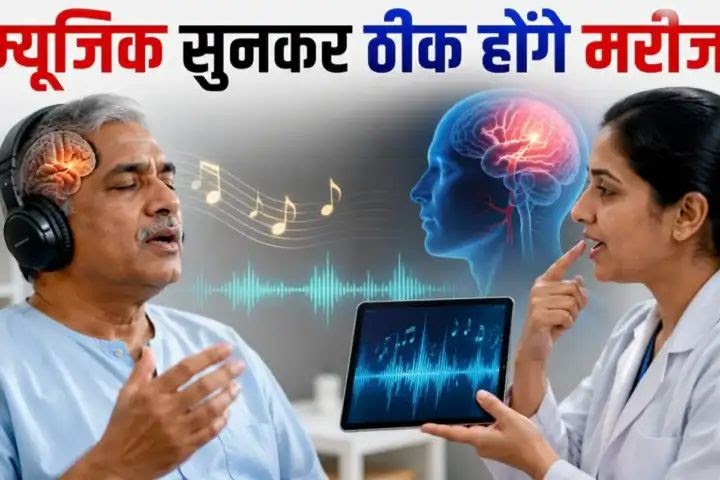
Researchers at IIT Delhi in collaboration with All India Institute of Medical Sciences AIIMS and IHWAS have developed melodic intonation therapy for stroke patients. Through this therapy, those stroke patients who have difficulty in speaking will be able to speak properly.
In fact, when oxygen or blood does not reach the brain due to some obstruction, stroke occurs immediately. This is called stroke attack. It can also be fatal, but those patients who survive develop many types of physical disabilities. Some of these patients have difficulty in speaking. They speak stammeringly or speak late in a very breaking voice. Melodic intonation therapy can prove to be a boon for such patients. Although this therapy was being used in western countries for years, now for the first time it has been adapted to the Hindi language.
Creation of new therapy according to Hindi language
Experts from IIT Delhi, AIIMS and IHBAS Hospital have worked together on this. This music-based therapy will help patients suffering from difficulty in speaking (aphasia) after stroke to develop the ability to speak again. Stroke patients are often unable to express themselves but can easily hum old rote songs. Taking advantage of this, in this therapy the ability to speak is linked to tune and rhythm. Scientists have not just translated English words into Hindi but have prepared this new method keeping in mind the way of speaking and the rhythm of the Hindi language.

Excellent results in initial experiments
This new therapy was tested on 6 Hindi speaking patients who recovered from stroke. The experts gave them a total of 40 sessions of 45 to 60 minutes. After completion of the therapy, a huge and positive change was seen in the speech of all the patients. Patients were now able to speak longer sentences and converse with others easily. His life actually improved. The best thing was that this method had no bad effect on the patients. Researchers say that although it started with six patients, its results are very strong and hopeful. Now the team of scientists is working on creating such digital technology and mobile tools, so that the benefits of this therapy can be availed not only in big hospitals but also to the patients living in remote areas sitting at home. This research has been published in the international journal Aphasiology.
How does this therapy work?
Melodic intonation therapy is based on neuroplasticity. When someone has a stroke, the cells of the left hemisphere of the brain get damaged. Due to this the patient has difficulty in speaking. On the other hand, the patient’s right side remains safe. In this right part, the process of music, tune, rhythm and pitch takes place. Even after stroke, the right side remains safe and active. In melodic intonation therapy, the therapist sits in front of the patient and sings in rhythm. During this, the mirror neurons present in the patient’s brain try to imitate that action by seeing and hearing. Initially the words are associated with the musical tune, due to which the right brain gets activated and sends signals to the vocal cords. Gradually the tune is reduced in a scientific manner and only the natural rhythm is maintained. Eventually the patient is able to speak words in a normal conversational rhythm without singing because control of language has been transferred to the right side of the brain and its newly formed neuronal networks.