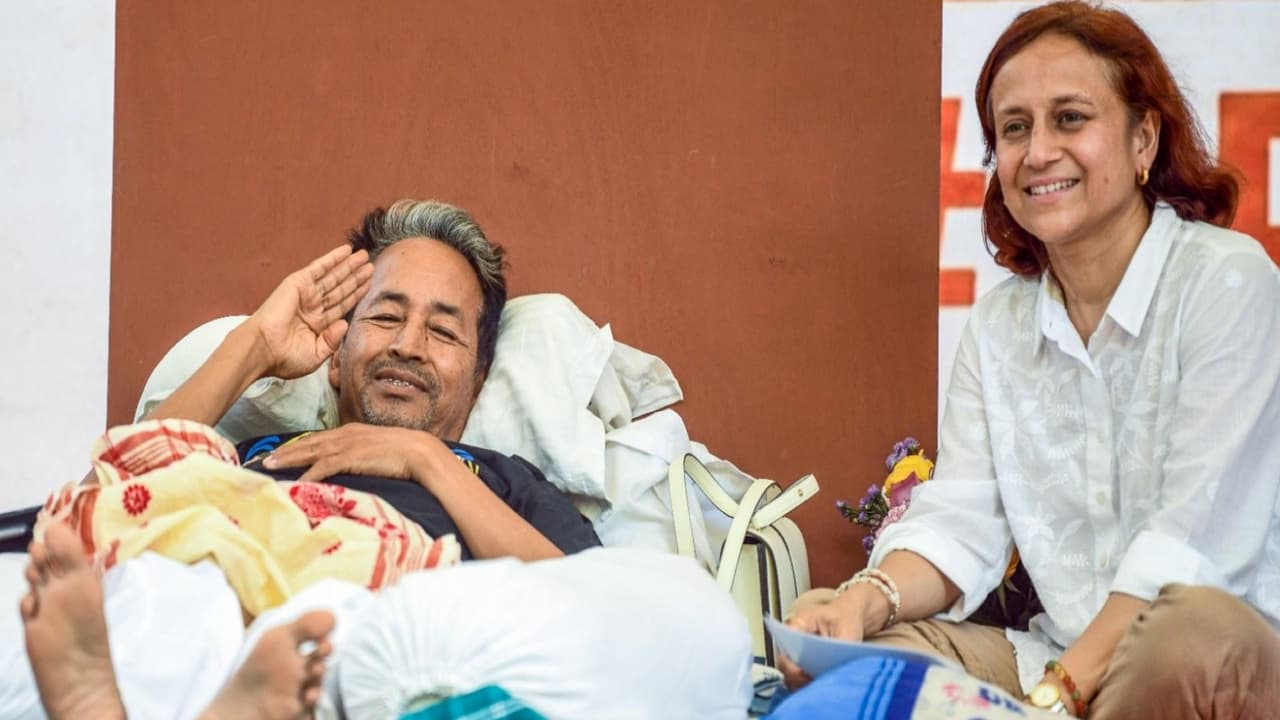
Sonam Wangchuk: Dr Geetanjali J Angmo, wife of climate activist Sonam Wangchuk, has filed a petition in the Delhi High Court. During this time, he has made many revelations and made many big allegations.
New Delhi [भारत]July 19 (ANI): Dr Geetanjali J Angmo, wife of climate activist and educationist Sonam Wangchuk, has approached the Delhi High Court. They have demanded that Wangchuk should be immediately discharged from Safdarjung Hospital and allowed to be admitted to any private hospital of the family’s choice. The petition alleges that Wangchuk has been kept in “unlawful and unconstitutional confinement” in the name of treatment in a government hospital.
Why is Sonam Wangchuk not being allowed to meet other people?
In this petition filed under Article 226 of the Constitution, Geetanjali has demanded that keeping Wangchuk in Safdarjung Hospital should be declared illegal as it is a violation of her fundamental rights. They have also demanded that Wangchuk’s family, lawyers and doctors who were monitoring his health during his fast be allowed unhindered access. Apart from this, he has also appealed to hand over Wangchuk’s complete medical records and allow an independent medical investigation.
Wangchuk was taken to the hospital without the family.
According to the petition, Sonam Wangchuk was on an indefinite hunger strike at Jantar Mantar since June 28 in support of the students against the alleged rigging in the NEET-UG examination. On July 18, he was forcibly removed from the protest site and admitted to Safdarjung Hospital. All this was done without his consent or informing his family in advance.
Wangchuk’s wife Geetanjali reached Delhi High Court
- It has been said in the petition that this action was taken under the cover of an order of Delhi High Court dated July 16. Whereas in that order, it was said only about daily medical examination and necessary interventions based on the opinion of doctors.
- The petition emphasizes that neither Wangchuk nor his wife were part of the PIL in which the High Court had recorded the Solicitor General’s assurance that government doctors would monitor Wangchuk’s health on a daily basis and provide medical help if needed.
- It has been argued in the petition that the court order did not give any right to forcibly remove him from the protest site or keep him confined in the hospital.
- Geetanjali has alleged that when Wangchuk was removed, all his vital parameters were stable and he was being looked after by qualified doctors even at the protest site. He claims that there was no such medical emergency for which it was necessary to take this step. He was informed about this not by the officials, but by a volunteer.
Wife’s big allegation against hospital
- A major allegation of disturbance in Wangchuk’s potassium level has also been made in the petition. Accordingly, the hospital told the family that his potassium level had fallen to 2.9, whereas in the report a day earlier it was 4.3.
- The petition said that after repeated requests, the hospital gave Wangchuk’s blood sample after about 10.5 hours. After this, a private lab tested him and found his potassium level to be 3.6. The petitioner says that this raises serious questions on the medical grounds of his hospitalization.
- The petition further alleges that despite three written requests, the hospital authorities refused to discharge Wangchuk or transfer him to a private medical facility. It has also been claimed that his lawyers and the doctors treating him during his fast were prevented from meeting him, while only selective medical information was given to the family.
- The petition states that Wangchuk has neither been arrested nor detained under any judicial order. The authorities are preventing them from holding a peaceful protest by giving the excuse of “medical intervention”. This is a violation of the rights of personal liberty, physical autonomy, informed consent and peaceful protest guaranteed under Articles 19 and 21 of the Constitution.