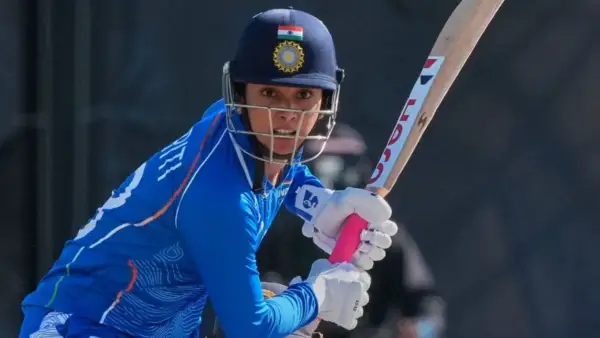
Smriti Mandhana has walked into Indian women’s cricket’s hottest seat with a smile that rarely gives away the furnace behind it.
The BCCI appointed her India women’s captain on October 6, 2026, after Harmanpreet Kaur stepped down, handing Mandhana a dressing room built by one era and now waiting for another.
She comes in with serious currency: India debut in 2013, WPL titles with Royal Challengers Bengaluru in 2024 and 2026, plus previous leadership experience in 18 T20Is and 4 ODIs.
Sangli’s Soft Rhythm Still Keeps Her Grounded
Mandhana’s captaincy story cannot be understood without Sangli. The city sits inside her public personality like a secret metronome: unhurried, warm, slightly stubborn, allergic to unnecessary noise. Vogue India’s 2026 cover story followed her through sugarcane fields and school grounds in Sangli, noting how home still returns her to a slower rhythm between tours.
That piece also gave the line that explains why Mandhana never feels swallowed by fame. “I am exactly like Sangli,” she said (via Vogue India). “Laid-back.” It is a deceptively small quote, yet it carries the whole mood. Indian cricket loves thunder. Mandhana has always brought a breeze with a blade hidden inside it.
Her old friends apparently do not fuss over every milestone, which may be the healthiest luxury in modern sport. Vogue reported that when her latest achievement appears on their Instagram feed, they tease her with, “Lagta hai aaj tune kuch kiya hai?” That is Sangli doing what Sangli does best: trimming celebrity down to human size.
The family thread matters too. Mandhana has said her cricket journey was tied deeply to her family’s dream, saying (via Indian Express), “More than my dream it was my family’s dream that I play for India and they always supported me.” Her father Shrinivas and brother Shravan both played district-level cricket for Sangli, giving her story a sporting inheritance rather than a sudden miracle.
The Crown Arrives After A Record-Breaking Storm
The timing of Mandhana’s promotion is almost cinematic. A month before taking over, she smashed 124 off 64 balls against Hong Kong, China, at the Women’s Asia Cup, with 14 fours and seven sixes. The knock took her past Mithali Raj as the all-time leading run-scorer in women’s international cricket, reaching 10,880 runs across formats.
That innings did more than fill a scorecard. It changed the room around her. The ICC also reported that the century was her 18th across formats, moving her past Meg Lanning for the most hundreds in women’s international cricket. In plain terms, Mandhana is taking the captaincy while standing on one of the tallest personal summits in the women’s game.
Harmanpreet’s exit makes the handover heavier. Reuters reported that Kaur stepped down after a major leadership career that included India’s first women’s 50-over World Cup title on home soil, four T20 Asia Cup titles, and two Asian Games gold medals. This is no empty chair. It carries trophies, bruises, scrutiny, and the memory of a captain who dragged Indian women’s cricket through several difficult rooms.
Mandhana’s own first words after the appointment sounded respectful rather than triumphant. She said (per BCCI), “To be given the responsibility of leading India is a very special honour,” while acknowledging Harmanpreet’s contribution. That is crucial because this captaincy does not need chest-thumping on day one. It needs poise, patience, and the ability to turn calm into culture.
Mandhana’s captaincy is not merely a promotion; it is a temperament test. Her cover drive made her famous, her records made her unavoidable, and Sangli may now become her greatest weapon. Indian women’s cricket has chosen a captain whose softness is often mistaken for ease, yet the record book says otherwise. The smile remains gentle, the job is merciless, and the next chapter already feels personal.