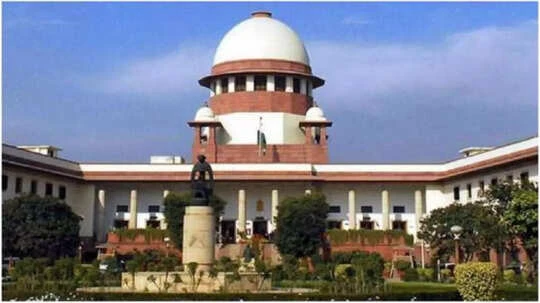
The Supreme Court on Monday dismissed a petition seeking the use of EVMs instead of ballot papers in the Punjab Municipal elections tomorrow.
The bench led by Chief Justice of India Surya Kant refused to interfere, saying that it was too late as all arrangements had been made.
Senior Advocate Nachiketa Joshi, the advocate for one Ruchita Garg, who moved the Supreme Court after the Punjab and Haryana High Court dismissed her plea, submitted that it was the first time that the ballot papers were being used in the recent past.
The appeal was filed through Advocate-On-Record Alabhya Dhamija and was argued by senior advocate Nachiketa Joshi. Advocate Joshi pointed out that the “SC always observed that EVMs are the norm”.
When the advocate said that the ECI had agreed to make available the requisite EVMs, Justice Joymalya Bagchi said that the ECI was not conducting the elections, and the authority conducting the elections was not before the Court.
“We will not second-guess the decision of the SEC, and cannot interfere with an ongoing election process. The ultimate master is the State Election Commission. If the State Election Commission did not have the power to use ballot papers, we would have injuncted. Rules allowed the use of ballot papers. Ballot paper election has not been deleted from the scheme of the municipal election. It is open to the State Election Commission to choose between ballot papers and EVM. We agree that the Supreme Court in the ADR judgment held that it would be a regressive step to go back to ballot papers. But as the election process has started, it would be unwise for us to interfere when the rules do not exclude ballot papers,” Justice Bagchi said.
When Joshi argued that booth-capturing events can happen, CJI Surya Kant said that if law and order problems are there, even EVMs can be of no help.
When Joshi made a request to appoint observers to oversee the elections, the bench said that such a prayer was not there before the High Court, and that it cannot proceed on the presumptions. “Why are we going to presume that elections will be unfair?” CJI asked.
ECI told the court it has taken a policy to lend EVMs to SECs for local body elections, and only the transportation charges are levied.
ECI said that usually, requisitions come from States six months in advance. He added that it might require three days to check the machines and train the officials.
While dismissing the petitions for election through EVMs, the High Court had said: “In our society, where illiteracy, poverty and ignorance continue to plague a large section of society, the Rule making authority intentionally retained the provision of ballot papers and ballot boxes and did not omit the same, while introducing the concept of EVMs in municipal elections. There may be occasions where the Election Commission of India or the State Election Commission may have to revert back to the traditional mode of ballot papers and ballot boxes. As such, the provision for the same in the Rules were and are understandably retained.”