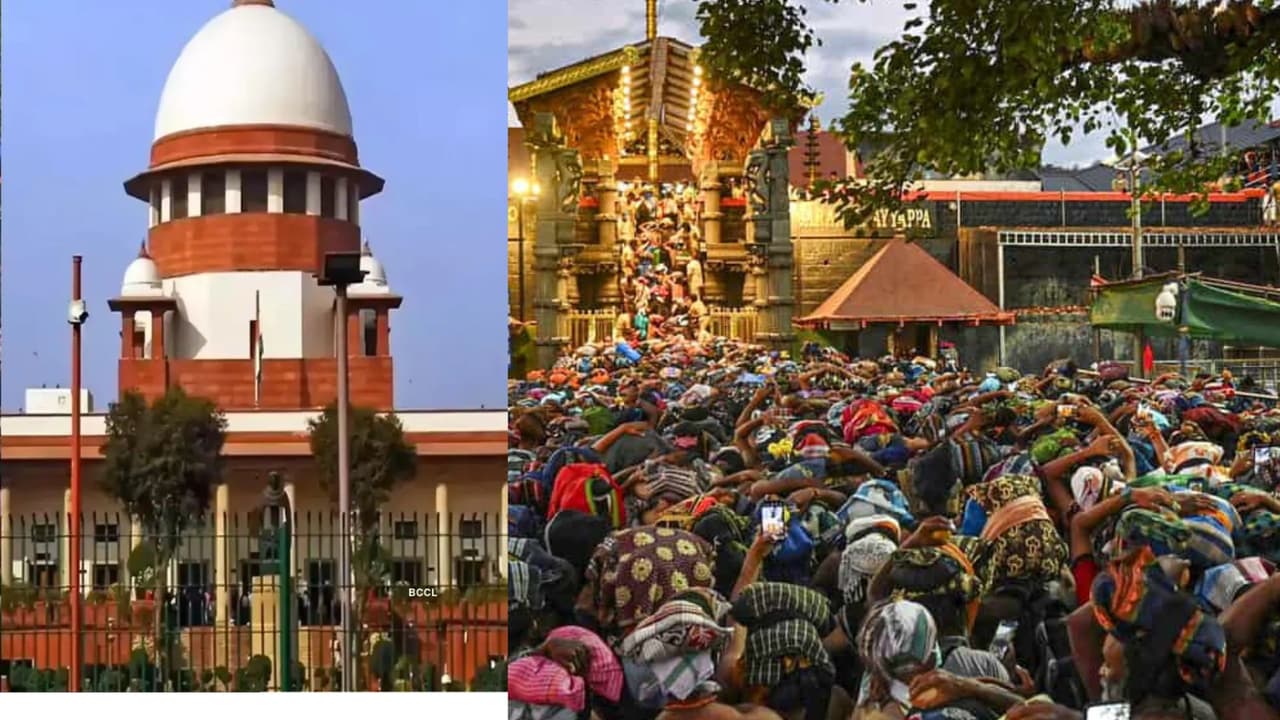
SC has said religious groups are free to decide how they worship, but they cannot disrupt public life. During Sabarimala-related hearings, court made it clear that roads cannot be blocked for religious events and State can regulate activities that affect the public. Judges also stressed religious institution must have proper rules and management.
Supreme Court on Tuesday made an important observation while hearing a group of cases linked to religious freedom and discrimination at places of worship, including the Sabarimala temple issue. The court said every religious denomination has the right to decide how it wants to worship. Judges cannot interfere in those religious matters. However, if religious activities affect public life or involve secular matters, the government has the power to step in and regulate them.
This means that while faith is protected under the Constitution, public order and the rights of others must also be respected.
Roads cannot be blocked for religious events
Justice B V Nagarathna gave a simple example during the hearing. She said a temple may hold an annual chariot or cart festival, but it cannot block all nearby roads in the name of religion.
People have a right to use public roads. Religious celebrations cannot cause unnecessary trouble to the public.
She said the State can regulate such situations because blocking roads is not an essential religious practice. It is a public issue.
The court made it clear that worship can continue, but not at the cost of ordinary citizens.
Court cannot decide how people worship
Justice Nagarathna also stressed that courts should not interfere in the actual manner of worship. If a religious denomination follows a particular tradition, ritual or method of worship, that choice belongs to the denomination.
The Constitution gives religious groups autonomy in these matters.
“The court cannot sit in judgment” over such practices, she observed.
But once a religious activity affects secular life, such as traffic, public safety or administration, the State can regulate it.
This balance, the court said, is necessary in a constitutional democracy.
Hearing linked to Sabarimala and women’s entry cases
The observations came during hearings before a nine-judge Constitution bench. The bench is examining important questions related to religious freedom, denominational rights and discrimination against women at religious places.
These issues arose from several cases, including the long-running Sabarimala temple matter in Kerala.
The court is considering how Articles 25 and 26 of the Constitution should be interpreted when religious rights and equality rights appear to clash.
Nine judges hearing the case
The Constitution bench is headed by Chief Justice of India Surya Kant. Other judges on the bench are Justices B V Nagarathna, M M Sundresh, Ahsanuddin Amanullah, Aravind Kumar, Augustine George Masih, Prasanna B Varale, R Mahadevan and Joymalya Bagchi.
A nine-judge bench is usually formed only for matters involving major constitutional questions.
Its decision is expected to have a wide impact on religious institutions across India.
Debate over Article 25 and Article 26
Senior advocate Akshay Nagarajan appeared for the Hindu Dharma Acharya Sabha.
He argued that the government cannot interfere with the rights of a religious denomination by broadly using Article 25(2)(a). This constitutional provision allows the State to regulate economic, financial, political or other secular activities linked to religion.
Nagarajan said Article 25 protects not only beliefs but also rituals, ceremonies and practices connected with worship.
He argued that these outward expressions of faith deserve constitutional protection.
State can regulate secular activities
The judges agreed that genuine religious practices are protected. However, they drew a clear line between religion and secular activity.
If an activity affects the public or involves administration, finance or public order, the State can regulate it.
This principle has long been part of Indian constitutional law.
The latest hearing reinforced that religious freedom is broad, but it is not unlimited.
Court warns against disorder in religious institutions
Later in the hearing, Justice Ahsanuddin Amanullah addressed the management of religious institutions. He said the right to manage a temple, mosque or dargah does not mean complete freedom without rules.
“There cannot be anarchy,” he observed.
Every religious institution must have a proper system.
There must be rules about worship, entry, timings and administration. Without structure, orderly functioning would be impossible.
Dargahs also have management rights
Advocate Nizam Pasha appeared for Peerzada Syed Altamash Nizami, a descendant of the Chishti Nizami lineage linked to the dargah of Hazrat Khwaja Nizamuddin Aulia.
He explained the importance of dargahs in Sufi Islam.
A dargah is the burial place of a saint and is deeply respected by followers.
He said the Chishtiya order, one of India’s major Sufi traditions, qualifies as a religious denomination under the Constitution. He also argued that controlling entry into a religious institution is part of the right to manage it.
Regulation is necessary, says court
Justice Amanullah agreed that management requires authority. He said someone must regulate how a religious institution functions.
There must be rules regarding worship, entry and the sequence of rituals. It cannot be left to every individual to decide for themselves.
At the same time, such regulation must remain within constitutional limits. It cannot become discriminatory or violate fundamental rights.
Ashwini Upadhyay diverted from the main issue
During the proceedings, advocate Ashwini Upadhyay made wider remarks about denominational conflicts and the history of Bharat. He also spoke about Sanskrit and the meaning of the word “Samvidhan”.
Justice R Mahadevan quickly brought the discussion back on track.
He noted that Tamil has even more letters than Sanskrit and asked counsel to focus on the legal issue before the court. The exchange added a lighter moment to an otherwise serious hearing.
The Supreme Court’s final ruling could affect many religious institutions in India. It may help define the exact limits of religious freedom.
The judgment could clarify when the State can regulate religious practices and when it must stay away.
It could also shape future disputes involving women’s entry, management rights and denominational autonomy. For millions of worshippers, the decision will be highly significant.
Balancing faith and constitutional rights
India’s Constitution strongly protects religious freedom. At the same time, it also guarantees equality, public order and individual rights.
The Supreme Court is trying to balance these values. Religious groups can govern their own worship. But they cannot ignore laws that protect the wider public.
That is the central message emerging from the hearings.
The hearing will continue on Wednesday. More arguments are expected from different religious groups and intervenors.
Once the hearings conclude, the Constitution bench will reserve its judgment. Its final decision will likely become one of the most important rulings on religious freedom in recent years.
Until then, the court’s message is already clear that faith deserves respect, but public rights matter too.
(With inputs from agencies)