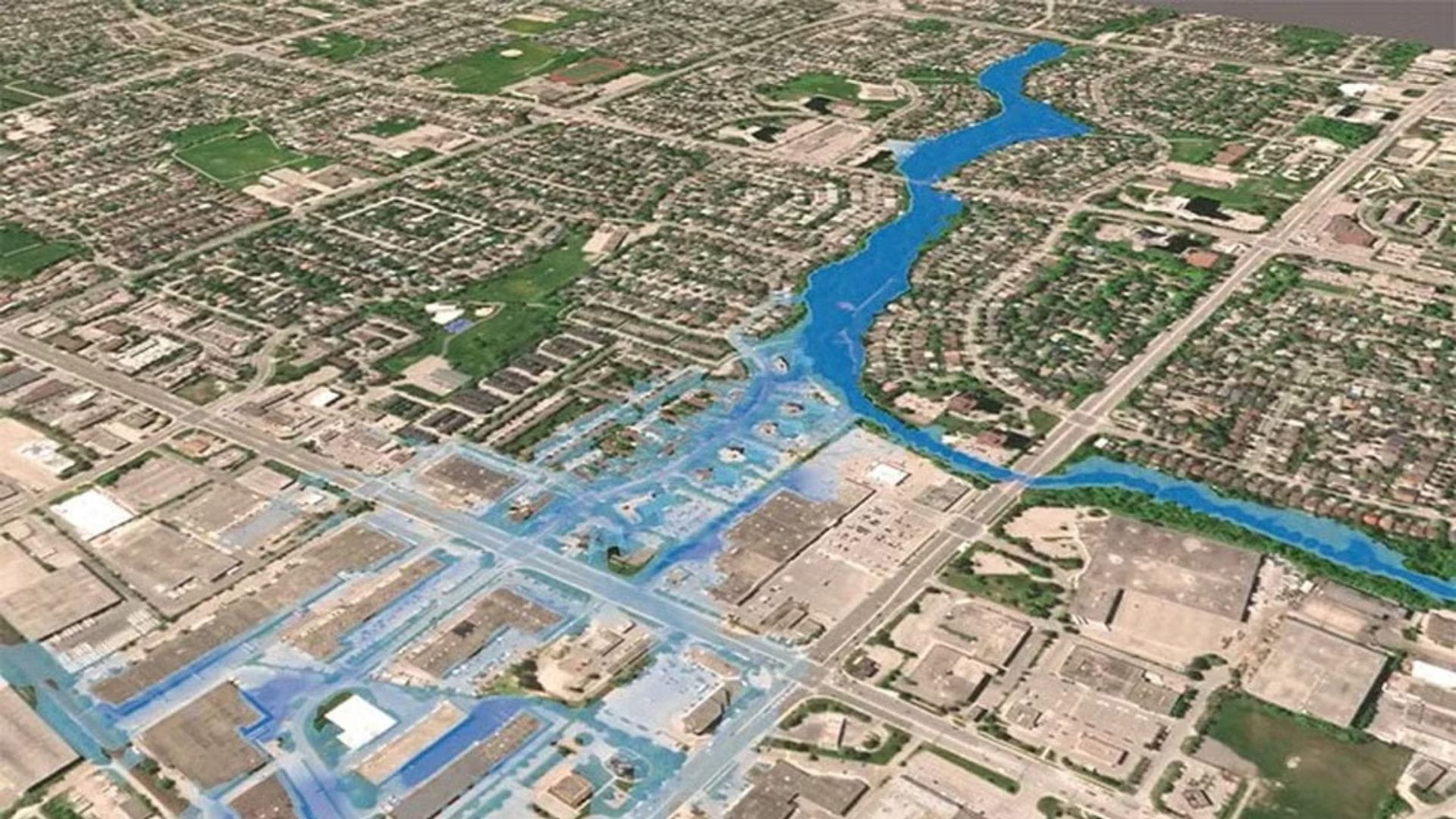
New Delhi: An interdisciplinary team of researchers across Canada are using a combination of flood, fire modelling, data visualisation, design, planning and environmental psychology to explore scenarios for extreme weather events as part of the Envisioning Climate Futures project. The project is aimed at encouraging individuals, communities and governments to take action to mitigate climate change, while providing stakeholders with tools that can help them better understand the impact of different choices. The researchers start with a documented extreme weather event then build or adapt simulation models, which are then validated. The raw data is converted into images and animations that reveals hypothetical scenarios.
In the example visualised above, the researchers focused on flooding along the Little Etobicoke Creek in Mississauga in Ontario. There are plans to build a new channel and a new bridge at a bend in the creek. The researchers recreated and visualised major flood events from 2013 and 2024, and discovered that both the channel and the bridge would be required to mitigate the anticipated flood damage in those scenarios, as either intervention alone is incapable of providing sufficient protection.
Scientists are exploring multiple visualisation modes
The researchers have applied their modelling to reconstruct the mouth of the Don River in Toronto, demonstrating the improved flood resilience in the Port Lands area. They have also started to model coastal flooding scenarios, and recreate the 2016 Fort McMurray wildfire, in Alta, where as many as 88,000 people were forced to flee their homes. This was far from the worst case scenario, and the blaze could have been even more damaging if the weather had been hotter, windier or drier, all of which are conditions that are becoming more likely because of climate change. The researchers are also planning to produce immersive experiences as well as videogames.