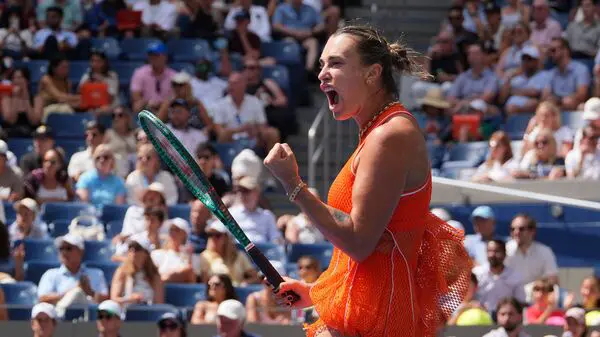
World No. 1 Aryna Sabalenka’s line about emptying out emotion is not a motivational poster. It is a working method. In a May 2026 Vogue interview, she said she used to punish herself for getting angry on court.
Now she treats the outburst as a reset: let it out, empty the tank, start the next point as if the last one never happened.
The quote matters now because Sabalenka is back in New York chasing a third straight US Open, after a season that already included a painful French Open collapse and the familiar debate over her on-court fire. According to the star player, “Sometimes you just need to let it go, to empty it so you’re ready to start over and play the match. Yeah, sometimes it looks ugly and terrible, but I need it in order to keep my head in it.”
What it means
Aryna Sabalenka is not arguing that rage is a virtue. She is describing a valve. If the feeling is already flooding the system, she would rather spend it in one ugly burst than carry it into the next game. “Empty it so you’re ready to start over and play the match.” The point is not the smash. The point is the empty tank that follows.
That is why the line travels outside tennis. Most people do not throw rackets. They do replay a bad email, a sharp comment, a missed chance, until the next task is already poisoned. Sabalenka’s claim is narrower and more useful than “just let go.” Release the charge so you can restart. Without the restart, the release is only theatre.
Where it comes from
The quote is from Aryna Sabalenka’s May 2026 American Vogue digital cover story. She was speaking about intensity, grief, and the version of “composure” tennis still sells as professionalism. In the same passage, she added that the release can “look ugly and terrible,” but she needs it “in order to keep my head in it.”
How to apply it today
Takeaway 1: Separate the dump from the next action. Aryna Sabalenka’s useful move is not the yell. It is the line after the yell, start over and play the match. After a mistake, give yourself a short, finite release (a walk, a closed-door minute, a written sentence), then name the next concrete task. If there is no next task, you only vented.
Takeaway 2: Stop punishing the feeling twice. Her younger pattern – emotion, then shame about the emotion is common at work and at home. The second hit is usually what freezes people. You can dislike how you showed up and still refuse to spend the afternoon prosecuting yourself.
Takeaway 3: Agree the container in advance. She asked her team to absorb the burst so it did not have to live inside her. That only works if the people around you consented, and if the release does not harm someone who cannot leave the room. A reset that requires a target is not a reset.
About Aryna Sabalenka
Aryna Sabalenka was born on 5 May 1998 in Minsk. Her father, Sergey, a former ice-hockey player, pulled over at some public courts when she was six and put a racket in her hand. He died of meningitis in November 2019, aged 43, before she had won a Grand Slam singles title. She has said the family dream was that she would win majors; after his death the goal sharpened into putting the family name into tennis history.
The titles followed: Australian Open in 2023 and 2024, US Open in 2024 and 2025. She has also finished runner-up at majors, including the 2025 Australian Open and French Open, and she remains one of the clearest power players of her generation: first-strike serve, heavy forehand, the on-court roar that made the “Tiger” nickname stick. Grief has not only been a father-shaped absence. In March 2024, her former partner, the hockey player Konstantin Koltsov, died during the Miami swing. She has talked about tennis as the thing that kept her moving when staying still was worse.
The emotional record is mixed on purpose. She has improved since the Break Point years, when she said emotion was destroying her game. She has also kept the valve. It is not a brand line. It is a player explaining why the mess is, for her, the price of staying in the point.