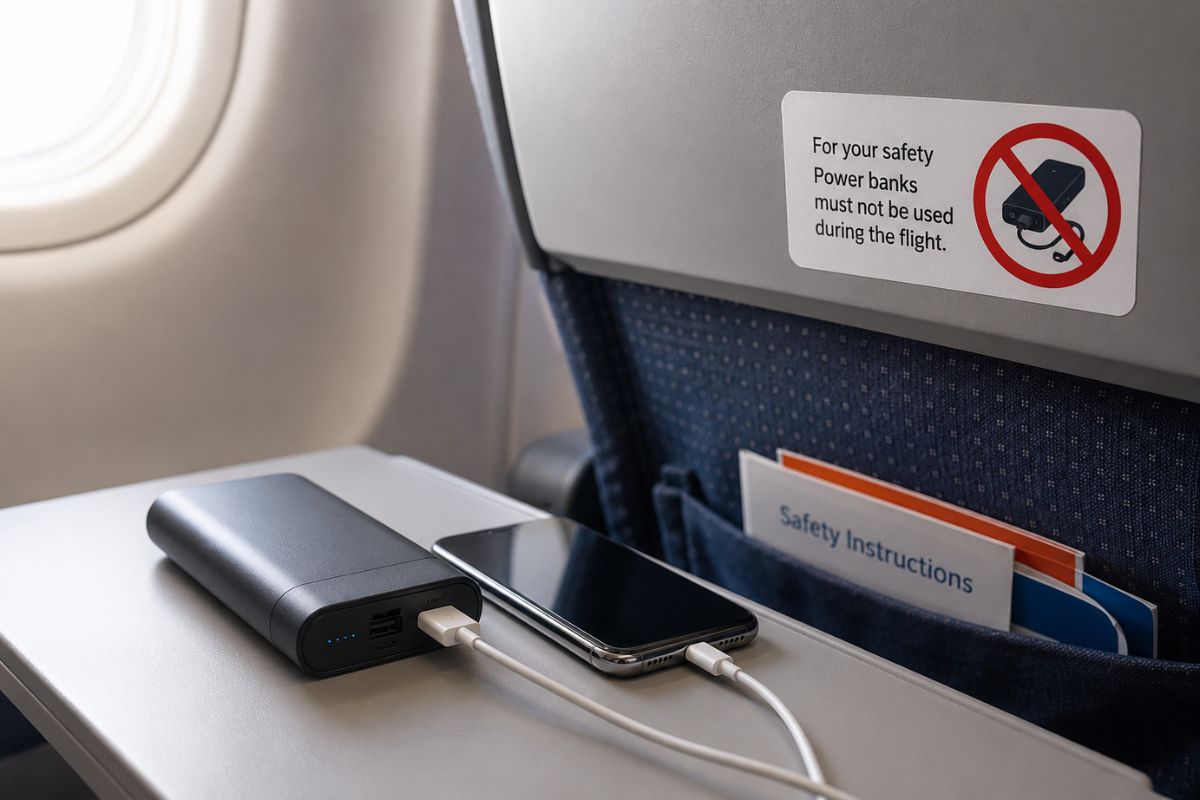
International travellers flying to Dubai, Abu Dhabi or Sharjah should check their cabin baggage before heading to the airport. Emirates, Etihad Airways, flydubai and Air Arabia are now enforcing stricter rules on power banks after a recent onboard fire involving a China Eastern Airlines flight.
The message is simple. You can carry a power bank, but you cannot use it during the flight.
What Happened on the China Eastern Flight?
The latest trigger was China Eastern Airlines Flight MU2421, an Airbus A320 that had just landed in Guiyang after flying from Lanzhou on July 24. As the aircraft was taxiing to the terminal, a passenger’s power bank stored inside an overhead cabin bag caught fire, sending flames and smoke through the overhead compartment.
Cabin crew quickly put out the fire, and nobody was injured, but the incident once again exposed the risks posed by lithium-ion batteries inside aircraft cabins.
China had already tightened power bank regulations after several battery-related incidents, including restrictions on uncertified or recalled power banks on domestic flights.
New Rules on Emirates
Passengers travelling on Emirates to Dubai or onward to Europe, North America, Africa and Australia can carry only one power bank with a capacity of up to 100 Wh. The airline also requires passengers to:
- Carry the power bank only in cabin baggage.
- Never place it in checked baggage.
- Keep it under the seat or inside the seat pocket instead of the overhead bin.
- Avoid charging the power bank or using it to charge any electronic device during the flight.
Etihad Airways Rules
Etihad Airways follows almost identical safety measures. Passengers may carry one power bank of up to 100Wh, provided the capacity is clearly marked. The device cannot be used onboard, either for charging phones or tablets or for recharging the power bank itself. It should remain easily accessible throughout the flight.
flydubai Policy
flydubai permits one power bank of up to 100 Wh without prior approval. Devices between 100Wh and 160Wh require airline approval, while devices above that limit are prohibited. Like other UAE carriers, power banks must remain in the cabin, protected from accidental activation, and cannot be stored inside checked baggage.
Air Arabia Requirements
Air Arabia also requires passengers to keep power banks in cabin baggage only and prohibits them from checked luggage. The airline has aligned its safety procedures with wider UAE aviation guidelines that discourage using or charging power banks during flights.
Why Airlines Are Tightening Power Bank Rules
Power banks use lithium-ion batteries. If damaged, poorly manufactured or exposed to excessive heat, they can enter what’s known as thermal runaway, where the battery rapidly overheats and catches fire.
A fire inside the cabin is dangerous enough. A fire hidden inside an overhead baggage compartment is even harder for cabin crew to spot during its earliest stages.
Across the industry, airlines are shifting from simply allowing power banks onboard to controlling exactly where they are stored and whether passengers can use them. That tells you battery safety has become one of aviation’s fastest-moving cabin safety concerns.
Airlines Around the World Introducing Similar Restrictions
Several airlines have already tightened their power bank policies, including:
- Emirates
- Etihad Airways
- flydubai
- Air Arabia
- Singapore Airlines
- Scoot
- Qantas
- Thai Airways
- Several South Korean airlines have introduced tighter restrictions after lithium battery fire incidents
Most international airlines now follow similar core rules:
- Power banks must travel in cabin baggage.
- Devices under 100Wh are generally allowed.
- Batteries between 100Wh and 160Wh often require airline approval.
- Power banks are prohibited in checked baggage.
What This Means for Indian Travellers
The change matters because UAE airlines carry millions of passengers from Indian cities such as Delhi, Mumbai, Bengaluru, Chennai, Hyderabad, Kochi and Ahmedabad, with many travellers connecting onward to Europe, the US, Canada and Africa.
If you’re flying with any UAE carrier, keep your power bank in your personal item or cabin bag under the seat, avoid using it during the flight, and make sure its capacity label is visible. That small check before boarding could save delays at security or unwanted attention from the cabin crew.
Travelobiz Take
We believe these rules are practical, not excessive. A power bank is easy to replace, but an onboard battery fire is not. Indian travellers should expect more airlines to adopt similar restrictions soon.
Follow and connect with us on Facebook, Twitter, LinkedIn, Instagram and Google News for the latest travel news and updates!