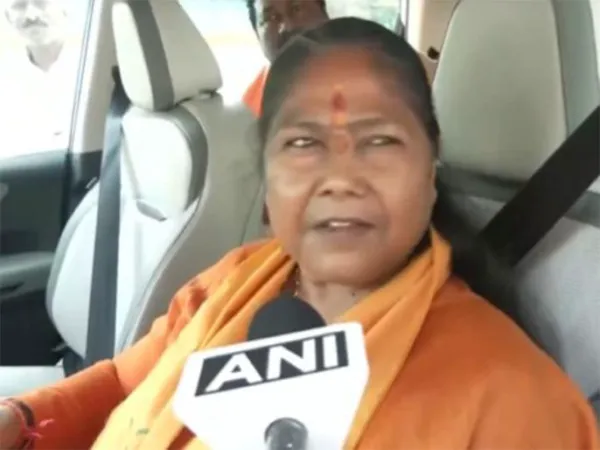
Following the Madhya Pradesh High Court’s verdict on the Bhojshala Temple-Kamal Maula Mosque complex dispute case, National Commission for Backwards Classes (NCBC) Chairperson Sadhvi Niranjan Jyoti hailed the order as a “positive development” and expressed gratitude for those who worked on the matter.
Speaking to ANI, Jyoti said on Friday, “The court works on evidence, and this is a very positive development that a constructive verdict has been delivered by the Madhya Pradesh High CourtI extend my best wishes for this, and also thank those who tirelessly fought for this cause.”
Meanwhile, Senior Congress leader Digvijaya Singh said that the verdict would be “studied”, adding, “This is an ASI-protected monument, and whether worship or prayer can take place within such a monument is for the Supreme Court to decide.”
Their remarks came after the Indore Bench of the Madhya Pradesh High Court delivered a verdict, granting the Hindu side the right to worship and recognising the complex as belonging to Raja Bhoj.
ASI Lawyer Aviral Vikas Khare highlighted the legal framework of the decision, stating, “The key highlights of this order are that the Bhojshala site has been designated as a ‘Protected Monument,’ a status it has held since the year 1904. This implies that the entire administration and regulation of this monument shall remain exclusively with the ASI (Archaeological Survey of India); in essence, the supervision of this site will rest solely with the ASI.”
The court ruled that the disputed site is fundamentally a temple dedicated to Goddess Vagdevi, dating back to the Bhoj-Parmar dynasty, and overturned the previous ASI order that permitted the offering of ‘Namaz’ in the complex.
“The Court determined the character of the site, affirming that it was historically the location of a temple dedicated to Vagdevi (Goddess Saraswati) and that it was constructed during the era of the Bhoj/Parmar dynasty. Based on this determination of its character, the Hindu community has been granted the right to offer worship at the site. Additionally, the ASI’s previous orderwhich had granted the Muslim community permission to offer ‘Namaz’ (prayers) on Fridays for a specific durationhas been modified…The complex itself will remain under the custody of the ASI,” he said.
Addressing media personnel after the MP High Court’s order, Vishnu Shankar Jain, representing the Hindu side, termed the judgment as “historic,” noting that the court has partially set aside the Archaeological Survey of India’s (ASI) order dated April 7, 2003.
“The Indore High Court has delivered a historic verdict, partially setting aside the ASI’s order dated April 7, 2003. Furthermore, the Court has granted the Hindu side the right to worship and has recognised the Bhojshala complex as belonging to Raja Bhoj,” Jain said.
The advocate further revealed that the court addressed the demand for the repatriation of the idol, which is currently housed in a museum in London.
Meanwhile, two caveat pleas have been moved in the Supreme Court hours after the Madhya Pradesh High Court declared the disputed Bhojshala-Kamal Maula complex in Dhar a temple, anticipating that parties from the Muslim side may challenge the verdict before the apex court.
Pending adjudication, the State authorities had put in place a shared arrangement for religious practices while the site remained under the supervision of the Archaeological Survey of India (ASI), which had also surveyed the complex.