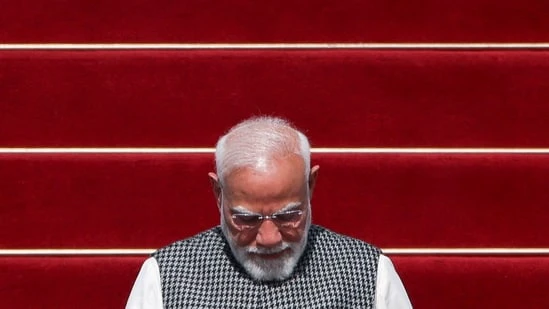
Prime Minister Narendra Modi will address the nation at 8.30 PM on Saturday, a day after a bill to implement women’s reservation in legislatures was defeated in the Lok Sabha.
“The Prime Minister will address the nation at 8.30 PM (April 18, Saturday),” an official said.
Modi is expected to delve into the issue of implementing the women’s quota and the developments in Parliament, where opposition parties on Friday voted against the Constitution (131st Amendment) Bill.
Under the Bill, Lok Sabha seats were to be increased up to 816 from the current 543 to “operationalise” the women’s reservation law before the 2029 parliamentary polls, following a delimitation exercise based on the 2011 Census. The government said that the seats in state and UT assemblies needed to be increased to accommodate 33 per cent reservation for women.
A two-thirds majority was required to pass the crucial bill, but the ruling BJP-led alliance could not muster the numbers. During the voting on the bill in the Lok Sabha on Friday night, 298 members voted in its support, while 230 MPs voted against it.
Out of 528 members who voted, the bill required 352 votes for a two-thirds majority.
Why did the opposition vote against the bill?
While union home minister Amit Shah accused the opposition of blocking women’s reservation, opposition leaders, including Rahul Gandhi, maintained that they support the quota but oppose its linkage to delimitation.
“Yesterday in Parliament, they came up with a new Bill. They said it was a Women’s Bill, but that was already passed in 2023. The hidden agenda behind that Bill was delimitation. The idea was to reduce Tamil Nadu’s representation in the Parliament of India and weaken southern and smaller states. We defeated that Bill in Parliament yesterday,” Gandhi said during a campaign rally in Ponneri, Tamil Nadu, on Saturday.
Outlining his broader political position, he said India is a “union of states” where each state must have equal space. “Every state should have a voice in the Union and should be free to express its language and protect its tradition.”